“ His dive into the crowded depths of Euston Square brought forth no result—no clue which would help in his search. He interviewed many keepers of the “temperance hotels” and boarding-houses which abounded in that quarter, all sorts of women, but all alike in their quick suspicious resentment of his guarded inquiries and in their pretended ignorance of past visitors to their dingy portals. ”
Euston Square
Definition and stakes
The theme of “Euston Square” has been addressed by authors such as Arthur Bartlett Maurice, Emily Constance Baird Cook, Samuel Hopkins Adams, Various and Henry James. It is often associated with terms like London, street, city, Washington and new.
Quotes about “Euston Square”
 Charles Dickens,
Nicholas Nickleby
(1839)
“ And let not those whose eyes have been accustomed to the aristocratic gravity of Grosvenor Square and Hanover Square, the dowager barrenness and frigidity of Fitzroy Square, or the gravel walks and garden seats of the Squares of Russell and Euston, suppose that the affections of Tim Linkinwater, or the inferior lovers of this particular locality, had been awakened and kept alive by any refreshing associations with leaves however dingy, or grass, however bare and thin. The City square has no inclosure, save the lamp-post in the middle, and no grass but the weeds which spring up round its base. ”
George Clement Boase, Dictionary of National Biography… (1888)
“ Pancras parish, he built the houses of Upper Woburn Place, Woburn Buildings, Gordon Square, Tavistock, Gordon, and Endsleigh streets, and part of Euston Square. Perceiving the tendency of the fashionable world to move westward, he proceeded, in 1825, to lease the Five Fields, Chelsea, on which he erected Belgrave Square, Lowndes Square, Chesham Place, and other ranges of houses. ”
 Edgar Wallace,
The Man Who Knew
(1918)
“ The hour was eight o'clock on a warm summer evening, and that the unusual spectacle attracted only a small crowd may be explained by the fact that Gray Square is a professional quarter given up to the offices of lawyers, surveyors, and corporation offices which at eight o'clock on a summer's day are empty of occupants. The unprofessional classes who inhabit the shabby streets impinging upon the Euston Road do not include Gray Square in their itinerary when they take their evening constitutionals abroad, and even the loud children find a less depressing environment for their games. ”
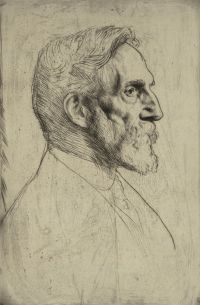 Philip Norman,
Catalogue of a collection of early drawings and pictures of London…
(1920)
“ Watercolour. 93⁄4 by 81⁄2 in. Signed “T. Rowlandson.” Written in pencil, but hidden, are the words: “Richard Trevithick’s Railroad, Euston Square 1809.” 34 In fact, the Square dates only from 1825; as late as 1820 its site was a large nursery garden, and a group of farm buildings occupied ground on which the London and North Western Railway now stands. Trevithic, “father of the locomotive engine,” the main facts of whose remarkable career are recorded in “Dict. Nat. Biog.,” must have hired the ground in order to test and exhibit his invention. ”
 Talbot Baines Reed,
Boycotted, and Other Stories
“ London in the morning! What a scene! The whistle of the workmen’s trains sounds, and the noise of vegetable carts going to Covent Garden Market, give the place an animated appearance. Very few people are awake, and those that are look sleepy.“In such a scene as this a hideous-looking woman, about fifty years old, with a long nose and a shabby barrel-organ, wended her way from some of the slums near Farringdon Street Station in the direction of Euston Square.“It was not a very pretty walk. There were no birds twittering in the trees, or cuckoos. ”
Daniel Joseph Kirwan, Palace and Hovel; Or, Phases of London Life
“ Beside the parks and gardens, London has an infinity of squares, commons, and crescents, which are surrounded by private residences and inclosed by railings and walls—such as Trafalgar Square (public) , Bedford, Cavendish, St. George's, Grosvenor, Leicester, Soho, Belgrave, Euston, Finsbury, Fitzroy, Portman, Russell, Wellclose, Hanover, Brunswick, Eaton, Berkeley, Golden, Mecklenburg, Red Lion, Tavistock, and a great number of other squares which I do not now call to mind. ”
by the London Congregational Union, The bitter cry of outcast London (1883)
“ The misery and sin caused by drink in these districts have often been told, but these horrors can never be set forth either by pen or artist's pencil. In the district of Euston Road is one public-house to every 100 people, counting men, women and children. Immediately around our chapel in Orange Street, Leicester Square, are 100 gin-palaces, most of them very large ”
Henry James, ../../ (1909)
“ To haunt Eaton Square in fine would be to show that he hadn't, like his brilliant associate, a sufficiency of work in the world. It was just his having that sufficiency, it was just their having it together, that, so strangely and so blessedly, made, as they put it to each other, everything possible. What further propped up the case moreover was that the "world," by still another beautiful perversity of their chance, included Portland Place without including to anything like the same extent Eaton Square. ”
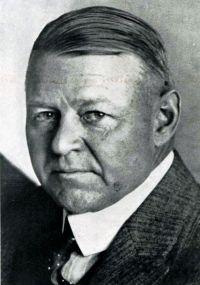 Samuel Hopkins Adams,
From a Bench in Our Square
“ Let me confess at once that we are a bit supercilious in our attitude toward the sister Square far to our West, across the Alps of Broadway. Our Square was an established center of the social respectabilities when the foot of Fifth Avenue was still frequented by the occasional cow whose wanderings are responsible for the street-plan of Greenwich Village. Our Square remains true to the ancient and simple traditions, whereas Washington Square has grown long hair, smeared its fingers with paint and its lips with free verse, and gone into debt for its inconsiderable laundry bills. ”
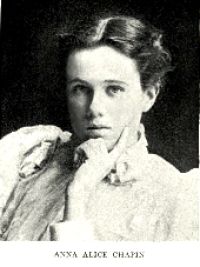 Anna Alice Chapin,
Greenwich Village
“ There is scarcely a plot of ground below Fourteenth Street without its story and its associations, its motley company of memories and spectres both good and bad, its imperishably adventurous savour of the past, imprisoned in the dry prose of registries and records. Let us just take a glance, a bird's-eye view as it were, of that region which we now know as Washington Square, as it was when the city of New York bought it for a Potter's Field. ”
Van Tassel Sutphen, The Gates of Chance
“ Do you know Abingdon Square? It is a small, irregularly shaped triangle of asphalt situated on the lower West Side, and at the intersecting-point of Eighth Avenue and Hudson Street. The houses that front upon it have seen better days. Many of them are now the quarters of cheap political clubs or centres of foreign revolutionary propaganda. It is a neighborhood that has finally lost all semblance to gentility and has become frankly and unreservedly shabby. A square, mind you, and not a park, for there is neither blade of grass nor tree in all of its dreary expanse. ”
With the World's Great Travellers…
“ All the streets run at right angles to one another, so that a short cut, the joy of the accomplished Londoner, is impossible. It is a chess-board on which the bishop’s move is unknown. Nothing diagonal can be done. The city is ruled like the page of a ledger, from top to bottom with streets, from side to side with avenues. It is all divided into squares. When you are first told this, a vision arises of the possibility of cutting across these squares from corner to corner. Not a bit of it: a square at Philadelphia means a solid block of houses, not an open space enclosed by buildings. ”
 Hugh Walpole,
The Golden Scarecrow — Henry Fitzgeorge Strether
(1915)
“ There can be nothing in the world more charming than the way the Square receives its friends. Let it number amongst its guests a Duchess, that is no reason why it should scorn "Colonel Harry" or "Mouldy Jim," the singer of hymns. Scorn, indeed, cannot be found within its grey walls, soft grey, soft green, soft white and blue—in these colours is the Square's body clothed, no anger in its mild eyes, nor contempt anywhere at its heart.The Square is proud, and is proud with reason, of its garden. It is not a large garden as London gardens go. It has in its centre a fountain. ”
James Dabney McCabe, Lights and Shadows of New York Life
“ Stuyvesant Square lies to the east of Union Square, and is bisected by the line of the Second avenue. Its upper and lower boundaries are Fifteenth and Seventeenth streets. It consists of two beautiful parks of equal size, surrounded by a handsome iron railing, and filled with choice flowers and shrubbery. ”
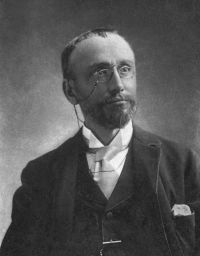 H. C. Bunner,
Natural Selection — Part II
(1888)
“ Those streets between Union and Madison Squares are, for the most part, given over to boarding-houses and lodging-houses of dull respectability, and although they are not much traversed, they lie in lines that anyone might follow who would pass from Murray Hill to—say, for a fine old-fashioned quarter, Stuyvesant Square. ”
Samuel Hopkins Adams,
Our Square and the People in It
“ WALLED in by slums stands Our Square, a valiant green space, far on the flank of the Great City. Ours is an inglorious little world Sociologists have-not yet remarked and classified us. The Washington Square romancers who bold sentimental revel at the foot of Fifth Avenue reck nothing of their sister park, many blocks to the east. But we are patient of our obscurity. Close-knit, keeping our own counsel, jealous of our own concerns, and not without our own pride of place, we live our quiet lives, a community sufficient unto itself. ”
Charles Dickens,
Nicholas Nickleby
“ It is one of the squares that have been; a quarter of the town that has gone down in the world, and taken to letting lodgings. Many of its first and second floors are let, furnished, to single gentlemen; and it takes boarders besides. It is a great resort of foreigners. The dark-complexioned men who wear large rings, and heavy watch-guards, and bushy whiskers, and who congregate under the Opera Colonnade, and about the box-office in the season, between four and five in the afternoon, when they give away the orders,—all live in Golden Square, or within a street of it. ”
Jack Allyn, Jonathan and His Continent: Rambles Through American Society
“ Three fine squares alone break the monotony of all these parallelograms of streets: Washington Square, Union Square, and Madison Square.On the north, Central Park, with its fine avenues, its hillocks, its valleys, its lakes, and its magnificent terrace over the Hudson, is a very lovely pleasure ground. It is the only place where one can see trees, turf, and flowers. New York does not possess a single garden, public or private, if one excepts the three squares I named just now.That which strikes the visitor to New York is not the city itself, but the feverish activity that reigns there. ”
Samuel Hopkins Adams,
From a Bench in Our Square
“ Washington Square we suspect of playing at life; Our Square has a sufficiently hard time living it. We have little in common. Nevertheless, it must be admitted that there are veritable humans, not wholly submerged in the crowd of self-conscious mummers who crowd the Occidental park-space, and it was at the house of one of these, a woman architect with a golden dream of rebuilding Greenwich Village, street by street, into something simple and beautiful and, in the larger sense urban, that the Bonnie Lassie, whose artistic deviations often take her far afield, met Barbran. ”
Alfred Rimmer, Ancient Streets and Homesteads of England
“ Now a broad red wall is one of the most dreary objects of modern civilisation, and, indeed, the side of a square, broken only by rectangular windows, as exhibited in London squares, has doubtless had a depressing and injurious effect on the duration of human life. Russell Square and Bedford Square are familiar instances of this; and how unfavourably they contrast with old Lincoln’s Inn buildings, in the same city, the engraving will show, yet the same architecture that prevails in Lincoln’s Inn would abundantly serve all the purposes of a London square of modern times. ”
 John Galsworthy,
A Simple Tale
(1914)
“ By that big church—which, like all those places, had its air of coldness, far and ungrateful among us others, little human creatures who have built it—he passed, into the great Eaton Square, whose houses ought well to be inhabited by people very rich. There he crossed to lean him against the railings of the garden in the centre, very tranquil, his long white beard falling over hands joined on his staff, in awaiting what—I could not figure to myself at all. ”
Willard W. Glazier, Peculiarities of American Cities
“ Union Square is reached at Fourteenth street. It is oval in form, with beautiful green turf, trees and walks, and contains a fine fountain in the centre, a colossal bronze statue of Washington on a granite pedestal, and statues of Hamilton and Lafayette. Along its northern [Pg 301] end is a wide plaza for military parades and popular assemblies. Union Square was once a fashionable residence quarter, but it is now occupied almost wholly by business. ”
Willard W. Glazier, Peculiarities of American Cities
“ At Twenty-third street, Broadway runs diagonally across Fifth avenue, touching the southwestern corner of Madison Square—not so very long since the most genteel locality in New York, but now, like Union Square, becoming occupied by hotels and business houses.Fifth Avenue, the most splendid avenue in America, makes a beginning at Washington Square, a lovely public park embowered in trees, which was once Potters' Field, the pauper burying ground, and where one hundred thousand bodies lie buried. New York University and Dr. Hutton's Church face the square on the east. ”
Edwin A. Brown, "Broke," The Man Without the Dime
“ With the vanishing of the sunshine and shadows which all day long had been playing in and about Union Square—whose bits of green lawn, sparkling fountains, and many settees welcome the weary and heavy laden, for a little time at least, and invite rest,—came the myriad lights of the great city which follow the active day of toil and care. ”
Samuel Hopkins Adams,
Our Square and the People in It
“ New York knows little of Our Square, submerged as we are in a circle of slums. Yet for us, as for more Elysian fields, the crocus springs in the happy grass, the flash and song of the birds stir our trees, and Romance fans us with the wind of its imperishable wing. The first robin was singing in our one lone lilac when the Bonnie Lassie came out of the Somewhere Else into Our Square and possessed herself of the ground floor of our smallest house, the nestly little dwelling with the quaint old door and the broad, friendly vestibule, next but one to the Greek church. ”
Various, The International Monthly, Volume 4…
“ After this, scarcely a break in the line of dazzling shops, until we reach the vicinity of Union Square, a pretty oval park, with a noble fountain in the midst, and lofty and handsome houses all round, situated on perhaps the highest ground on this part of the island. Half a mile beyond is Madison Square, a green expanse, about which wealthy citizens are now building elegant residences of brown freestone, with some attempt at architectural display. ”
Various, Popular Science Monthly (1899)
“ Nor was this all: a resolution was adopted, prepared by the association, guaranteeing the ground occupied by the square to be kept "forever" as a park for purposes of public health and recreation. That Washington Square remains to-day, an oasis of beauty in the desert of brick and stone, and a breathing place in that densely built portion of the great city, is due principally to the watchfulness and energy of Professor Egleston. He it was who saved that park to the people of New York, and a debt of lasting gratitude therefor is owing him from them. ”
Anna Alice Chapin,
Greenwich Village
“ Their farthest uptown terminal was at Fourteenth Street, so they were not much help to suburbanites!No single article, or chapter, can even attempt to encompass the complete story of Washington Square. Covering the entire period of the city's history, passing through startling changes and transformations, the scene of great happenings, the background of illustrious or curious lives,—it is probably more typical of the vertiginous development of New York than any single section. ”
Hugh Walpole,
The Golden Scarecrow
“ There is no house that can claim beauty, and yet the Square, as a whole, has a fine charm, something that age and colour, haphazard adventure, space and quiet have all helped towards.There is, perhaps, no square in London that clings so tenaciously to any sign or symbol of old London that motor-cars and the increase of speed have not utterly destroyed. All the oldest London mendicants find their way, at different hours of the week, up and down the Square. There is, I believe, no other square in London where musicians are permitted. ”
Related terms
Authors who wrote about “Euston Square”
 Arthur Bartlett MauriceEmily Constance Baird CookSamuel Hopkins AdamsVariousHenry James
 Joel CookCharles DickensHugh WalpoleAnna Alice Chapin
 Walter BesantWillard W. GlazierJames Dabney McCabeBaron Edward Bulwer Lytton Lytton
 John Dos PassosPercy FitzgeraldAnonymousEdgar Wallace
 Will Levington ComfortVan Tassel SutphenDaniel Joseph Kirwan
