“ Franklin Blake! Before I could say a word, I saw Mr. Franklin, a little surprised to all appearance, look up from me to Rosanna. Following his lead, I looked at the girl too. She was blushing of a deeper red than ever, seemingly at having caught Mr. Franklin’s eye; and she turned and left us suddenly, in a confusion quite unaccountable to my mind, without either making her curtsey to the gentleman or saying a word to me. Very unlike her usual self: a civiller and better-behaved servant, in general, you never met with. ”
Quotes about “Franklin Blake”
“ Franklin Blake’s manners and appearance doesn’t seem to me to be the maddest part of her conduct by any means. However, I’m glad the thing is cleared up: it relieves one’s mind to have things cleared up. Yes, I’ll keep it a secret, Mr. Betteredge. I like to be tender to human infirmity—though I don’t get many chances of exercising that virtue in my line of life. You think Mr. Franklin Blake hasn’t got a suspicion of the girl’s fancy for him? ”
“ Franklin Blake. I have been cut off from all news of my relatives by marriage for some time past. When we are isolated and poor, we are not infrequently forgotten. I am now living, for economy’s sake, in a little town in Brittany, inhabited by a select circle of serious English friends, and possessed of the inestimable advantages of a Protestant clergyman and a cheap market. In this retirement—a Patmos amid the howling ocean of popery that surrounds us—a letter from England has reached me at last. I find my insignificant existence suddenly remembered by Mr. Franklin Blake. ”
“ Franklin Blake. “Who’s watching you, sir,—and why?” I inquired. “Tell me about the three Indians you have had at the house today,” says Mr. Franklin, without noticing my question. “It’s just possible, Betteredge, that my stranger and your three jugglers may turn out to be pieces of the same puzzle.” “How do you come to know about the jugglers, sir?” I asked, putting one question on the top of another, which was bad manners, I own. But you don’t expect much from poor human nature—so don’t expect much from me. “I saw Penelope at the house,” says Mr. Franklin; “and Penelope told me. ”
“ But there happen to be two difficulties in the way of your theory, Miss Clack. I manage Franklin Blake’s affairs, and I beg to inform you that the vast majority of his creditors (knowing his father to be a rich man) are quite content to charge interest on their debts, and to wait for their money. There is the first difficulty—which is tough enough. You will find the second tougher still. I have it on the authority of Lady Verinder herself, that her daughter was ready to marry Franklin Blake, before that infernal Indian Diamond disappeared from the house. ”
Various, Graham's Magazine Vol XXXII No…
“ He saw Caroline was no common thief, and Franklin no common man. There were moments when he actually believed the fact really was as Franklin represented—and, thus quailing under the torrent of eloquence to which the voice and manner gave something absolutely irresistible, half suffocated with rage and fear, he said with ill assumed indifference:"Oh! very well, sir, very well. I will wait for my partners. Nothing shall be done rashly. Nothing from revenge. But the young lady shall not escape. Mr. Williams, go and see if Mr. Blake or Mr. Blanchard have come in." ”
Various, Graham's Magazine Vol XXXII No…
“ Old Mr. Blake had learned how the land lay from Mrs. Clifford, and he resolved to make the young people reparation. He owed it to them in all conscience. They were married in about six weeks; and when the ceremony was over, a parcel was brought in, directed "To Mrs. Franklin, with the compliments of Messrs. Blake, Blanchard & Co.," which, on being opened, was found to contain a superb Cashmere shawl—thirty yards of the £12 lace, and a neat mahogany box, with a coronet of diamonds for the young criminal. ”
 Wilkie Collins,
The Moonstone
(1874)
“ Blake disliked all boys, his own included, and you will admit that it could only end in one way. Master Franklin was taken from us in England, and was sent to institutions which his father could trust, in that superior country, Germany; Mr. Blake himself, you will observe, remaining snug in England, to improve his fellow-countrymen in the Parliament House, and to publish a statement on the subject of the Duke in possession, which has remained an unfinished statement from that day to this. ”
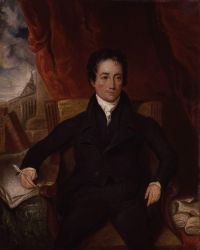 Charles Lamb,
The Best Letters of Charles Lamb
“ I too have a picture of my father and the copy of his first love-verses; but they have been mine long. Blake is a real name, I assure you, and a most extraordinary man, if he is still living. He is the Robert [William] Blake whose wild designs accompany a splendid folio edition of the "Night Thoughts," which you may have seen, in one of which he pictures the parting of soul and body by a solid mass of human form floating off, God knows how, from a lumpish mass (fac-simile to itself) left behind on the dying bed. ”
Wiliam Cabell Bruce, Benjamin Franklin, Self-Revealed…
“ He had advised Bache, he said, to settle down to business in Philadelphia, where he would always be with her; almost any profession a man has been educated in being preferable, in his opinion, to an office held at pleasure, as rendering him more independent, more a freeman, and less subject to the caprices of superiors. This means, of course, that the Baches, too, were looking for a seat in the Post-Office carryall, in which room was found for so many of Franklin's relations and protégés. ”
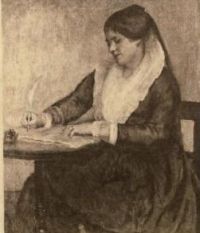 Anne Gilchrist,
Life of William Blake
(1880)
“ The mingling of sound sagacity with the utmost licence of imagination showed itself at every hour of Blake's life. He would, at any moment, speak as he here writes, and was not a mere sensible mortal in the morning, and a wild visionary in the evening. Visionary glories floated before his eyes even while he stooped over the toilsome copper-plate. There was no pause or hiatus in the life-long wedding of spiritual and earthly things in his daily course; no giving the reins to imagination at one time more than other. ”
 Anna Katharine Green,
A Strange Disappearance
“ Blake know anything about it?” The faintest shadow of a change came into her manner. “Yes,” said she, “I told him at breakfast time; but Mr. Blake doesn’t take much interest in his servants; he leaves all such matters to me.” “Then he does not know you have come for the police?” “No, sir, and O, if you would be so good as to keep it from him. It is not necessary he should know. I shall let you in the back way. Mr. Blake is a man who never meddles with anything, and—” “What did Mr. Blake say this morning when you told him that this girl—By the way, what is her name?” “Emily.” ”
Anna Katharine Green,
A Strange Disappearance — Chapter VI. A Bit of Calico
(1880)
“ Blake had no appearance of being a suspicious man, nor do I think at this time, he had the remotest idea that he was either watched or followed; an ignorance of the truth which I took care to preserve by taking my seat in a different car from him and not showing myself again during the whole ride from New York to Putney. ”
Anne Gilchrist,
Life of William Blake
(1880)
“ He would have been in actual want but for one friend, himself an artist, himself not overburthened, at that time, with the gifts of Fortune; who had, as other rising artists have—but in 1823 it was a still tougher struggle than in 1860—to toil hard for himself and family at often ungenial task-work. The drawings of Job had been borrowed from Mr. Butts to be shown to such as might seem likely to prove employers. From Mr. Linnell alone they drew a commission. He engaged Blake to execute and engrave a duplicate set. ”
“ If he gets wind of what we are figuring on doing here in this office he might have influence enough to make trouble for us before we’re ready for the big blow-off. Leave Blake out of it for the time being—leave him strictly alone! He can do his talking and his explaining after we’ve smoked the nigger out of the woodpile. But here are two other men”—he touched the remaining piles of sorted-out clippings—“who are willing, under cover, to indulge in a little conversation. ”
Anna Katharine Green,
A Strange Disappearance — Chapter X. The Secret of Mr…
(1880)
“ Mr. Blake uttering a cry sank on his knees before the drawer. "My God! My God!" was his only reply, "what are these?" Suddenly he rose, his whole form quivering, his eyes burning. "Where is Mrs. Daniels?" he cried, hastily advancing and pulling the bell. "I must see her at once. Send the house-keeper here," he ordered as Fanny smiling demurely made her appearance at the door."Mrs. Daniels is out," returned the girl, "went out as soon as ever you got up from dinner, sir.""Gone out at this hour?""Yes sir; she goes out very often nowadays, sir." ”
Jay Little, Maybe—Tomorrow (1952)
“ Blake grinned ... "I've always looked older than I am. Well, to get back to this kid at the bar. He asked me if I wanted to go home with him. You know what I did?" "No." "I took his hand like this," he grabbed Gaylord's hand, "and laid it like this. I said, ‘Feel, feel good and hard ... it's not big ... and you guys like big ones ... do you still want me to go home with you?'" Blake uttered a chuckle ... "Ok ... you want me to stop the car?" ”
Wiliam Cabell Bruce, Benjamin Franklin, Self-Revealed…
“ The suggestion that Sally should be sent over to England did not find favor with her, and in a later letter Franklin writes to her, "I am glad that you find so much reason to be satisfy'd with Mr. Bache. I hope all will prove for the best." And all did prove for the best, as the frequency with which Richard Bache's name occurs in Franklin's will, to say nothing more, sufficiently attests. When the marriage was solemnized, Franklin's strong family affection speedily crowned it with his full approval. ”
Anna Katharine Green,
A Strange Disappearance — Chapter X. The Secret of Mr…
(1880)
“ Mr. Gryce's hand which had been stretched out towards the hitherto untouched decanter before him, suddenly dropped. "You deny then," said he, "all connection between yourself and the woman, lady or sewing-girl, who occupied that room above our heads for eleven months previous to the Sunday morning I first had the honor to make your acquaintance.""I am not in the habit of repeating my assertions," said Mr. Blake with some severity, "even when they relate to a less disagreeable matter than the one under discussion." ”
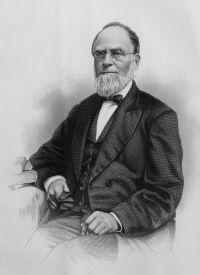 John S. C. Abbott,
Benjamin Franklin
“ If you can promote the prosperity of your people, and leave them happier than you found them, whatever your political principles are, your memory will be honored.”While Franklin was absent, a young merchant of Philadelphia, Richard Bache, offered his hand to Franklin’s only daughter, from whom the father had been absent nearly all of her life. Sarah was then twenty-three years of age, so beautiful as to become quite a celebrity, and she was highly accomplished. Mr. Bache was not successful in business, and the young couple resided under the roof of Mrs. Franklin for eight years. ”
 Benjamin Franklin,
Autobiography of Benjamin Franklin
“ There are croakers in every country, always boding its ruin. Such a one then lived in Philadelphia; a person of note, an elderly man, with a wise look and a very grave manner of speaking; his name was Samuel Mickle. This gentleman, a stranger to me, stopt one day at my door, and asked me if I was the young man who had lately opened a new printing-house. Being answered in the affirmative, he said he was sorry for me, because it was an expensive undertaking, and the expense would be lost; for Philadelphia was a sinking place, the people already half-bankrupts, or near being so ”
Anne Gilchrist,
Life of William Blake
(1880)
“ Linnell and Mr Palmer express themselves in the same sense, and almost in the same words. Another very unbiassed and intelligent acquaintance—Mr. Finch—summed up his recollections thus:—'He was not mad, but perverse and wilful; he reasoned correctly from arbitrary, and often false premises.' This, however, is what madmen have been sometimes defined to do; grant them their premises, and their conclusions are right. Nor can I quite concur in it as characteristic of Blake, who was no reasoner, but preeminently a man of intuitions ”
Jay Little, Maybe—Tomorrow (1952)
“ Blake let up on the gas a little and the car almost stopped. He went on. "I wish you were a man ... it'd be different then ... I could slap the shit out of you. But you're not. You're too pretty. Too innocent ... too ... too much like Venus. ”
 Rosa Campbell Praed,
Outlaw and Lawmaker
(1894)
“ As they got down into the gulley, the rocks became more steep and slippery, and the way more difficult. Blake held out his hand to help Elsie over the stones. She slipped and fell into his arms, but quickly recovered herself, and poised with the lightness of a fawn on a jutting rock. "You don't seem to like taking my hand," said Blake, resentfully. "I am a very good climber," she answered. " And besides, Mr. Blake, did you really mean what you said? Is everything that you or I do or say to be counted as a move in the game?" ”
Anne Gilchrist,
Life of William Blake
(1880)
“ With which meagre biographic trait, the inquisitive reader must be satisfied. The most diligent search yields nothing further. That he was an amiable, kindly man we gather from the circumstances of his first notice of the child Flaxman in the father's cast-shop, coughing over his Latin behind the counter, and of his continued notice of the weakly child during the years which elapsed before he was strong enough to walk from the Strand to Rathbone Place, and be received into the sunshine of Mrs. Mathew's smiles. To that lady's agreeable and brilliant conversazioni Blake was made welcome. ”
 William MacLeod Raine,
The Fighting Edge (Smith's Magazine 1907…
(1907)
“ There was a little humorous gleam in Blake’s eyes. “Oh, he’s modest just yet. He will be content with a seat in the United States Senate this year. Of course, he aims higher ultimately.” “And will he get his seat in the millionaire’s club?” “On my word, I believe he will. He gets whatever he sets his will on getting. If he should take a fancy to Miss Maisie Marriott——” His warm, impudent smile finished the sentence for him. ”
Anne Gilchrist,
Life of William Blake
(1880)
“ In such cases, the traces of past beauty do but heighten the melancholy of its utter ruin. Amid so much that was beautiful in her affectionate, wifely spirit, these externals were little noticed. To friends who remember Blake in Fountain Court, those calm, patriarchal figures of Job and his Wife in the artist's own designs, still recall the two, as they used to sit together in that humble room. All I have met, who at any period of the poet-artist's life knew much of Blake, speak with affection of him. A sweet, gentle, lovable creature, say all; courageous too, yet not bitter. ”
Anna Katharine Green,
A Strange Disappearance — Chapter IV. Thompson's Story
(1880)
“ Blake was a man who if he paid but little attention to domestic affairs was yet rarely seen out of his own house, except upon occasions of great political importance, when he was always to be found on the platform at meetings of his constituents. Though to the ordinary observer a man eminently calculated, from his good looks, fine position, and solid wealth to enjoy society, he not only manifested a distaste for it, but even went so far as to refuse to participate in the social dinners of his most intimate friends ”
Wiliam Cabell Bruce, Benjamin Franklin, Self-Revealed…
“ Colonial America was far more favorable to practical activity than to philosophical investigation, but the society, nevertheless, performed an office of no little usefulness. When Franklin built a new wing to his residence in Philadelphia, after his return from Paris, he provided a large apartment on the first floor of this addition for the accommodation of the American Philosophical Society into which this Society had been merged. When he made his will, he was the President of the new society, and he bequeathed to it his History of the Academy of Sciences, in sixty or seventy volumes quarto ”
Wiliam Cabell Bruce, Benjamin Franklin, Self-Revealed…
“ There is a vast difference between the situation of a man, who relies upon his memory for the scattered incidents of his past life, and that of a biographer whose field of vision takes them all in at one glance. It is true that Franklin did not know, before he left London, that Deborah had married, but the reasons he gives in the Autobiography for desiring to return to Philadelphia are only that he had grown tired of London, remembered with pleasure the happy months that he had spent in Pennsylvania, and wished again to see it. ”
