“ What does Majella think will be wise? If men have been sent out to pursue us, they may be at Hartsel's. His store is the place where everybody stops, everybody goes. I dare not have you go there, Majella; yet I must go. The only way I can get any money is from Mr. Hartsel.” “I must wait somewhere while you go!” said Ramona, her heart beating as she gazed ahead into the blackness of the great plain. It looked vast as the sea. “That is the only safe thing, Alessandro.” ”
Majella
Definition and stakes
The theme of “Majella” has been addressed by authors such as Helen Hunt Jackson. It is often associated with terms like Alessandro, Ramona, Majendie, Ferdinand and Mary.
Quotes about “Majella”
 Helen Hunt Jackson,
Ramona
(1887)
Helen Hunt Jackson,
Ramona
(1887)
“ It was none too soon that he had persuaded Majella to flee to the mountain. There, at least, they could live and die in peace,—a poverty-stricken life, and the loneliest of deaths; but they would have each other. It was well the baby had died ”
Helen Hunt Jackson,
Ramona
(1887)
“ It is the most beautiful water I have ever seen, Majella. The two high lands come out like two arms to hold it and keep it safe, as if they loved it.” “But, Alessandro,” continued Ramona, “were there really bad men at the other Missions? Surely not the Franciscan Fathers?” “Perhaps not the Fathers themselves, but the men under them. It was too much power, Majella. When my father has told me how it was, it has seemed to me I should not have liked to be as he was. It is not right that one man should have so much power. ”
Helen Hunt Jackson,
Ramona
(1887)
“ That is what the Señora is ever saying: 'To the sea!' Oh, the beautiful sea! Can we behold it from San Pasquale, Alessandro?” “No, my Majella, it is too far. San Pasquale is in the valley; it has hills all around it like walls. But it is good. Majella will love it; and I will build a house, Majella. All the people will help me. That is the way with our people. In two days it will be done. But it will be a poor place for my Majella,” he said sadly. Alessandro's heart was ill at ease. Truly a strange bride's journey was this; but Ramona felt no fear. ”
“ He was nearly beside himself with rage and despair. “You see, it is as I said, Majella. There is no place safe. We can do nothing! We might better be dead!” “It is a long way off, that canon Doctor Morong had,” said Ramona, piteously. “It wouldn't do any harm, his living there, if no more came.” “Majella talks like a dove, and not like a woman,” said Alessandro, fiercely. “Will there be one to come, and not two? It is the beginning. To-morrow may come ten more, with papers to show that the land is theirs. We can do nothing, any more than the wild beasts. They are better than we.” ”
“ Tears filled Ramona's eyes. How should she win this saddened man, this distrusting lover, to the joy which was his desert? “Alessandro can do one thing,” she said, insensibly falling into his mode of speaking,—“one thing for his Majella: never, never say that he has nothing to give her. When he says that, he makes Majella a liar; for she has said that he is all the world to her,—he himself all the world which she desires. Is Majella a liar?” But it was even now with an ecstasy only half joy, the other half anguish, that Alessandro replied: “Majella cannot lie. Majella is like the saints. ”
“ Alessandro laughed. “I need no bed,” he said. “We think it is on our mother's lap we lie, when we lie on the ground. It is not hard, Majella. It is soft, and rests one better than beds. But to-night I shall not sleep. I will sit by this tree and watch.” “Why, what are you afraid of?” asked Ramona. “It may grow so cold that I must make a fire for Majella,” he answered. “It sometimes gets very cold before morning in these canons; so I shall feel safer to watch to-night.” This he said, not to alarm Ramona. ”
“ It is beautiful to sleep with the Madonna close to your bed. She speaks often to you in dreams.” Alessandro fixed serious, questioning eyes on Ramona as she uttered these words. When she spoke like this, he felt indeed as if a being of some other sphere had come to dwell by his side. “I cannot find how to feel towards the saints as you do, my Majella,” he said. “I am afraid of them. It must be because they love you, and do not love us. That is what I believe, Majella. I believe they are displeased with us, and no longer make mention of us in heaven. ”
Helen Hunt Jackson,
Ramona
(1887)
“ It would be a mercy if they might be driven out of the land, Majella.” “Yes,” sighed Majella. “But there is no hope. I have heard the Señora speak of it with Felipe. There is no hope. They have power, and great riches, she said. Money is all that they think of. To get money, they will commit any crime, even murder. Every day there comes the news of their murdering each other for gold. Mexicans kill each other only for hate, Alessandro,—for hate, or in anger; never for gold.” “Indians, also,” replied Alessandro. “Never one Indian killed another, yet, for money. It is for vengeance, always. ”
“ But undying memories stood like sentinels in her breast. When the notes of doves, calling to each other, fell on her ear, her eyes sought the sky, and she heard a voice saying, “Majella!” ”
“ One man in San Bernardino last year, when an Indian would not take a bottle of sour wine for pay for a day's work, shot him in the cheek with his pistol, and told him to mind how he was insolent any more! Oh, Majella, do not ask me to go work in the towns! I should kill some man, Majella, if I saw things like that.” Ramona shuddered, and was silent. Alessandro continued: “If Majella would not be afraid, I know a place, high up on the mountain, where no white man has ever been, or ever will be. ”
Helen Hunt Jackson,
Ramona
(1887)
“ Some of my people went there from Temecula; but it is a poor little village, Majella. Majella would not like to live in it. Neither do I believe it will long be any safer than San Pasquale. There was a kind, good old man who owned all that valley,—Señor Ravallo; he found the village of Saboba there when he came to the country. It is one of the very oldest of all; he was good to all Indians, and he said they should never be disturbed, never. He is dead; but his three sons have the estate yet, and I think they would keep their father's promise to the Indians. ”
“ Alessandro glanced around. They were alone on the breezy open; it was not yet full dawn; great masses of crimson vapor were floating upward from the hills behind San Diego. The light was still burning in the light-house on the promontory walling the inner harbor, but in a few moments more it would be day. “No, Majella, not here.” he said. “We must not stay. As soon as the sun rises, a man or a horse may be seen on this upper coast-line as far as eye can reach. We must be among the trees with all the speed we can make.” ”
“ Already the instinct of the hunted and wounded animal to seek hiding, was striving in Alessandro's blood. “But there would be no food. We could not live here.” Ramona's exclamation had set Alessandro to thinking, however. “Would Majella be content to stay here three days now?” he asked. “There is grass enough for the horses for that time. We should be very safe here; and I fear very much we should not be safe on any road. I think, Majella, the Senora will send men after Baba.” ”
“ I know not, Majella! Into the mountains, where the white men come not! At sunrise we will start.” Ramona wished to say good-by to their friends. There were women in the village that she tenderly loved. But Alessandro was unwilling. “There will be weeping and crying, Majella; I pray you do not speak to one. Why should we have more tears? Let us disappear. I will say all to Ysidro. He will tell them.” This was a sore grief to Ramona. In her heart she rebelled against it, as she had never yet rebelled against an act of Alessandro's ”
Helen Hunt Jackson,
Ramona
(1887)
“ At twilight of the third day, when Ramona saw Alessandro leading up Baba, saddled ready for the journey, the tears filled her eyes. At noon Alessandro had said to her: “To-night, Majella, we must go. There is not grass enough for another day. We must go while the horses are strong. I dare not lead them any farther down the cañon to graze, for there is a ranch only a few miles lower. To-day I found one of the man's cows feeding near Baba.” ”
Helen Hunt Jackson,
Ramona
(1887)
“ At his death the authority passed into the hands of his son, Ysidro, the cousin of whom Alessandro had spoken. “Ysidro has that paper still,” Alessandro said, “and he thinks it will keep them their village. Perhaps it will; but the Americans are beginning to come in at the head of the valley, and I do not believe, Majella, there is any safety anywhere. ”
“ If the Senora couldn't keep hers, with Senor Felipe to help her, and he knows all about the law, and can speak the American language, what chance is there for us? We can't take care of ourselves any better than the wild beasts can, my Majella. ”
Helen Hunt Jackson,
Ramona
(1887)
“ Down in the bottom of the cañon it was still the dusky gloaming when they arrived. Day came late to this fairy spot. Only at high noon did the sun fairly shine in. As Ramona looked around her, she uttered an exclamation of delight, which satisfied Alessandro. “Yes,” he said, “when I came here for the ferns, I wished to myself many times that you could see it. There is not in all this country so beautiful a place. This is our first home, my Majella,” he added, in a tone almost solemn ”
Cecilia Pauline Cleveland, The Story of a Summer
“ The blonde hair is artistically coiffed, and though the features are not strikingly regular, there is sympathy and great sweetness in the face, and art and refinement are expressed even by the slim, pale hands. An airy, lithesome figure she has, and the beat of her footfall is cadenced to the measure of joyous music. Frail she seems compared with Lela's well-rounded figure, but if she has not equal strength, she has elasticity; and if more energy and power is indicated by the physiognomy of Lela, Majoli has ambition and judgment to compensate. ”
Paul B. Du Chaillu, The Country of the Dwarfs
“ The Otando people said, the Apono said, as soon as they heard you had arrived in my village, 'Mayolo is a dead man!' As soon as I fell ill, they said, 'Mayolo will never get up again! Has not the Oguizi killed Remandji and Olenda?' But here I am, alive and well! Fire guns, that the people of the villages around may know that Mayolo is well! ”

“ Majendie, she divined by instinct, had recognised her quality. He was the only one who had. And he had asked nothing of her. She would have lived miserably for Charlie Gorst. She would have died with joy for Mr. Majendie. And Maggie feared death worse than life, however miserable.But there was something in her love for Majendie that revealed it as a thing apart. It had not made her idle. Her passion for Mr. Majendie blossomed and flowered, and ran over in beautiful embroidery. That industry ministered to it. Her heart was set on having those little sums to send him every week ”
 Thomas A. Janvier,
The Christmas Kalends of Provence
Thomas A. Janvier,
The Christmas Kalends of Provence
“ Naturally, the disturbance was central over Esperit and Magali and the Vidame. The latter—his kind old face shining like the sun of an Easter morning—gave back with a good will on Magali's cheeks her kisses of gratitude; and exchanged embraces and kisses with the elder women; and went through such an ordeal of violent hand-shaking that I trembled for the integrity of his arms. But as for the young people, whom everybody embraced over and over again with a terrible energy, that they came through it all with whole ribs is as near to being a miracle as anything that has happened in modern times! ”
“ Steve pushed off from the bank. Maggie stood there watching them go. She stood till the boat reached the creek's mouth, and Majendie turned, and raised his cap to her; stood till the white sail moved slowly up the river and disappeared, rounding the spit of land.Majendie, as he paced the deck and talked to his men of wind and weather, turned casually, on his heel, to look at her where she stood alone in the level immensity of the land. The world looked empty all around her.And he was touched with a sudden poignant realisation of her life; its sadness, its incompleteness, its isolation. ”
Cecilia Pauline Cleveland, The Story of a Summer
“ Lela has been bred within a cloister's walls, and foreign travel has polished both mind and manners. "In no school has Majoli's mind been formed, nor is she greatly indebted to learned professors for her mental attainments. A mother's love has quickened the budding intellect, a mother's intelligence has trained and directed the unfolding powers. The grace of foreign speech is on her tongue, and scenes and pictures of distant lands are enshrined in her memory. Ancient lore has for her a peculiar charm; history is her delight; Plutarch, Josephus, Gibbon, Macaulay, she has conned well. ”
“ The Indian chief welcomed Mayall and his son to his most ample hospitality, and then, turning to the fairy queen that stood near him, he said he was pleased with having an opportunity of making Esock Mayall, the son of his old friend, acquainted with his adopted daughter. The maiden stopped gently forward and took young Mayall by the hand. The secret was out. The vision of beauty constantly appeared before him, by night and by day. ”
“ The professor glances keenly at the girl's downcast face, and then at Miss Majendie. The latter glance is a question."You hear her," says Miss Majendie coldly—she draws her shawl round her meagre shoulders, and a breath through her lean nostrils that may be heard. "Perhaps you may be able to discover her meaning.""What is it?" asks the professor, turning to the girl, his tone anxious, uncertain. Young women with "wrongs" are unknown to him, as are all other sorts of young women for the matter of that. And this particular young woman looks a little unsafe at the present moment. ”
 Élisée Reclus,
Africa by Élisée Reclus/Volume 1
(1892)
Élisée Reclus,
Africa by Élisée Reclus/Volume 1
(1892)
“ East of the Abaï, on a promontory above the upper valley of the Beshilo, stands the famous fortress of Magdala, which was, like Debra-Tabor, one of Theodore's residences, where he preferred death at his own hands whilst still free, and defying his English assailants. The amba of Magdala, rising to a height of 9,100 feet, or 3,300 feet above the Beshilo, resembles the rock of Mahdera-Mariam, although higher, more difficult of access, and of a more imposing aspect. ”
“ Indeed, to-day being Wednesday in the heart of June, he may be seen sitting bolt upright in a hansom on his way to the unlovely house that holds Miss Majendie.As he enters the dismal drawing-room, where he finds Miss Majendie and her niece, it becomes plain, even to his inexperienced brain, that there has just been a row on, somewhere.Perpetua is sitting on a distant lounge, her small vivacious face one thunder-cloud. Miss Majendie, sitting on the hardest chair this hideous room contains, is smiling. A terrible sign. The professor pales before it. ”
Jennie J. Young, The Ceramic Art
“ All the glazed earthen-ware of Italy was thereafter called majolica; and the application of the word has been growing wider ever since. Mr. Fortnum says, “We think, with M. Jacquemart, M. Darcel, Mr. J. C. Robinson, and others, that the word ‘maiolica’ should be again restricted to lustred wares.” Any such attempt must necessarily end in failure. The popular employment of a word is not to be controlled by its scientific application. The tendency is in the opposite direction—toward the establishment of a universal usage by which faience and majolica will become convertible terms. ”
 Antonio Pigafetta,
The first voyage round the world…
Antonio Pigafetta,
The first voyage round the world…
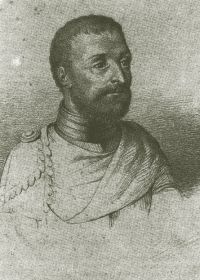
“ Then Magellan, with the three ships which he had, entered the river, through which he ran for more than a hundred leagues, and came out on the other side into the open sea, where he had a stern wind from the east, with which they ran for more than five months without lowering 251their sails, and they fetched some uninhabited islands, in one of which they found some savages, who lived in huts underground. They went to another island where they gave them gold for its weight of iron, by which means they collected much gold: the people also were of a good disposition, and had a king. ”
