“ You’re doing yourself proud, Mr. Wilcox. My congratulations.” “And mine,” said Helen. “Do remind Evie to come and see us—two, Wickham Place. We shan’t be there very long, either.” “You, too, on the move?” “Next September,” Margaret sighed. “Every one moving! Good-bye.” The tide had begun to ebb. Margaret leant over the parapet and watched it sadly. Mr. Wilcox had forgotten his wife, Helen her lover; she herself was probably forgetting. Every one moving. Is it worth while attempting the past when there is this continual flux even in the hearts of men? ”
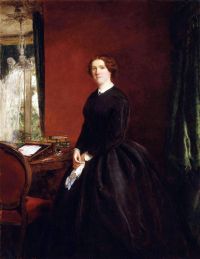
Margaret Wilcox
Definition and stakes
Quotes about “Margaret Wilcox”
E. M. Forster,
Howards End
(1921)
“ Wilcox buttoned up her jacket, she said: "What an interesting life you all lead in London!" "No, we don't," said Margaret, with a sudden revulsion. "We lead the lives of gibbering monkeys. Mrs. Wilcox—really— We have something quiet and stable at the bottom. We really have. All my friends have. Don't pretend you enjoyed lunch, for you loathed it, but forgive me by coming again, alone, or by asking me to you." "I am used to young people," said Mrs. Wilcox, and with each word she spoke the outlines of known things grew dim. ”
E. M. Forster,
Howards End
(1921)
“ Wilcox. "I put it to this gentleman. I ask you, sir, am I to have my brain picked?" Mr. Wilcox turned to Margaret with the air of humorous strength that he could so well command. "Are we intruding, Miss Schlegel? Can we be of any use or shall we go?" But Margaret ignored him. "I'm connected with a leading insurance company, sir. I receive what I take to be an invitation from these—ladies" (he drawled the word) . "I come, and it's to have my brain picked. I ask you, is it fair?" "Highly unfair," said Mr. Wilcox, drawing a gasp from Evie, who knew that her father was becoming dangerous. ”
E. M. Forster,
Howards End
(1921)
“ Wilcox intended to reserve for Paul, while Evie would take the jewellery and lace. How easily she slipped out of life! Charles thought the habit laudable, though he did not intend to adopt it himself, whereas Margaret would have seen in it an almost culpable indifference to earthly fame. Cynicism—not the superficial cynicism that snarls and sneers, but the cynicism that can go with courtesy and tenderness—that was the note of Mrs. Wilcox's will. She wanted not to vex people. That accomplished, the earth might freeze over her for ever. ”
“ Miss Wilcox had changed perceptibly since her engagement. Her voice was gruffer, her manner more downright, and she was inclined to patronise the more foolish virgin. Margaret was silly enough to be pained at this. Depressed at her isolation, she saw not only houses and furniture, but the vessel of life itself slipping past her, with people like Evie and Mr. Cahill on board. There are moments when virtue and wisdom fail us, and one of them came to her at Simpson’s in the Strand. ”
“ I called to tell you that Paul has gone abroad. “RUTH WILCOX.” Margaret’s cheeks burnt. She could not finish her breakfast. She was on fire with shame. Helen had told her that the youth was leaving England, but other things had seemed more important, and she had forgotten. All her absurd anxieties fell to the ground, and in their place arose the certainty that she had been rude to Mrs. Wilcox. Rudeness affected Margaret like a bitter taste in the mouth. It poisoned life. At times it is necessary, but woe to those who employ it without due need. ”
E. M. Forster,
Howards End
(1921)
“ Wilcox is the only one who has stuck. It is now over three years, and we have drifted away from far more interesting people in that time. "Interesting people don't get one houses." "Meg, if you start in your honest-English vein, I shall throw the treacle at you." "It's a better vein than the cosmopolitan," said Margaret, getting up. "Now, children, which is it to be? You know the Ducie Street house. Shall I say yes or shall I say no? Tibby love—which? ”
“ Glancing at these, he saw that the car would be round during the next five, and plunged into action. Gongs were tapped, orders issued, Margaret was sent to dress, and the housemaid to sweep up the long trickle of grass that she had left across the hall. As is Man to the Universe, so was the mind of Mr. Wilcox to the minds of some men—a concentrated light upon a tiny spot, a little Ten Minutes moving self-contained through its appointed years. ”
E. M. Forster,
Howards End
(1921)
“ Wilcox's vitality was low that morning, and it was Margaret who decided on a horse for this little girl, a golliwog for that, for the rector's wife a copper warming-tray. "We always give the servants money." ”
E. M. Forster,
Howards End
(1921)
“ When their father died and they ruled alone at Wickham Place, she often absorbed the whole of the company, while Margaret—both were tremendous talkers—fell flat. Neither sister bothered about this. Helen never apologized afterwards, Margaret did not feel the slightest rancour. But looks have their influence upon character. The sisters were alike as little girls, but at the time of the Wilcox episode their methods were beginning to diverge; the younger was rather apt to entice people, and, in enticing them, to be herself enticed ”
E. M. Forster,
Howards End
(1921)
“ Wilcox wanted to order some private greeting cards. "If possible, something distinctive," she sighed. At the counter she found a friend, bent on the same errand, and conversed with her insipidly, wasting much time. "My husband and our daughter are motoring." "Bertha too? Oh, fancy, what a coincidence!" Margaret, though not practical, could shine in such company as this. While they talked, she went through a volume of specimen cards, and submitted one for Mrs. Wilcox's inspection. Mrs. Wilcox was delighted—so original, words so sweet ”
“ But unworthiness stimulates woman. It brings out her deeper nature, for good or for evil. Here was the core of the question. Henry must be forgiven, and made better by love; nothing else mattered. Mrs. Wilcox, that unquiet yet kindly ghost, must be left to her own wrong. To her everything was in proportion now, and she, too, would pity the man who was blundering up and down their lives. Had Mrs. Wilcox known of his trespass? An interesting question, but Margaret fell asleep, tethered by affection, and lulled by the murmurs of the river that descended all the night from Wales. ”
“ Wilcox from the other forces that were pulling Leonard downhill. Consequently, I was full of pity, and almost of revenge. For weeks I had blamed Mr. Wilcox only, and so, when your letters came—” “I need never have written them,” sighed Margaret. “They never shielded Henry. How hopeless it is to tidy away the past, even for others!” “I did not know that it was your own idea to dismiss the Basts.” “Looking back, that was wrong of me.” “Looking back, darling, I know that it was right. It is right to save the man whom one loves. I am less enthusiastic about justice now. ”
E. M. Forster,
Howards End
(1921)
“ Wilcox mildly. "It is exactly there that the Porphyrion is weak. It has tried to undercut, has been badly hit by a long series of small fires, and it hasn't been able to reinsure. I'm afraid that public companies don't save one another for love." "'Human nature,' I suppose," quoted Helen, and he laughed and agreed that it was. When Margaret said that she supposed that clerks, like every one else, found it extremely difficult to get situations in these days, he replied, "Yes, extremely," and rose to rejoin his friends. ”
E. M. Forster,
Howards End
(1921)
“ Wilcox, who thought the episode amusing, if risque. With most ladies he would not have discussed it, but he was trading on Margaret's reputation as an emanicipated woman. "He said so, and about such a thing he wouldn't lie." They both began to laugh. "That's where I differ from you. Men lie about their positions and prospects, but not about a thing of that sort." He shook his head. "Miss Schlegel, excuse me, but I know the type." "I said before—he isn't a type. He cares about adventures rightly. He's certain that our smug existence isn't all. ”
George S. McWatters, Knots Untied; Or, Ways and By-ways in the Hidden Life of American Detectives
“ It must have been a bitter thing for old Boyd to consider how foolishly he played into Frederic Alvord's hands through the Wilcox letters. But old Boyd is dead now, and never, I suppose, learned how Mr. Alvord was led to inquire for old Andrew Wilcox's funny letters.Margaret was overjoyed with the success of affairs, and declared, as did all the rest of the family, that after this she would consider nothing impossible, and never lose hope, even in the darkest hour. She is living still, a beautiful but older woman, with her children grown up about her, and married, I believe. ”
“ He must never be bothered with emotional talk, or with a display of sympathy. He was an elderly man now, and it would be futile and impudent to correct him. Mrs. Wilcox strayed in and out, ever a welcome ghost; surveying the scene, thought Margaret, without one hint of bitterness. Chapter 19 If one wanted to show a foreigner England, perhaps the wisest course would be to take him to the final section of the Purbeck Hills, and stand him on their summit, a few miles to the east of Corfe. Then system after system of our island would roll together under his feet. ”
E. M. Forster,
Howards End
(1921)
“ I'm not running it down—a very good kind of prose, but well considered, well thought out. For instance, I know all Mr. Wilcox's faults. He's afraid of emotion. He cares too much about success, too little about the past. His sympathy lacks poetry, and so isn't sympathy really. I'd even say"—she looked at the shining lagoons—"that, spiritually, he's not as honest as I am. Doesn't that satisfy you?" "No, it doesn't," said Helen. "It makes me feel worse and worse. You must be mad." Margaret made a movement of irritation. ”
“ Wilcox it was certainly Howards End.” One’s own name will carry immense distances. Mr. Wilcox, who was sitting with friends many seats away, heard his, rose to his feet, and strolled along towards the speakers. “It is sad to suppose that places may ever be more important than people,” continued Margaret. “Why, Meg? They’re so much nicer generally. I’d rather think of that forester’s house in Pomerania than of the fat Herr Förstmeister who lived in it.” “I believe we shall come to care about people less and less, Helen. The more people one knows the easier it becomes to replace them. ”
E. M. Forster,
Howards End
(1921)
“ Wilcox, how can you?" "Because, if he has had enough tea, we ought to go.—Dolly's a good little woman," he continued, "but a little of her goes a long way. I couldn't live near her if you paid me." Margaret smiled. Though presenting a firm front to outsiders, no Wilcox could live near, or near the possessions of, any other Wilcox. They had the colonial spirit, and were always making for some spot where the white man might carry his burden unobserved. Of course, Howards End was impossible, so long as the younger couple were established in Hilton. ”
E. M. Forster,
Howards End
(1921)
“ Wilcox, as it were thrusting his hand into her speech. "Well, you do admit that there are rich and poor. That's something." Margaret could not reply. Was he incredibly stupid, or did he understand her better than she understood herself? "You do admit that, if wealth was divided up equally, in a few years there would be rich and poor again just the same. The hard-working man would come to the top, the wastrel sink to the bottom." ”
“ It’s one of the curses of London. I quite expect to end my life caring most for a place.” Here Mr. Wilcox reached them. It was several weeks since they had met. “How do you do?” he cried. “I thought I recognised your voices. Whatever are you both doing down here?” His tones were protective. He implied that one ought not to sit out on Chelsea Embankment without a male escort. Helen resented this, but Margaret accepted it as part of the good man’s equipment. “What an age it is since I’ve seen you, Mr. Wilcox. I met Evie in the Tube, though, lately. I hope you have good news of your son.” ”
“ It is thus, if there is any rule, that we ought to die—neither as victim nor as fanatic, but as the seafarer who can greet with an equal eye the deep that he is entering, and the shore that he must leave. The last word—whatever it would be—had certainly not been said in Hilton churchyard. She had not died there. A funeral is not death, any more than baptism is birth or marriage union. All three are the clumsy devices, coming now too late, now too early, by which Society would register the quick motions of man. In Margaret’s eyes Mrs. Wilcox had escaped registration. ”
E. M. Forster,
Howards End
(1921)
“ Wilcox." "About Mr. Bast? Yes, do. He'll be more lenient to a special case." "But, Mr. Wilcox, do first light another cigarette. It's this. We've just come across a young fellow, who's evidently very poor, and who seems interest—" "What's his profession?" "Clerk." "What in?" "Do you remember, Margaret?" "Porphyrion Fire Insurance Company." "Oh yes; the nice people who gave Aunt Juley a new hearth-rug. He seems interesting, in some ways very, and one wishes one could help him. He is married to a wife whom he doesn't seem to care for much. ”
E. M. Forster,
Howards End
(1921)
“ He must expect to suffer with the lower animals." Mrs. Wilcox was silenced. In growing discomfort they drove homewards. The city seemed Satanic, the narrower streets oppressing like the galleries of a mine. No harm was done by the fog to trade, for it lay high, and the lighted windows of the shops were thronged with customers. It was rather a darkening of the spirit which fell back upon itself, to find a more grievous darkness within. Margaret nearly spoke a dozen times, but something throttled her. She felt petty and awkward, and her meditations on Christmas grew more cynical. Peace? ”
E. M. Forster,
Howards End
(1921)
“ She did not care about rights, but if men came into Howards End, it should be over her body. "Come, this is an odd beginning," said her husband. The doctor came forward now, and whispered two words to Mr. Wilcox—the scandal was out. Sincerely horrified, Henry stood gazing at the earth. "I cannot help it," said Margaret. "Do wait. It's not my fault. Please all four of you to go away now." Now the flyman was whispering to Crane. "We are relying on you to help us, Mrs. Wilcox," said the young doctor. "Could you go in and persuade your sister to come out?" ”
Ella Wheeler Wilcox,
Poems of Cheer — Two
(1914)
“ One leaned on velvet cushions like a queen - To see him pass, the hero of an hour, Whom men called great. She bowed with languid mien, And smiled, and blushed, and knew her beauty's power. One trailed her tinselled garments through the street, And thrust aside the crowd, and found a place So near, the blooded courser's prancing feet Cast sparks of fire upon her painted face. One took the hot-house blossoms from her breast, And tossed them down, as he went riding by, And blushed rose-red to see them fondly pressed To bearded lips, while eye spoke unto eye. ”
Various, The Cornhill Magazine (Vol. I, No… (1860)
“ Many people would think Miss Wilcox, standing there [495] in her blue merino dress and pomegranate ribbon, a very agreeable woman. She has regular features; the nose is a little sharp, the lips a little thin, good complexion, light red hair. She is very business-like, very practical; she never in her life knew a refinement of feeling or of thought; she is entirely limited, respectable, and self-satisfied. ”
Ella Wheeler Wilcox,
A Woman of the World: Her Counsel to Other People's Sons and Daughters
“ I do not feel I could meet their questioning eyes when they asked me about my parents. I can better bear the loss of the personal happiness of a home and a husband's love." Wilfred is just the man to protect you and to keep the world at a distance, where it could not affect your life by its comments. He regards your birth in the same light that I do, and would rather transmit your lovely qualities of soul and mind to his descendants than the traits of many proudly born girls who are ready to take him at the first asking: for you must know how popular he is with our sex. ”