Thomas C. Jerdon

Definition and stakes

Fanny Emily Penny,  On the Coromandel Coast (1908)

“ The man who is perhaps best known to posterity is T. C. Jerdon. His name is familiar to every naturalist in England as well as in India. His catalogue of Indian birds is a standard work on the subject. In drawing it up he was greatly assisted by Walter Elliot, of the Civil Service. Jerdon was on the Nilgiris and in Travancore, the Deccan, Trichinopoly, and other parts of the Presidency. He was also in Madras in 1845, when he was secretary of the Madras Literary Society, which was founded by Sir John Newbolt. ”
Source: Wikisource

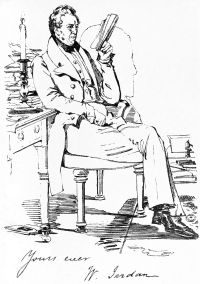
Portrait of William Jerdan William Jerdan,  Extract from The Autobiography of William Jordan (1852)

“ Jerdan, from the very great politeness the family have at all times received, ventures to intrude the enclosed lines. They are written by a young friend, for whom Miss L. feels most anxious solicitude. If Mr. Jerdan will, therefore, give his candid opinion whether he considers any taste or genius is expressed, or, on the contrary, if he should only call it a waste of time from which no benefit can arise. Miss L. feels the liberty she is taking; trusts Mr. Jerdan will believe it is an obligation never to be forgotten. ”
Source: Wikisource

The Modern Scottish Minstrel, Volume 5

“ Cheerless o'er the wave-worn shore,
On the past with sadness pond'ring,
Hope's fair visions charm no more.
[Pg 30] WILLIAM JERDAN.
The well known editor of the Literary Gazette, William Jerdan, was born at Kelso, Roxburghshire, on the 16th April 1782. The third son and seventh child of John Jerdan, a small land proprietor and baron-bailie under the Duke of Roxburghe, his paternal progenitors owned extensive possessions in the south-east of Scotland. His mother, Agnes Stuart, a woman of superior intelligence, claimed descent from the Royal House of Stuart.
”
Source: Gutenberg

Get perspective with Kwize: daily news enlightened by great literature