“ Joints cut right across the bedding, and are often variously combined, one set of joint planes traversing the rock in one direction, and another set or sets intersecting these at various angles. Thus, in many cases the rocks are so divided as easily to separate into more or less irregular fragments of various sizes. Besides these confused joints there are usually other more regular division planes, which intersect the strata in some definite directions, and run parallel to each other, often over a wide area: these are called master-joints. ”
Joint (geology)
Definition and stakes
The theme of “joint (geology)” has been addressed by authors such as Thomas Henry Huxley, John Phillips, Charles Darwin, Thomas C. Chamberlin and James Geikie. It is often associated with terms like rock, stratification, limestone, sandstone and shale.
Quotes about “joint (geology)”
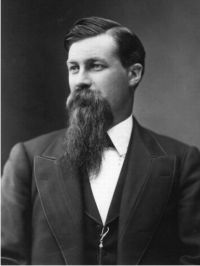 Thomas C. Chamberlin,
Geology
(1906)
“ If the axis of a fold is not horizontal, that is, if it “plunges,” as it commonly does, a second set of joints roughly perpendicular to the first will be developed. If the uplift be dome-shaped and sufficient to develop joints, they will radiate from the center. It is true that joints affect regions where the rocks have not been folded, and where they have been deformed but little, but deformation to some extent is well-nigh universal. Fig. 416.—Jointing in granite. The surface of the rock is a joint plane. ”
Thomas C. Chamberlin,
Geology
(1906)
“ They must be limited to the zone of fracture, and most of them are probably much more narrowly limited. Joints frequently end at the plane of contact of two sorts of rock. Thus a joint extending down through limestone may end where shale is reached.511 Joints are frequently offset at the contact of layers or formations, and a single joint sometimes gives place to many smaller ones. All these phenomena are to be explained on the basis of the different constitution and elasticity of various sorts of rock. Generally speaking, rigid rock is more readily jointed than that which is more yielding. ”