“ Spurt, stroke, spurt! We mustn't get beaten on the post. But stroke, that [Pg 134] wary old warrior, knows what he is about. Unmistakable signs prove to him that this effort is the last desperate rally of his enemies. He sees their boat lurch; their time is becoming erratic; two of them are rolling about in evident distress. His own crew he has well in hand; we are rowing as one man, and he feels that he has only to give a sign, and our restrained eagerness will blaze forth and carry us gloriously past the post. ”
Rowing stroke
Definition and stakes
The theme of “rowing stroke” has been addressed by authors such as Walter Bradford Woodgate, R. C. Lehmann, James H. Sterrett, James Bell Pettigrew and Frank Eugen Dalton. It is often associated with terms like oar, leg, swimming, arm and muscle.
Quotes about “rowing stroke”
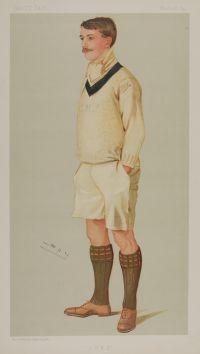 Charles Murray Pitman,
1911 Encyclopædia Britannica
(1911)
“ The secret of good rowing is the simultaneous application of leg and bodywork from end to end of the stroke. The instant the blades are covered the whole weight must be lifted from the stretcher and applied to the oar-handle, and must remain so applied until the hands come in to the chest. In order to ensure that the pressure so applied to the blade shall be as long and as lhard as possible, the body must be swung forward to its full extent, and during the stroke the shoulders must always be swinging back faster than the seat, while at the same time the legs are driving hard at the stretcher. ”
“ But a real heavy-weight is almost invariably slow and lacking in initiative when placed at stroke, although, in the middle of the boat, with another man acting as fugleman for him, he may be able to row perfectly well at any rate of stroke that may be set to him. ”
“ The pace of the bodies on the forward swing, though, of course, it does increase, should feel as if it were slower. Relatively to the rate of stroke used, it is, in fact, slower at a fast than at a slow stroke. The best stroke-oars have been men who fully realized this, and who, either in breaking from a paddle into a row, or in spurting during a hard piece of rowing, gave their crew a delightful sense of steadiness and balance, which enabled them to put their utmost energies into every stroke. ”
Various, Harper's Round Table, July 23, 1895
“ Your back aches, your wrists feel limp as wet strings, and your chest is absolutely bursting, and yet you do not seem to be able to put one good stroke in; the boat slips away from you all the time. So for weeks and months runs your daily experience. But when the rudiments of rowing are mastered at last, when patient attention and hard exercise have made you strong, and taught you when and where to use your strength, then comes the reward. ”
“ How to work the Stroke up to Racing Pace.There comes a time in the history of every crew when, having been plodding along comfortably at [Pg 103] thirty-four, they suddenly realize that the race is barely a week off, that if they are to have any chance of success they must raise the stroke, and that they don't know how on earth it is to be done, seeing that they have usually felt pretty well cleaned out after rowing even a half course at their present rate. ”
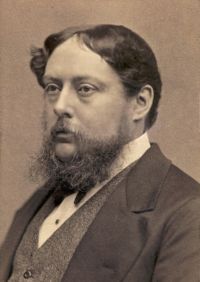 Richard A. Proctor,
Rough Ways Made Smooth: A series of familiar essays on scientific subjects
“ One who has taken part in boat-races very soon detects any irregularity in the rowing—by which I do not of course refer to so gross a defect as not keeping time. All the men of a crew may be keeping most perfect time, and may even present the appearance of keeping stroke together, and yet may not be feeling their work simultaneously. I was aware that something was going wrong, but I found it impossible, without abandoning the style of rowing in which I had been so carefully trained, to keep stroke with the rest of the crew. ”
Donald Walker, Walker's manly exercises (1855)
“ The oar must consequently cross the boat, and be held on its opposite side, so as to clear the back of the man before.It should be neither held nor pulled obliquely to the side by twisting the body, as is practised by many, because the muscles in that case act disadvantageously, and are sooner fatigued. The stroke must be longer in sea than in river rowing. The oar must be thrown out with a heave, caused by the simultaneous extension of the body and the arms. It is still more essential to feather in sea than in river rowing. ”
“ You are then quite firm, and can control your body in the event of your boat rolling. Although when a man has become a waterman he will find the back-stop unnecessary, it is safest for the novice to have it, so as to be able to press against it; otherwise, having nothing to press against at the [Pg 163] finish of his stroke, he may acquire the bad habit of relying entirely on his toes to pull him forward. In such a position he is unstable, and if his boat rolls he has no control over his body.Having got your balance, the next thing to be thought of is the stroke. ”
A. R. Calhoun, Healthful Sports for Boys
“ This consists in bringing the edge of the blade parallel with the water—a splendid exercise for the wrists— then turning the blade as it reaches the water, and with all the strength of every muscle drawing the oars steadily, never jerkily, till the stroke is finished. The one purpose is to keep up a uniform speed, and this can be done only by a uniform stroke. Endurance, rather than mere brute strength, is the thing to be kept in mind in rowing, as in everything else requiring effort. Always have in reserve a stock of endurance to be used should occasion require. ”
William Blaikie, How to Get Strong and How to Stay So
“ It is a matter of supreme importance in rowing to get a strong grip at the beginning of the stroke, and to put the weight on heavily then; while it is a glaring fault to do anything like jerking toward the end of the stroke. But with this parlor rowing-machine, instead of lifting a solid weight, as in the ordinary rowing-weight, a rubber strap, or, rather, two rubber straps, are simply stretched while the stroke is pulled, and then slackened to begin the next. ”
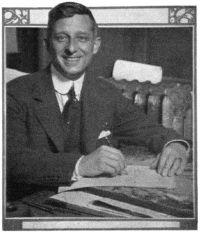 Lester Chadwick,
The Eight-Oared Victors
(1913)
“ There was no jerking progress, but a steady onward movement, the perfection of rowing. "Get a little more into the finish of the stroke!" called the coach at one point. "You must get the beginning of the stroke with the body only, but finish with the arms and shoulders. Send your elbows past your sides. Drop your shoulders, but keep up your heads and chests." ”
 Walter Bradford Woodgate,
Boating
“ Thirty strokes a minute is plenty for slow rowing. Some strokes, though good to race behind, have a difficulty in rowing slow; especially after having had a spell at a fast stroke. It is important to inculcate upon the stroke that thirty a minute should be his ‘walking’ pace, and should always be maintained except when he is set to do a course, or a part of one, or to row a start. When once he is told to do something like racing over a distance, he must calculate his stroke to orders, whether thirty-two, -four, -six, -eight, &c. ”
Walter Bradford Woodgate,
Boating
“ As an illustration: suppose a man is rowing forty strokes in a minute, and that his body hangs the tenth of a second when it is back after each stroke, then at the end of a minute’s rowing he will have sat still for four whole seconds! An oarsman who has no hang in his recovery can thus row a fast stroke with less exertion to himself than one who hangs. The latter, having wasted time between stroke and recovery, has to swing forward all the faster, when once he begins to recover, in order to perform the same number of strokes in the same time as he who does not hang. ”
Walter Bradford Woodgate,
Boating
“ If the legs leave off supporting the body before the oar-handle comes to the chest, the body droops to the strain from want of due support; or if the oarsman tries to row the stroke home with arms only, ceasing the swing back; and still more, if he tries to finish with biceps instead of by shoulder muscles, he is not unlikely to row deep, because he feels the strain of rowing the oar home in time, with less power behind it than that employed by others in the boat. ”
 Arthur Stanwood Pier,
The Crashaw Brothers
(1910)
“ It’s important that a stroke should have a wonderful sense of time—so that he should know instinctively when he’s rowing thirty-two strokes to the minute and when he’s rowing thirty-four, and so that he should be able to keep the pace even and not be hitting it up and then dropping it again. ”
Walter Bradford Woodgate,
Boating
“ It is during the ‘off’ work, when rowing or paddling to or from a course, that there is most scope for coaching, and faults are best cured at a slow stroke.In training for a short course, such as Henley and college races, a crew may be taken twice each day backwards and forwards over the distance; the first time at thirty a minute each way, the second time at the ‘set’ pace of the day, over the course, relapsing into the usual ‘thirty’ on the reverse journey. The ‘set’ stroke depends on the stage of training. ”
Walter Bradford Woodgate,
Boating
“ The pupil was enjoined not to let his slide run ahead of his swing while rowing the stroke through; but on the recovery he may, and should, let his slide get well ahead, and be completed before the body has attained its full reach forward. The body should not wait for the swing to do its duty first, but it should begin at once to recover, though more leisurely than the legs. ”
“ The swing must be slow and balanced, for "the time occupied in coming forward should be the body's rest, when the easy, measured swing, erect head, braced shoulders, and open chest, enable heart and lungs to work freely and easily, in preparation for a defined beginning of the next stroke." ”
“ As your body swings back, your feet are to press against the stretcher and drive the slide back, in order that, by the combination of body-swing and leg-drive, you may retain the power which you have applied at the beginning evenly throughout the whole of the stroke. ”
Albertus T. Dudley, The School Four
“ I knew all this before, but rowing directions are awfully hard to apply. You have to watch the back of the man in front of you for your stroke, and yet start at the very instant he does. That means that you must feel when he is going to start and start with him. That’s an example of what they expect of you in a boat; other things are a good deal harder.“On Friday the first went to Suffolk to race the Suffolk School. They have a little course out there of about a quarter of a mile, and they practice for just this short distance with an awfully quick stroke. ”
“ But if you put this man at No. 3 in a Four, the results are sure to be disastrous. An easier style of movement is required for a Four. A strenuous application of all the body-weight at the beginning of the stroke is still, no doubt, necessary. ”
Walter Bradford Woodgate,
Boating
“ If such a crew are set to row a fast stroke in order to blow themselves and to accustom their vascular system to high pressure, their style may be damaged. If on the other hand they do no work except rowing at a slow stroke until within a few days of the race, they will come to the post short of condition. Such a crew should be kept at a slow stroke in the boat, in order to enable them to learn style, for a fortnight or so; but meantime the trainer should put them through some [167] sharp work upon their legs. He should set them to run a mile or so after the day’s rowing. ”
 Talbot Baines Reed,
Parkhurst Boys, and Other Stories of School Life
“ But what of our opponents? At the first stroke their boat had dashed away an inch or two in advance of ours, at the third that distance had become a foot, and presently they were far enough ahead to enable me to catch sight of their coxswain’s back. As we both settled down to work, they were rowing at a considerably quicker pace than we, wrenching the boat forward at each stroke, and inch by inch improving their advantage. ”
“ When the body is full forward the knees should be opened to about the breadth of the arm-pits, the flanks closed in against the thighs. The knees should bend steadily and gradually into this position, and at the moment of beginning they must maintain themselves there and not fall loosely apart. Such a movement entails a great loss of power at the beginning of the next stroke. Nor, on the other hand, ought the knees to be clipped together as the stroke begins. ”
Richard A. Proctor,
Light Science for Leisure Hours
“ In the Cambridge crew we see the first part of the stroke done with the shoulders—precisely accord271ing to the old-fashioned models—the arms straight until the body has fallen back to an almost upright position; then comes the sharp drop back of the shoulders beyond the perpendicular, the arms simultaneously doing their work, so that as the swing back is finished, the backs of the hands just touch the ribs in feathering. All these things are quite in accordance with what used to be considered the perfection of rowing ”
Ed. James, Practical Training for Running…
“ It teaches to feather the oar correctly, it gives the dip of the oar, it has the sliding seat, it can be regulated for heavy or light, short or long stroke, and is manufactured for either open or cross-handed rowing, and the pressure can be changed to suit the weak or the strong. ”
Walter Bradford Woodgate,
Boating
“ In dealing with scientific racing we have previously remarked that the point wherein a tiring oarsman first gives way is in his recovery, because of the relative weakness of the muscles which conduct that portion of the action of the stroke. ”
Richard A. Proctor,
Rough Ways Made Smooth: A series of familiar essays on scientific subjects
“ A stroke which resulted in mere jerking, injurious to the rower and not adding to speed, in the old racing boats, is absolutely essential to the effective propulsion of the modern racing [Pg 176] boat, when once at least full speed has been attained, for before this the old fashioned long drag with lightning feather is as useful now as ever. Now, no one who has watched a really good Oxford crew at full speed can fail to observe the way in which the oars literally smite the water at the beginning of each stroke. ”
Walter Bradford Woodgate,
Boating
“ The pace of recovery should be proportionate to the speed of stroke. If recovery is too slow, the oarsman becomes late in getting into the water for the next stroke; if he is too quick, he has to wait when forward in order not to hurry the stroke.15. Too many even high-class oars are prone to omit to keep the oar feathered for the full distance of the recovery. They have a tendency to turn it square too soon. By so doing they incur extra resistance of air and extra labour on the recovery, and they are more liable to foul a wave in rough water. ”
The boy mechanic, book 3 (1919)
“ For a short afternoon paddle almost any kind of a stroke will suffice to drive the canoe ahead, but upon long trips, or when head winds and rough water are encountered, the quick, short stroke will save both time and muscle. ”
Walter Bradford Woodgate,
Boating
“ The moment the oar touches the body, drop the hands smartly straight down, then turn the wrists sharply and at once shoot out the hands in a straight line to the front, inclining the body forward from the thigh-joints, and simultaneously bring up the slider, regulating the time by the swing forward of the body according to the stroke. Let the chest and stomach come well forward, the shoulders be kept back ”
William Blaikie, How to Get Strong and How to Stay So
“ The better the beginning of a stroke is caught in the water, the more the fulcrum of water itself solidifies, and by so much more can the rower throw his weight on then, and at just the right time. The effect with the rubber straps is the very reverse; for, in throwing the weight on at the beginning, the straps do not offer enough resistance to have the desired effect, while they offer too much at the finish of the stroke. ”
Sir Charles G. D. Roberts, Reube Dare's Shad Boat: A Tale of the Tide Country
“ A few long, powerful strokes brought him to the spot where his comrade was standing.“Now,” said he, “get in there in front of me when the water comes up to the lower part of your chest. You use your legs wrong, and your arms too. Your arms don’t make a quarter the stroke they ought to, and your fingers are wide open, and your hands press out instead of down on the water too much. Keep your fingers together, and turn your palms so that they tend to lift you, instead of just pushing the water away on each side. And, moreover, finish your stroke!” ”
Related terms
Authors who wrote about “rowing stroke”
Walter Bradford Woodgate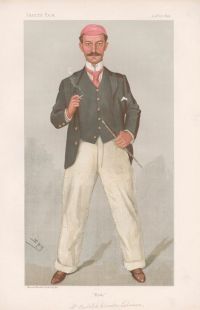 R. C. LehmannJames H. Sterrett
 James Bell PettigrewFrank Eugen DaltonCharles Murray PitmanWilliam HenryClaude Harris MillerWilliam BlaikieCharlotte OelschlagerEd. JamesRichard A. ProctorVariousA. R. CalhounDonald WalkerTalbot Baines ReedAlbertus T. DudleyLester ChadwickSir Charles G. D. Roberts
 Algernon Blackwood
