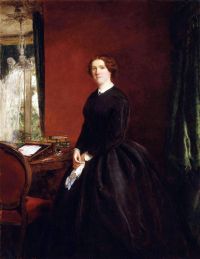
“ But the answer—by word of mouth of the steward or stewardess always—was unfailingly to the same effect:—the lady in number 7 refused to hold any communication with the sick gentleman."She's a hard one!" the steward remarked to the stewardess, when they talked the matter over in a comfortable manner during the progress of a snug little supper in the steward's cabin, "she must be an out-and-out hard-hearted one to stand out against him like that, if he is her husband, and I suppose he is. ”
Stewardess
Definition and stakes
The stewardess, a female attendant tasked with passenger care on ships or aircraft, appears in literature as a figure embodying both practical responsibilities and quiet emotional depth. Authors such as M.E. Braddon portray her as a mediator of conflict, while Henry James presents her as a quietly perceptive presence in moments of intrigue.
Winifred Hawkridge Dixon emphasizes her nurturing role, contrasting it with the stoicism of male crew members, and Angela Brazil depicts her as a resilient individual facing physical challenges. These diverse representations highlight the stewardess as a liminal character—connecting the practical and the personal, the professional and the human—within the restricted environments of travel and transit.
Quotes about “stewardess”
Stephen H. Branch's Alligator, Vol…
“ The stewardess is the only female on board, who is a legion, and has contributed much to make us happy. Extraordinary harmony has prevailed. All are armed to the teeth, which warns us to respect each other. ”
“ The stewardess thought she had been a bit odd the night before, but had waited a little and then gone back. Miss Mavis hadn’t turned up—and she didn’t turn up. The stewardess began to look for her—she hadn’t been seen on deck or in the saloon. Besides, she wasn’t dressed—not to show herself; all her clothes were in her room. ”
Winifred Hawkridge Dixon, Westward hoboes (1921)
“ The stout lady, the flirtatious purser—why is he of all classes of men the most amorous?—the bounder, the bride and groom, the flappers of both sexes, the drummer, the motherly stewardess and the sardonic steward were all present. And why does the sight of digestive anguish bring out the maternal in the female, and only profanity in the male? Our plump English stewardess cooed over us, helpless in upper and lower berths ”
 Angela Brazil,
The Princess of the School
Angela Brazil,
The Princess of the School
“ Lilias and Dulcie would thankfully have gone to the bottom, and though Carmel and Cousin Clare were more cheerful, the physical discomfort troubled them decidedly more than the danger. The stewardess, who, poor woman, was herself ill, managed to struggle into their cabin, and holding on tightly to the berths, would pass them drinks of tea in cups that could only be filled a quarter full for fear of spilling. ”
The English and Scottish popular ballads…
“ The steward comes upon the scene, and is angry to find the child in such company. When the child gives his name as Poor Disaware, the steward denounces him as a thief who had robbed his own father; but the duke speaks kindly to the boy, and makes him his stable-groom. One day, when he is watering a gelding, the horse flings up his head and hits the child above the eye. The child breaks out, Woe worth thee, gelding! thou hast stricken the Lord of Lorn. I was born a lord and shall be an earl; my father sent me over the sea, and the false steward has beguiled me. ”
 Francis James Child,
The English and Scottish Popular Ballads…
Francis James Child,
The English and Scottish Popular Ballads…
“ To learn the speeches of each land.' 'Who shall go with him?' said the lady; 'Husband, we have no more but he;' 'Madam,' he saith, 'My head steward, He hath bin true to me.' She cal'd the steward to an account, A thousand pound she gave him anon; Sayes, Good Sir Steward, be as good to my child, When he is far from home. 'If I be fals unto my young lord, Then God be [the] like to me indeed!' And now to France they both are gone, And God be their good speed. ”
Gonçalo Fernandes Trancoso, The venture; an annual of art and literature (1903)
“ The steward read them, and both wept for joy and grief, he and the King, and when their transport was over they agreed that the steward should go in a King's ship with the youth wheresoever the youth should guide him, and should see the damsel that should be shown him whom the youth should affirm to be she who wrought the linen, and if she were the Princess he should give him in whose house she had been kept, all he should say he had spent upon her, and two thousand crusadoes to boot, and promise him that if he would come with her the King would show him great favour, and to the youth also. ”
 Charles Perrault,
Old-Time Stories
Charles Perrault,
Old-Time Stories
“ But there came an evening when this evil queen again addressed the steward.'I have a mind,' she said, 'to eat the queen with the same sauce as you served with her children.'This time the poor steward despaired of being able to practise another deception. The young queen was twenty years old, without counting the hundred years she had been asleep. Her skin, though white and beautiful, had become a little tough, and what animal could he possibly find that would correspond to her? ”
The English and Scottish popular ballads…
“ The steward answers, as in A 8, that the queen has taken a new love, and conducts the king to his chamber. Hugo cuts off the black man's head. Every drop of his blood turns to a burning candle, which makes the king think that he has killed a holy man. But the steward says, Not so; rather she is a witch, that can make stones float and feathers sink, and urges the king, now that his sword is out, to take off the queen's head, too. The king refuses. Olif wakes, and is astounded at what her eyes behold. What means this black man in her bed! God wot, says Milon, he has long been your leman. ”
Jean Macé, The History of a Mouthful of Bread
“ Thus, the steward gives tiles to the slater, planks to the carpenter, colors to the painter, lime and bricks to the mason—the very same lime that we have in our teeth—in fact, he has got everything that can be wanted in his storehouse, and it is to him that every one applies in time of need.Now our body also is a mansion, and has its steward too. But what a steward—how active! what a universal genius I how inefficient by comparison are the stewards of the greatest lords! He goes, he comes, he is everywhere at once ”
“ Steward (greater stamp of the foot than ever,) how dare you not keep your eyes on me? Let everything, everywhere, always be in the first style, so that people may respect us. Begone, fool!”“And pray now ma’m,” suggested the don, “who pays?”“And pray now sir, who should know better than you?”“Oh, heaven! Pray am I master, or am I not?”“You are not—master, where I am! Zounds!” She flings over a chair.“Sister, sister,” said the doctor, but the sister did not even look at him. She flew at the don as well as she could, seeing she was a wingless angel ”
The English and Scottish popular ballads…
“ Then sing to thy gelding, and not to me, she says. The child repeats his story, and adds that the steward has been deceiving both her and him for a twelvemonth. The lady declares that she will marry no man but him that stands before her, sends in haste to her father to have her wedding put off, and writes an account of the steward’s treachery to the old lord in Scotland. The old lord collects five hundred friends of high degree, and goes over to France in search of his son. ”
 T. G. Steward,
Memoirs of Mrs. Rebecca Steward…
T. G. Steward,
Memoirs of Mrs. Rebecca Steward…
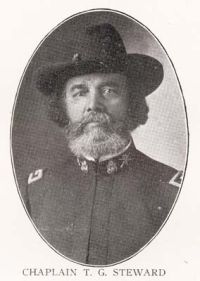
“ Another intelligent minister said to me, "Sister [73] Steward is one of the best read women I ever had the favor of conversing with."To the church she was a pillar. She was among the few that were found at the prayer meeting and Sabbath-school, and was always aiming to do something for the Master's cause. As a wife and mother, I can only say few husbands are favored as was her's. No woman could possibly be more interested in the welfare of her husband's business than she was. She was a helpmeet in every sense of the word to her husband. ”
H. R. Wilton Hall, Social Life in England Through the Centuries
“ But we find in every place a steward, and in each town the king's reeve or the lord's reeve. These acted for the overlord, whoever he was, and saw that the villeins and cottiers did their proper proportion of work at the right time; they saw that the lord's tolls at the markets, fairs, and ferries, were properly enforced. The steward was a most important officer in every town and village, and a great deal of power was in his hands. ”
Henry Norman Hudson, Shakespeare: His Life, Art, And Characters…
“ Her reply to the Steward, when, by way of scorching the Clown, he "marvels that her ladyship takes delight in such a barren rascal," gives the true texture of her mind and moral frame: "O, you are sick of self-love, Malvolio, and taste with a distempered appetite. To be generous, guiltless, and of free disposition, is to take those things for bird-bolts that you deem cannon-bullets. There is no slander in an allowed Fool, though he do nothing but rail; nor no railing in a known discreet man, though he do nothing but reprove." ”
 Wilhelmine von Hillern,
On the Cross: A Romance of the Passion Play at Oberammergau
Wilhelmine von Hillern,
On the Cross: A Romance of the Passion Play at Oberammergau
“ Go away for a time. You are out of favor with the queen. What is more natural than to go on a journey and sulk. To the so-called steward also, this must at present serve for a pretext to avoid a tragical parting scene.""Go now! Now!--leave--you?" she whispered, blushing as she spoke."Madeleine," he said gently, drawing her hand to his breast. "How am I to interpret this blush? Is it the sign of a sweeter feeling, or embarrassment because circumstances have led you to say something which I might interpret differently from your intention?" ”
“ And his horse—I never saw a better.""But what is all this to me?" asked the steward. "If he is trespassing in the forest, it is your duty to bring him before the duke.""Ah! it is hard for you to understand," answered the forester. "Methinks that if our master had the boar, the sword, and the horn, he would let me keep the clothing, and you the horse, and would trouble us with but few questions.""Thou art indeed wise," answered the steward. And he at once called six men, whom he knew he could trust to any evil deed, and told them to go with the forester. ”
Anonymous, London and Its Environs Described…
“ IX. The Steward is to reside constantly in the house, and to follow no other employment than what relates to this charity. He is to receive the respective provisions and materials for the employment of the women, ordered by the committee, and inspect the weight, measures and quality thereof, and to make regular entries of them; to keep an exact account of all the work done by every respective woman, as the matron shall deliver it to him. ”
 Gustav Freytag,
The Lost Manuscript: A Novel
Gustav Freytag,
The Lost Manuscript: A Novel
“ The Princess rose, and turned away."Better, undoubtedly, is the situation of the man," concluded the High Steward, "whose personality allows him to guide, by silent work, the life-current of his high-born friend. Yet even he must not only himself lose much of what is most delightful in life, but, even with the purest intentions, he will not always be able to give pleasure to his princess. ”
F. Marion Crawford, The Upper Berth (1926)
“ The steward, who is a superstitious fellow, perhaps, and expected something to go wrong, went to look for him, this morning, and found his berth empty, but his clothes lying about, just as he had left them. The steward was the only man on board who knew him by sight, and he has been searching everywhere for him. He has disappeared! Now, sir, I want to beg you not to mention the circumstance to any of the passengers; I don't want the ship to get a bad name, and nothing hangs about an ocean-goer like stories of suicides. ”
“ The steward and his wife, with the other servants, came to me immediately; all clinging together, with a number of lights in their hands. It seems they had all been waiting to see the issue of the interview betwixt me and the apparition. They asked me what was the matter. I told them the foregoing circumstances, and showed them the box. The steward durst not meddle with it, but his wife had more courage, and, with the help of the other servants, tugged it out, and found the key. ”
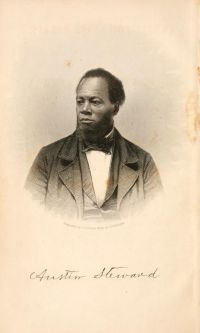 Austin Steward,
Twenty-Two Years a Slave, and Forty Years a Freeman
Austin Steward,
Twenty-Two Years a Slave, and Forty Years a Freeman
“ The gentleman had just come from London, and had seen handbills at every conspicuous place, describing me and my horses. I asked him what I should do? He said, 'you are not safe a moment; there is no hope but in flight; avoid the main road, and get to the colony if you can; if you succeed, go to A. Steward; he is an upright man and will never betray you for money,' And here I am: if I am arrested, six months imprisonment, three hundred dollars fine, and the forfeiture of my father's valuable and favorite horses, will be my portion. ”
Portal:Anonymous texts, The Urantia Book (1955)
“ And so did this dishonest steward seek to make friends for himself after he would be discharged from his stewardship. Even his lord and master, when he subsequently found out about this, was compelled to admit that his unfaithful steward had at least shown sagacity in the manner in which he had sought to provide for future days of want and adversity. "And it is in this way that the sons of this world sometimes show more wisdom in their preparation for the future than do the children of light. ”
Christian D. Ginsburg, The Essenes: Their history and doctrines (1864)
“ A steward is appointed in every city of this order to provide strangers with clothes and other necessaries.46 The keeping and appearance of their body are such as of children brought up in fear; they change neither garments nor shoes till they are worn out or made unfit by time.47 They neither sell nor buy anything among themselves, but everyone gives of that which he has to him that wants, and gets from [43] him that which he needs; and even without requital they can freely take whatever they want. ”
Mrs. A. T. Thomson, Memoirs of the Jacobites of 1715 and 1745…
“ Proclamation for silence having been made by the [Pg 418] Lord Steward's serjeant-at-arms, the commission was read, the lords standing up, uncovered. Then his Grace, making obeisance to the lords, reseated himself; and Garter, and the Black Rod, with their reverences, jointly presented the white staff, on their knees, to his Grace. Thus fully invested with his office, the Lord Steward took his staff in his hand and descended from the woolsack to a chair prepared for him on an ascent before the throne. ”
 Augusta de Grasse Stevens,
Miss Hildreth: A Novel, Volume 2
Augusta de Grasse Stevens,
Miss Hildreth: A Novel, Volume 2
“ I am not one, Esther, as you know, to come lightly to a decision, especially one of such grave importance to me; but in this you cannot change me; nothing can alter my decision. You are blinded by your loyalty, you see her as you fain would see her, with the glamour of her beauty and her fascination surrounding her so closely you cannot perceive the real woman beneath. But I have beheld her as she is, cold, hard, brilliant, illusive, heartless; she is but the mocking personation of her old self; the outside tenement, beautiful, bewitching, but soulless and insincere. ”
 Robert Neilson Stephens,
The Bright Face of Danger
Robert Neilson Stephens,
The Bright Face of Danger
“ The Count lounged limply back in his great chair at the head of the table, unsteadily holding a glass of wine; and the Captain leaned forward on the board, narrowly regarding the Count. Both were well gone in wine, the Count apparently the more so. There was a look of mental torment on the Count's face."Yes, I know, I know," he said, wincing at his own words as if they pierced him. "There was opportunity enough with that De Merri. I was blind then. And with this new puppy! Women and lovers have the ingenuity of devils in devising opportunities. ”
Robert Neilson Stephens,
The Bright Face of Danger
“ The Count's eyes waited for my answer."I—exchanged a few words with her yesterday afternoon," I replied."In regard to what subject?" asked the Count quickly, making a veritable grimace in the acuteness of his suspicion."I paid her a compliment or two, such as one bestows upon a pretty girl.""He is evading," said the Captain. "It is a question whether he did not presume to offer his compliments higher. One does not say to a pretty girl, 'What is your name?' nor does the girl reply 'Mathilde,' as if she were a child. It is more likely he heard the girl's name from other lips. ”
 Harriet Martineau,
Illustrations of Political Economy…
(1834)
Harriet Martineau,
Illustrations of Political Economy…
(1834)
“ If the steward puts out the eyes that follow him too closely, and ties the tongue that importunes, and breaks the limbs of the strong man in sport, so as to leave him an impotent beggar in the porch of the mansion,—do we not know from the Scripture what shall be the fate of that steward? As it is with a single ruler, so shall it be with a company of rulers,—with a government which regards the people only as the something on which itself must stand, 81which takes bread from the children to give it to dogs ”
 Ann S. Stephens,
A Noble Woman
Ann S. Stephens,
A Noble Woman
“ She attempted to throw her arms about Elizabeth in her demonstrative way, but the woman rose quickly, and avoided the caresses which would have stifled her."It is time to dress," she said; "I am going to my room."She passed into her chamber with that dreary chill at heart, which, it seemed to her, would never leave it again! How could she endure that fearful pang of humiliation and self-abasement that wrung her soul, and would grow stronger with every proof of kindness that her husband could give?No love—no heart to give her under all his goodness and attention. ”
