AI-generated from sources
Mark Twain and the philosophy of engineering failure: Why 10,000 commissions cannot tame a river
In Brief
- Twain's skepticism toward centralized power stemmed from his intimate experience as a Mississippi pilot, where practical, empirical knowledge superseded the theoretical and simplistic plans of government commissions.
- The repeated failure of engineering to contain natural forces serves as an allegory for Twain's mechanistic philosophy, which posits that inherently flawed human beings create inherently limited and chaotic systems.
- The Mississippi pilot symbolized the truly independent individual, fostering the 'discriminating irreverence' Twain believed was necessary to check institutional arrogance and protect democratic liberty.
- Twain’s critique insists that acknowledging the untamable nature of certain forces, both natural and human, is not a failure but the beginning of true wisdom.
Main authors

The modern state often defines its legitimacy through the promise of security and order, a promise frequently manifested in monumental works of engineering designed to tame the natural world. This ambition to control, curb, and confine finds its ultimate challenge in the great rivers of the earth, forces that resist human hubris. The Mississippi River, in particular, stands as a potent symbol of this tension, a dynamic and seemingly untamable system that defies simplistic, top-down solutions [1, 2]. The repeated failures of levees and other infrastructure designed to manage its flow serve as a recurring critique of the belief that nature can be entirely subjugated by human will.
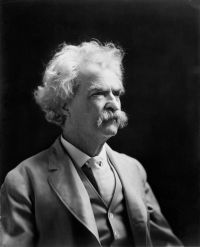
No figure is more central to understanding this conflict than Mark Twain, whose philosophy was shaped not in a university but in the pilot-house of a Mississippi steamboat. His profound skepticism towards engineered solutions was not born of abstract theory but of intimate, hard-won experience navigating the river's treacherous and ever-changing currents [3, 4]. This direct, empirical knowledge, which required an almost superhuman memory and an artist's attention to detail, gave him a unique vantage point from which to view the grand designs of commissions and governments with a critical eye [5, 6]. For Twain, the river was not a problem to be solved but a living entity to be respected, and the attempts to master it were a source of grim amusement .
Twain's critique of river management, however, is merely the most vivid expression of a much broader skepticism toward all forms of concentrated power and institutional arrogance. His distrust of the state's ability to control the Mississippi is a direct reflection of his cynical, often mechanistic, view of human nature itself [7, 8]. He saw a parallel between the untamable river and the unruly, often irrational, instincts of mankind. In his view, any system created by such flawed beings—be it a government, a church, or a river commission—was inherently limited and prone to failure [9, 10]. Thus, his commentary on the river becomes a powerful allegory for the fundamental limits of state engineering in both the natural and social worlds.
The University of the River: Knowledge Against Hubris
The foundation of Mark Twain's skepticism was the profound gap between theoretical and practical knowledge. The Mississippi pilot's craft was not a science that could be learned from maps or textbooks; it was an art mastered through relentless observation and memory . The pilot had to internalize thousands of miles of river, learning its every mood and feature by day and by night, an education that made the abstract plans of distant engineers seem dangerously simplistic . This deep, sensory understanding of the river's immense complexity and power engendered a humility that was starkly absent from the confident proclamations of state-sponsored commissions.
This unique mastery fostered an unparalleled sense of autonomy. In Twain's estimation, the Mississippi pilot was perhaps the only truly free individual in society, an independent agent unbound by the hierarchies and obligations that constrained even kings and politicians [11, 12]. This moral and professional freedom, born from indispensable skill, created a mindset inherently suspicious of external authority and control. The pilot's authority came not from a government mandate but from a direct, unmediated relationship with the river itself. This experience of true independence provided a permanent critical lens through which to view all societal institutions that sought to impose order through regulation and force.
From this vantage point, the endless parade of theories on how to solve the "eternal problems" of the Mississippi was a testament to human folly [13]. Twain saw the river as a fundamentally "lawless" entity that would ultimately ridicule any attempt at total confinement . State engineering projects, in this light, were not just potentially ineffective; they were acts of profound arrogance. They represented the dangerous belief that a complex, dynamic system could be understood and managed through rigid, centralized planning. Twain’s experience taught him that true navigation, both on the river and in life, required flexibility, adaptation, and a deep respect for forces beyond one's control.
Man as Machine: A Mechanistic View of Society and Its Limits
Twain's distrust of grand systems was rooted in a deeply pessimistic and mechanistic philosophy of human nature. In works like "What Is Man?", he argued that humans are not sovereign beings exercising free will but are essentially machines, or "coffee-mills," whose thoughts and actions are determined solely by external influences and their innate temperament [14]. He saw little difference between a human being and a complex engine, suggesting that both are compelled to act according to the laws of their make, with no room for personal merit or genuine choice [15].
This deterministic outlook led to a profound cynicism about the foundations of human morality. Twain viewed conventional morals not as an expression of inner virtue but as an "artificial" construct created by the forced suppression of natural instincts [16]. He contended that genuine moral understanding could not be taught by institutions like the church or state, but could only be acquired through direct, often painful, experience [17]. This conviction mirrored his belief about the Mississippi: just as true knowledge of the river came from navigating its dangers, true morality came from confronting one's own failings. Institutions that claimed to engineer human behavior were, in his view, building on a foundation of sand.
This philosophical stance informed his scathing social satire. Twain delighted in exposing the frailty of human integrity, creating scenarios where the most respected citizens would readily perjure themselves for personal gain, revealing the thin veneer of their boasted incorruptibility [18]. If individuals were so fundamentally flawed and easily manipulated by their environment, he reasoned, then the large-scale systems they created could be no better . The state, therefore, was not a reflection of humanity's highest ideals but an amplification of its inherent weaknesses. A commission of flawed men could not possibly perfect a flawed river; they would more likely compound the chaos.
The Irreverent Patriot: Reforming the State from Within
Despite his deep-seated cynicism about human nature and institutions, Mark Twain was not an anarchist but a reformer with a quintessentially American spirit [19, 20]. He wielded his pen as a weapon against the "ills of democratic government," using satire to expose tyranny, corruption, and insincerity wherever he found them [21]. He identified a core principle for safeguarding freedom, not in reverence for institutions, but in its opposite. For Twain, a critical and thinking populace was the only true defense against the consolidation of power.
Twain applied this principle of skepticism universally. His proposal that religion should be fractured into numerous competing sects, so that they might "police each other," serves as a perfect model for his political philosophy . He saw any concentration of power, whether in an established church or a federal agency, as a "political machine" inherently hostile to human freedom. A single, authoritative River Commission, claiming sole authority over the Mississippi, would represent the same dangerous monopoly on truth and power that he decried in religion. Plurality, dissent, and competition were the only reliable checks against institutional hubris.
This reveals the central paradox of Twain's worldview: he lost faith in the goodness of humanity but never abandoned his belief in the democratic project [23]. His relentless criticism was not an attempt to destroy the American system but to save it from its worst tendencies. He was a patriot who believed that the nation's strength lay in its capacity for self-criticism and its habit of independent thought [24, 25]. In challenging the state's mandate to control every aspect of life, from rivers to personal morality, Twain was performing what he saw as the highest civic duty: ensuring that the "precious ordinary self of the Republic shall suffer no harm" [26].
Mark Twain’s famous declaration that "ten thousand River Commissions" could never tame the Mississippi was far more than a piece of folk wisdom; it was the sharp point of a comprehensive and deeply considered philosophy . This worldview was forged by direct, tactile experience , supported by a cynical and mechanistic understanding of human nature , and animated by a fervent distrust of any and all concentrated power . For Twain, the inevitable failure of massive engineering projects to contain a "lawless stream" was not a mere technical shortfall but a resonant confirmation of a larger truth: that human systems are as flawed and unruly as the people who create them.
The enduring power of Twain's critique lies in its challenge to the core assumptions of the modern, technocratic state. He questions the belief that public security can be permanently achieved through engineering and control, whether applied to a river or a society. His legacy is that of the irreverent reformer, the necessary voice of doubt that reminds us of the limits of our power and the wisdom of humility [27]. He insists that some forces, both in the natural world and in the human heart, will forever resist being perfectly curbed and confined, and that acknowledging this reality is not a sign of failure, but the beginning of true wisdom.