Summary

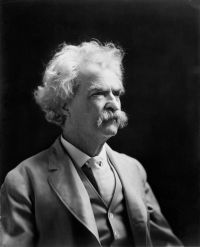
Portrait of Mark Twain Mark Twain What Is Man? and Other Essays

Could Circumstance have ordered another dweller in that town to go to the Amazon and open up a world-trade in coca on a fifty-dollar basis and been obeyed? No, I was the only one. There were other fools there—shoals and shoals of them—but they were not of my kind. I was the only one of my kind.
Circumstance is powerful, but it cannot work alone; it has to have a partner. Its partner is man’s temperament—his natural disposition. His temperament is not his invention, it is born in him, and he has no authority over it, neither is he responsible for its acts.
Source: Gutenberg

Portrait of Mark Twain Mark Twain What Is Man? and Other Essays

That is the way with art, when it is not acquired but born to you: you start in to make some simple little thing, not suspecting that your genius is beginning to work and swell and strain in secret, and all of a sudden there is a convulsion and you fetch out something astonishing. This is called inspiration. It is an accident; you never know when it is coming. I might have tried as much as a year to think of such a strange thing as an all-around left-handed man and I could not have done it, for the more you try to think of an unthinkable thing the more it eludes you
Source: Gutenberg

Portrait of Mark Twain Mark Twain What Is Man? and Other Essays

Love is a madness; if thwarted it develops fast; it can grow to a frenzy of despair and make an otherwise sane and highly gifted prince, like Rudolph, throw away the crown of an empire and snuff out his own life. All the whole list of desires, predilections, aversions, ambitions, passions, cares, griefs, regrets, remorses, are incipient madness, and ready to grow, spread, and consume, when the occasion comes. There are no healthy minds, and nothing saves any man but accident—the accident of not having his malady put to the supreme test.
Source: Gutenberg

Get perspective with Kwize: daily news enlightened by great literature