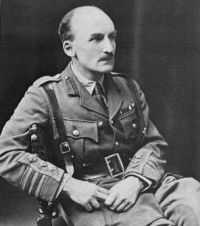
Amabel Williams-Ellis

Biographical details

Amabel Williams-Ellis The Tank Corps

As they moved a thousand concealed guns hailed down their fire upon the German line. Even through the din of the barrage and the clamour of their own engines the Tank crews could hear, as they advanced, the tearing and snapping of the German wire as they trampled it under them. The bewildered enemy was overwhelmed. He had only one last hope. Perhaps the wide trenches themselves would hold back this inexorable company!
But when each of the second line of Tanks stopped, ducked its head, laid its “stepping stone” in the trench and crawled easily over it, the enemy completely lost his balance.
Source: Gutenberg

Amabel Williams-Ellis The Tank Corps

If employment in the field was a struggle between policy and expediency, the principles of production and design represented a direct conflict of opposing policies, resulting happily in compromise. The fighting man, conscious of the weaknesses of the earlier weapons, and visualising development which he believed to be obtainable, and knew to be necessary, and the soldier-engineer overburdened with difficulties of maintenance and cursed with the nightmare of Spares and Spares and more Spares—both cried aloud from France for rapid progress in design.
Source: Gutenberg

Amabel Williams-Ellis The Tank Corps

More than once in the course of the chequered career of the Tanks it was this consideration which saved the Corps from extinction.
But it is not, of course, enough that the Tank offers protection to those who fight in it. A trench or a hole in the ground will do the same. But the Tank is essentially a mobile weapon of offence. It is the weapon for the nation which does not fight willingly, but when it fights, fights to win, and to win quickly with as little bloodshed as possible.
Source: Gutenberg

Get perspective with Kwize: daily news enlightened by great literature