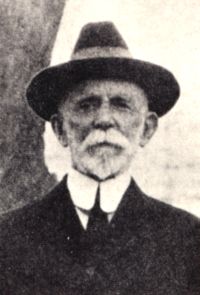
J. H. Emerton

Biographical details

Portrait of J. H. Emerton J. H. Emerton The Structure and Habits of Spiders

The spider walks on the nearest sound thread, and gathers in with her front-feet as much old web as she can tear off, and rolls it up with her palpi and mandibles into a ball, and, when it is tight enough not to stick to the web, drops it. As she walks along, gathering up the old web in front, she at the same time spins a new thread behind, and, when she gets to a suitable place, makes it fast as one of the rays of the new web. The common story has it, that the spider eats the old web.
Source: Gutenberg

Portrait of J. H. Emerton J. H. Emerton The Common Spiders of the United States

Sometimes the color is uniform all over the body, except that it is a little darker toward the head and the ends of the feet. The most common marking is a spot on the front of the abdomen over the spider's heart, sometimes merely a translucent part of the skin and sometimes a definite color spot darker in the middle and outlined with a lighter shade or white. The hinder half of the abdomen is often marked with several pairs of spots, becoming smaller toward the end, and these spots may be united into a pair of stripes or a more complicated pattern.
Source: Gutenberg

Portrait of J. H. Emerton J. H. Emerton The Structure and Habits of Spiders

Persons unfamiliar with spiders find it hard to tell young from old, and male from female. This is caused, in part, by the great differences between different ages and sexes of the same spider, on account of which they are supposed to belong to distinct species.
The adult males and females are easily distinguished from each other, and from the young, by the complete development of organs peculiar to each sex, which will be described further on.
Source: Gutenberg

Get perspective with Kwize: daily news enlightened by great literature