“ Everybody has seen a garden-spider trussing up a captured fly. It is held in the jaws and front legs and slowly revolved while with its hind legs the spider draws out bands of silk from the spinnerets and swathes it like a mummy. No silken rope, this, of fused or interwoven threads, but a broad band, every strand of which is separate and distinct and proceeds from a different spool. Two or three hundred fine threads wound simultaneously round the insect form a much more effectual winding sheet than would a single cord composed of them all. ”
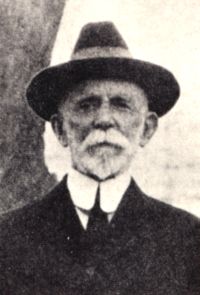
Cecil Warburton
Biographical details
Cecil Warburton (1854–1958), a British zoologist and entomologist, devoted his career to the study of arachnids and acarids, especially ticks of medical and veterinary significance. Educated at Cambridge and associated with organizations such as the Royal Agricultural Society and the Molteno Institute, he worked closely with G. H. F. Nuttall, contributing to foundational texts like Ticks: A Monograph of the Ixodoidea.
His most celebrated work, Spiders, investigates arachnid behavior through careful observation, exploring topics such as instinct, sensory development, and the complex mechanics of web-spinning. Warburton’s thorough empirical methods and vivid portrayals of spider ecology highlight his status as a pioneer in entomology, linking scientific research with engaging natural history.
Quotes by Cecil Warburton
“ Clearly as the egg-laying time approaches the spider feels an irresistible blind impulse to perform in a definite order certain complicated actions. It is like a machine actuated by an internal spring, and in the spider’s case the internal spring is the inherited nervous mechanism we call instinct, which urges it to actions which it is not in the least necessary that it should understand. ”
“ It is no doubt quite beyond our power to ascertain accurately the mental condition of a spider, but it is perfectly easy to make a few illuminating experiments on two points which have a very decided bearing on intelligence:—the development of the senses, and the degree of what has been called educability, or the power of learning from experience. To what extent can the spider see, hear, smell, feel, taste? ”
“ Now the fact that a newly-hatched garden-spider can make a complete snare without ever having seen the operation performed immediately relegates that action to the realm of instinct,—not less wonderful than intelligence perhaps, but certainly quite distinct from it. ”
“ The aerial portion of the web was always a puzzle, but now we know, thanks to Enock, that it constitutes the whole hunting ground of the spider. Like promises and pie-crust it is apparently made to be broken. If it is accidentally brushed against by a passing insect the spider is instantly aware of the fact, rushes to the spot, and transfixes the intruder with its powerful mandibles. It turns on its back to do this, and strikes the insect from behind, afterwards pulling its prey through the weft and into the tube by main force. ”
“ There is, then, in many of our lakes, ponds and slow-flowing rivers with a weedy bed, a spider which has entirely taken to a water life, and for which it is useless to search on land. It is a docile captive, and consequently a favourite subject for transference to an aquarium, where its habits can be observed at leisure. ”
“ They merely catch a spider, sting it to death, cut it to pieces with their jaws, and feed it into the mouths of their expectant grubs. The treatment is brutal enough, but at all events it is expeditious. Now the solitary “digger” wasps never see their young. They make cells, either by burrowing in the ground or by agglomerating particles of mud or gravel, and in each cell is placed an egg together with sufficient food to last the grub which hatches out for the whole of its larval existence. ”
“ A trap-door spider, then, does not go to work like a rabbit, or a terrier, scratching and kicking away the earth as it digs; it laboriously dislodges particles of soil with its powerful mandibles, and carries away the loosened fragments to deposit them at a distance. ”
“ We see, what we had not noticed before, that it is anchored to the fence by a silken line; indeed all the time it has been hunting it has been trailing behind it an exceedingly fine thread of silk which it has attached at frequent intervals to the fence, so that it can check its fall at will in the case of accident. At the right angle, we may see the delicate filaments glistening in the sun over the surface of its explorations. The garden-spider entangles its prey in a web, [Pg 81] the wolf-spider runs it down by sheer strength and speed, but the jumping spider stalks it like a Red Indian. ”
“ In their case the problem was to secure food for their larvae which should [Pg 70] remain fresh for many days, an instinct taught them to solve it in the most remarkable manner. The problem of the spider was different. It was a case of killing instantly, or being killed; a merely wounded bee is as formidable as one unharmed. What Fabre desired to know was this: did the spider trust to one invariable deadly stroke in dealing with the bee, as the solitary wasp, according to its species, had been found to act always precisely in the same way in paralysing its victim? ”
“ A male garden-spider courts the female at the risk of his life, and it is not surprising that he should evince [Pg 41] great hesitation and caution in his advances. If his attentions are unwelcome, or even if they have been accepted, he will be promptly trussed up and eaten unless he beats a hasty retreat. But with Agelena the conjugal relations are exemplary, and harmony reigns in the home. The question of food is certainly a difficulty, but if insects are let loose in the cage the spider will attend to the catching of them. In some cases raw meat has been found a satisfactory substitute. ”
“ Soon it begins to edge nearer in a stealthy manner, striving to approach its prey from behind, till, with a sudden spring, it pounces on its back. Not always is the spring successful; often the insect sees its peril at the last moment and takes to wing. But in this case, how does the spider avoid a fall? ”
“ A whole group of orb-weavers habitually decorate a sector of the snare with bands of flocculent silk, the object of which for a long time puzzled arachnologists, till it was observed that the spider drew upon this reserve supply of material to wrap up particularly obstreperous insects. It is not unusual for a spider of one of the common species to remove a whole sector of the snare, and by stretching a line from the centre to a place of retreat along the gap thus formed, to provide an unencumbered avenue between its home and its post when on duty. ”
“ They invariably lay their eggs on one spot—at the very front of the abdomen, near the cephalothorax, where the spider is powerless to dislodge them. The egg hatches out to a grub which is a veritable “old man of the sea” on the spider’s back, and there it remains until it causes the death of its victim by feeding on the contents of the abdomen. Four such Ichneumon flies have been found to attack the garden-spider, and no kind of spider seems exempt. How they contrive to deposit their eggs in the proper place without great danger of themselves falling a prey to their victims is a mystery. ”
“ For some time beforehand feeding ceases, and the animal becomes inert and apparently dead, but presently the integument splits, and out struggles the spider, pale and soft, and leaving behind it not only the outer skin but the lining of most of its alimentary canal and of its breathing tubes. Sometimes, as we have said, it fails to extricate itself and dies; quite often it emerges with the loss of a limb, which will reappear—reduced in size—at the next moult. It is necessary to go into retreat for a time after moulting, till strength has returned and the integument has hardened. ”
“ But if anything emerges from the study in which we have been engaged, it is surely this fact: that wherever there is a niche in nature capable of sustaining life, to that niche some animal will sooner or later adapt itself without any reference to man’s desires or interests. ”
“ A garden-spider in its web, or a burrowing spider in its tunnel are more or less formidable, but if the one can be thrown down, or the other dragged forth into the open, they are well-nigh defenceless. Therefore in attacking an Epeirid the wasp first darts at it, seizes a leg, and attempts to jerk it out of the web. If unsuccessful, the spider will now be on its guard, and the wasp leaves it and tries the same manœuvre on another individual. ”
“ The last joint or tarsus of the spider’s leg is very different in the two cases. It always terminates in claws—either two or three—so that any species can make some show of climbing where the surface is rough and there is anything to cling to, but to obtain a hold on a polished surface it needs a special contrivance. This takes the form of a pad of curiously modified hairs, called a scopula. The hairs are club-shaped, narrow at their stalk and swelling towards the tip, and their clinging power seems to be due to a viscid secretion. The foot of any jumping spider will show this structure well. ”
“ They live in holes in the ground or in trees, or sometimes in the fork of a tree-branch. In such hiding places they spend the hours of day-light, emerging at night in search of food. Their large size and uncanny appearance have attracted the attention of the collector, and a great many species are known, but the fact that they chiefly inhabit tropical countries has militated against any very extended study of their habits, and the few items of information we possess are best related with regard to the particular spider observed, and not taken as necessarily characteristic of the whole tribe. ”
“ Possibly different species of the genus behave in different ways, some being more truly aquatic than others, though it is certain that the troubled waters of a coral sea are not a very promising field for sub-aqueous operations. We know a great deal more of the mode of life of those Agelenids which have taken to living in fresh water. Indeed the subject of the water-spider, Argyroneta aquatica, is so hackneyed that in dealing with it we shall probably be telling the reader much of what he knows already, but that possibility must be risked. ”
“ And these impulses are not mere vague reminders that now is the time to spin a snare, or to weave an egg-cocoon; they prescribe precisely how it is to be done, involving perhaps a dozen different spinning operations in one unvarying order. Viewed in this [Pg 130] light, the germ of an insect or a spider would seem in a sense to be more complex than that of an animal whose vague instinctive impulses are under the direction of intelligence, and can be carried out in a variety of ways according to circumstances. ”
“ And this is what we should expect. A sedentary spider is informed of the whereabouts of its prey by the sense of touch, through the trembling of the web, but a wolf-spider spins no web and is dependent on the keenness of its vision. ”
“ Now when the dome-shaped web is ready to be filled with air the spider rises to the surface, lifts its abdomen above it, and brings it down with a flop, thus imprisoning an extra large air-bubble which it embraces with its hind-legs by way of holding it more securely, and then, swimming rapidly down by means of its other legs to the web it discharges its load of air beneath the downwardly directed mouth of the dome. ”
“ Not seldom it happens that the female is in no mood for dalliance, and a battle royal ensues, with disastrous results to both domiciles and the tube that connects them. The male, however, is in this case well able to hold his own, for he is larger than the female, a phenomenon elsewhere unknown in the spider realm. Argyroneta lives for some years, and makes two diving-bells each year—one near the surface in summer and one at a greater depth in winter. ”
“ The winter dome is of very dense silk, glossy in appearance, and giving the effect of a uniform sheet of silky material rather than a fabric. Moreover its mouth is closed, and the spider remains inactive within. It is this winter domicile that is most frequently found in the shells of molluscs. The egg-cocoon is also dome-shaped, having a convex upper and a flat under surface. The newly hatched young inhabit their mother’s tent for a time and then [Pg 52] set forth in the water to seek their living and set up establishments on their own account. ”
“ There is a waist, but no neck. The eight legs are attached to the cephalothorax, and the abdomen is not segmented or ringed like that of an insect, but entire, and bears at its extremity or on its under surface a little group of spinnerets or finger-like projections from which the spider’s silk proceeds. For the moment these three characteristics will suffice—the “waist” behind the leg-bearing portion of the body, the unsegmented, legless, abdomen, and the spinnerets (fig. 1 B) . A harvestman, for instance, lacks the waist, and its abdomen is segmented. ”
“ Now in the case of the tarantula, it is seven [Pg 74] months before they are able to fend for themselves. Meanwhile they eat nothing, and look on with indifference while their mother feeds. She not only carries them willingly, but exhibits solicitude when deprived of them, but she shows no discrimination as to her own offspring, and is quite content with those of another spider. The young, when brushed off, climb the legs of the nearest female, and a spider may thus be laden with thrice her proper load without any protest. ”
“ As a rule the circular snares of the different British species are of a very uniform pattern, [Pg 31] differing chiefly in the degree of neatness with which they are constructed, and in certain minor details of the “hub,” but we have one spider, Hyptiotes paradoxus—an exceedingly rare species, scarcely ever seen beyond the limits of the New Forest—which makes such a strange snare that it seems a pity to omit all mention of it. It consists of a sector—about one sixth of the full circle—comprising about four radii with cross lines. ”
“ We have seen spiders, all built on the same ground-plan, so to speak, and with the same essential organs, so modified in the details of structure and inherited instincts as to be able to thrive under the most diverse conditions. Think, for instance, of the water-spider and the desert Tarantula, or consider the difference in mode of life between the sedentary garden-spider and the hunting Attid. ”
“ But is it necessary to restore to the spider her own cocoon? Will not that of another spider serve as well? Certainly it will; a wolf-spider will eagerly adopt the cocoon of a spider even belonging to a different genus, if not greatly unlike her own in size. Nay, even a ball of pith of the same size will be attached with alacrity to the spinnerets, though if offered a choice between a cocoon and a pith ball the spider, after some hesitation, selects the real article. One spider even accepted a cocoon into which a leaden shot had been inserted, making it many times its original weight. ”
“ The tragic fate which sometimes overtakes the male spider has so hit the popular imagination that there is a general impression that the female spider is a confirmed misanthrope and desires the life of any suitor bold enough to approach her. Not at all! We have simply to remember that spiders are carnivorous and prone to cannibalism. If the female happens to be hungry she makes no nice discrimination between an amorous male and a succulent grass-hopper ”
“ A slight excess, and the animal is killed; too timid a thrust will not destroy movement. When the delicate operation has been successfully performed, the paralysed spider is dragged into the cell, placed on its back, and an egg carefully deposited at the base of its abdomen, after which the cell is sealed up. Some wasps, instead of providing a single large spider, store their cells with a number of smaller victims, all rendered limp and motionless. ”
“ One genus, appropriately named Pirata, is semi-aquatic, living at the margins of rivers and ponds, and able to run on the surface of the water, but most of the Lycosidae prefer dry land—the dryer the better. Heaths, sandhills, bare and stony stretches of soil, even deserts, are fertile in examples of this group. Most of the smaller species love the sunlight, and it is often noticeable on a bright day, when the ground seems to be alive with wolf-spiders, that a chance cloud obscuring the sun will cause them to disappear as if by magic. ”
“ Certainly spiders prey as a rule on insects and no doubt kill many which might injure us, and in the constant battles between man and insect pests, instances have been recorded where particular species of spider have fought on the side of man with appreciable effect. But then they are as likely to devour our insect friends as our insect enemies, impartially slaying the just together with the unjust, so that little stress can be laid on their utility on this score. ”
“ It was far otherwise with a wolf-spider in the same cage. Running towards the Dugesiella it was clearly aware of it at a distance of several inches, and could not be persuaded to approach nearer. But the supremacy of the sense of touch is most striking when the spiders are courting. When the male is seeking the female he seems quite unaware of her proximity unless he accidentally brushes up against her. If he loses contact for a moment he is quite at sea and wanders blindly about, turning, perhaps, to the left when the least motion to the right would bring them together again. ”
“ The actions of the spider make it quite evident that its power of sight is well developed. Mr and Mrs Peckham, whose remarkable observations on the mating habits of jumping spiders must presently be considered, established friendly relations with some of their captives which became so tame as to jump on their hands and take food from their fingers. They frequently induced them to jump from a finger of one hand to one of the other, gradually increasing the distance up to eight inches. They also twice observed a male chasing a female upon a table covered with jars, books and boxes. ”
“ It can hardly be doubted—though of course it is incapable of proof—that all the more complicated spinning operations originated in this universal spider habit, but all known spiders have learnt to apply their power of making silk to other purposes. If they do not make snares they at least spin “cocoons” for the protection of their eggs, and if they have a definite home from which they emerge to seek food, such a retreat is always more or less lined with silk. It is clear that a spider cocoon is quite different from that of an insect ”
“ There is no doubt at all that the sense of touch is extremely well developed in spiders, especially perhaps, in the sedentary groups, and it is probable that, under ordinary circumstances, the garden-spider works almost entirely by its guidance. Whether in the centre of the web or in its retreat under a neighbouring leaf it is in direct communication with every part of its snare by silken lines, and the least disturbance usually suffices to bring it to the spot ”
“ True hibernation, if it ever occurs, is not the rule among spiders, and there is no time of the year when some species may not be found at work. Beat trees or bushes over an old umbrella, or sweep grass and herbage with a sweeping net in summer, and you will never draw a blank—some spiders are sure to be found. In winter such measures are profitless, but if you take the trouble to grub among ground vegetation, or shake fallen leaves over a newspaper, or search under stones or logs of wood you will have no difficulty in finding spiders enough, and by no means dormant. ”
“ Circumstantial accounts of deaths from the bite of a spider are countered by the assertions of experimenters that they have allowed themselves to be bitten repeatedly by the same species without suffering any inconvenience. There is at all events some basis for the popular view in the fact that all spiders possess a poison gland which is analogous to that of the snake inasmuch as it opens near the tip of the fang which is plunged into the animal attacked. ”
“ The swift motion and predaceous habits have earned them the [Pg 59] name of wolf-spiders, but though they sometimes occur in incredible numbers so that it seems impossible to avoid treading upon them, they do not hunt in packs; each one is entirely concerned with his own individual quarry. They are moderate-sized or large spiders—commonly about half an inch long in this country though there are exotic species which attain an inch and a quarter—and in build they are very unlike the garden-spider, being elongate, and with the abdomen nothing like so globular. ”
“ Indeed there is quite as good a case to be made out of man benefiting spiders as of spiders benefiting man, for his architectural proclivities have provided some species with secure homes from which [Pg 128] most of their enemies—except man himself—are excluded, and where they are sheltered from the storms which are so fatal to their relatives outside, protected from extremes of temperature, and rendered so independent of times and seasons that the number of broods they produce in the year has increased. Whether a creature is useful or injurious is entirely a matter of the point of view. ”
“ All spiders spin, but it is by no means all spiders that make snares for the purpose of catching prey. The fundamental purpose of the spinning organs seems to be to connect the spider with its point of departure. The jumping spiders (Attidae) make no snare, but this “drag-line” as it has been called comes in very useful when stalking prey on the vertical surface of a wall, when a miscalculation at the moment of pouncing upon it would entail a considerable fall were it not for such an anchorage. ”
“ Our quarry is of small size, not more than a quarter of an inch long in the body, which resembles that of the wolf-spiders in build, the abdomen not rising above the level of the fore-body or cephalothorax. It is thickly clothed with short hairs—black, white, and grey—so arranged as to show oblique zebra-like stripes on either side of the abdomen. The legs are short and robust, very different from the long thin limbs of the garden-spider; especially strong are the fore-legs. ”
“ The best way to capture a spider for examination is to induce it to run up into a small glass specimen tube—for spiders readily part with their legs if handled roughly—and if we have adopted this method we shall see the spinnerets in use as the animal crawls about the tube. It will not move without first attaching a silken cable to the glass, and this cable lengthens as the spider progresses, so that before long the interior of the tube will be a network of silken threads, and its sides will be flecked with little white specks where the threads have been re-attached for a new departure ”
“ When an insect impinges on the web and causes it to tremble, the spider immediately lets go with its fore legs, and the consequent vibration of the web helps to entangle its prey.The circular snare is the highest form of spinning work attained by spiders, and there is little temptation to expend much time in studying the cruder structures that meet the eye everywhere, but two other types are worth a brief notice. ”
“ There is the line which most spiders lay down as they wander, and which secures them from the danger of a fall if they lose their footing; there is the snare for catching prey, the nest or retreat, and the egg-cocoon, and in addition, silk from the spinnerets may be used to enwrap and paralyse captured insects, or to assist the young spider to migrate. ”