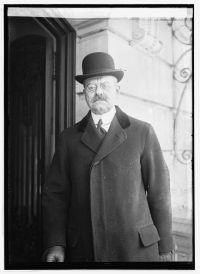
John Dyneley Prince

Biographical details

Portrait of John Dyneley Prince John Dyneley Prince,  The Russian Review (1916)

“ There is no use in sending men to deal with Russia who do not speak Russian, and in this, the Germans showed their wisdom. In no language in the world are there so thorough and so scientifically arranged grammars and handbooks of Russian as are found in German. Most unfortunately for the English-speaking peoples, there is not as yet in our tongue a single satisfactory grammar of Russian from the scientific point of view, so that in Columbia we are forced at the present moment to work under a great disadvantage with students who can read neither German nor French. ”
Source: Wikisource

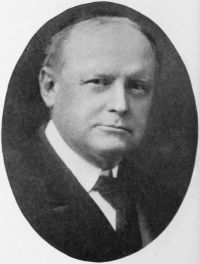
Portrait of John Dyneley Prince John Dyneley Prince,  1911 Encyclopædia Britannica (1911)

“ In a great number of Babylonian inscriptions an idiom has long been recognized which is clearly not ordinary Semitic in character. This non-Semitic system, which is found, in many instances, on alternate lines with a regular Semitic translation, in other cases in opposite columns to a Semitic rendering, and again without any Semitic equivalent at all, has been held by one school, founded and still vigorously defended by the distinguished French Assyriologist, Joseph Halévy, to be nothing more than a priestly system of cryptography based, of course, on the then current Semitic speech. ”
Source: Wikisource

Portrait of John Dyneley Prince John Dyneley Prince,  1911 Encyclopædia Britannica, Volume 1… (1911)

“ The usual signs denoting Akkadū in the Semitic narrative inscriptions were read in the non-Semitic idiom uri-ki or ur-ki, “land of the city,” which simply meant that Akkadū was the land of the city par excellence, i.e. of the city of Agade of Sargon I., which remained for a long period the leading city of Babylonia. [3]
It is quite probable that the non-Semitic name Agade may mean “crown (aga) of fire (de) ” [4] in allusion to Ištar, “the brilliant goddess,” the tutelar deity of the morning and evening star and the goddess of war and love, whose cult was observed in very early times in Agade.
”
Source: Wikisource

Get perspective with Kwize: daily news enlightened by great literature