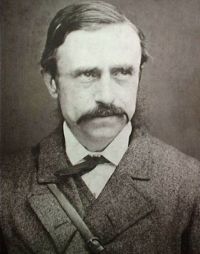
John Magens Mello

Biographical details

John Magens Mello,  Popular Science Monthly (1876)

“ When magnified and examined with the polariscope, a thin section of granite is a very beautiful object, and its different constituent parts stand revealed with the greatest distinctness: we at once learn to see the crystals of feldspar, somewhat opaque and cloudy as they usually are in granite, but now and then clear and beautifully striped, and also the crystals of mica, imbedded in the clear quartz, which will be at once known by its bright clear colors and by the margin of rainbow-like tints which border its patches. ”
Source: Wikisource

John Magens Mello,  Popular Science Monthly (1876)

“ Now, when we examine our granite beneath the microscope, which can be done by having thin slices prepared, we shall learn something about it which we could hardly hope to have discovered without this aid. There has been much speculation as to the origin of granite, whether it is a plutonic—that is, an old volcanic rock—or whether it is only a deposit from water consolidated and altered during the lapse of long ages by heat and pressure: the microscope will help us to the truth. ”
Source: Wikisource

John Magens Mello,  Popular Science Monthly (1883)

“ Among the most varied and beautiful forms of quartz which have had a purely aqueous origin are all the varieties of crystalline and amorphous silica, which frequently coat the interiors of geodes and other hollow spaces in the igneous rocks, and which consist chiefly of an intermingling of chalcedony and jasper, and are conveniently grouped under the general name of agates. Pure rock-crystal, amethyst, cairngorm, and other valuable crystallized forms of quartz, are often found in connection with the same rocks, or in others of a more purely metamorphic character. ”
Source: Wikisource

Get perspective with Kwize: daily news enlightened by great literature