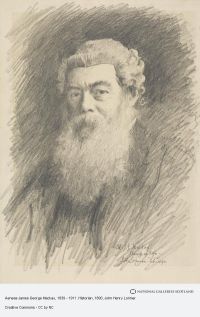
Thomas Finlayson Henderson

Biographical details

Thomas Finlayson Henderson Dictionary of National Biography… (1885)

For some years he remained the sole survivor of the old literary society of Edinburgh, whose mild splendours were eclipsed by the brilliant achievements of the succeeding generation with whom he mingled during the latter period of his life. He was among the last of the Scotch gentlemen who combined in their manners dignity and grace with a homely simplicity now for ever lost, and could make use of the graphic and strong vernacular Scotch in the pure and beautiful form in which, for many years after the union, it continued to be the current speech of the Scotch upper classes.
Source: Wikisource

Thomas Finlayson Henderson Dictionary of National Biography… (1886)

Ireland is not at peace. It is smothered war. England has sown her laws as dragon's teeth, and they have sprung up as armed men.’ The tumultuous applause provoked by this imagery was taken up by the gallery, from which it was thundered to the crowd at the door, and as the import of the words passed from mouth to mouth, they caused a thrill of excitement through the whole city.
Source: Wikisource

Thomas Finlayson Henderson 1911 Encyclopædia Britannica (1911)

At the same time he saves himself from the dangers of abstract and rash theorizing by a deep and absolute regard for facts, the diligent and accurate study of which he makes of the first importance to the proper use of reason. “The general and perpetual voice of men is,” he says, “as the sentence of God Himself. For that which all men have at all times learned, nature herself must needs have taught; and, God being the author of nature, her voice is but His instrument.”
Source: Wikisource

Get perspective with Kwize: daily news enlightened by great literature