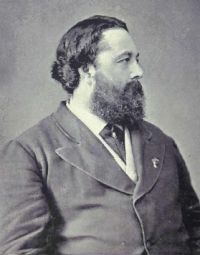
Thomas Sterry Hunt

Biographical details

Portrait of Thomas Sterry Hunt Thomas Sterry Hunt Popular Science Monthly (1883)

The law of birth, growth, and decay, of endless change and perpetual renewal, is everywhere seen working throughout the cosmos, in nebula, in world and in sun, as in rock, in herb, and in man; all of which are but passing phases in the endless circulation of the universe, in that perpetual new birth which we call Nature. This, it will be said, is the poet's view of the external world, but it is at the same time the one which seems to me to be forced upon us as the highest generalization of modern science.
Source: Wikisource

Portrait of Thomas Sterry Hunt Thomas Sterry Hunt Popular Science Monthly (1883)

Newton, Darwin, Faraday, Henry, and such as they, were not inspired by a desire for the praise of men, or for pecuniary reward, but pursued their life-long labors with higher motives; the love of truth for its own sake, the reverent desire to comprehend the hidden laws and operations of the universe. To such, and to such alone, does Nature reveal herself.
Source: Wikisource

Portrait of Thomas Sterry Hunt Thomas Sterry Hunt Popular Science Monthly (1874)

AMONG the most significant advances in chemical theory are those relating to the action of heat on bodies. If we define chemistry, as I have been tempted to do, as that science which treats of the relations to one another of the different forms of mineral (i. e., unorganized) matter, and their transformations under the physical agencies of heat, light, and electricity, we shall see how difficult it is, in a sketch like this, to draw the line between physics and chemistry.
Source: Wikisource

Get perspective with Kwize: daily news enlightened by great literature