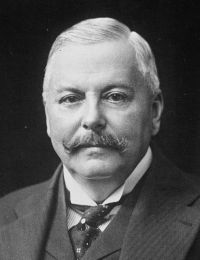
William Abbott Herdman

Biographical details

William Abbott Herdman,  1911 Encyclopædia Britannica (1911)

“ The branchial sac is simply an enlarged pharynx with two ventral ciliated openings (stigmata) leading to the exterior. There is no separate peribranchial cavity. The nervous system consists of a large dorsally placed ganglion and a long nerve cord, which stretches backwards over the alimentary canal to reach the tail, along which it runs on the left side of the urochord. The anus opens ventrally on the surface of the body in front of the stigmata. No reproduction by gemmation or metamorphosis is known in the life-history. ”
Source: Wikisource

William Abbott Herdman,  Encyclopædia Britannica, Ninth Edition (1888)

“ Free-swimming pelagic forms which may be either simple or compound, and the adult of which is never provided with a tail or a notochord. The test is permanent and may be either well developed or very slight. The musculature of the mantle is in the form of more or less complete circular bands, by the contraction of which locomotion is effected. The branchial sac has either two large or many small apertures, leading to a single peribranchial cavity, into which the amis opens. Alternation of generations occurs in the lifehistory, and may be complicated by polymorphism. ”
Source: Wikisource

William Abbott Herdman,  1911 Encyclopædia Britannica (1911)

“ Many of the forms reproduce by geminmation, and in most of them the sexually-produced embryo develops into a tailed larva.
The Ascidiacea includes three groups—the simple Ascidians, the compound Ascidians and the free-swimming colonial Pyrosoma.
Sub-Order I.—Ascidiae simplices.
Fixed Ascidians which are solitary and very rarely reproduce by gemmation; if colonies are formed, the members are not buried in a common investing mass, but each has a distinct test of its own. No strict line of demarcation can be drawn between the simple and the compound Ascidians, and Simple Ascidians.
”
Source: Wikisource

Get perspective with Kwize: daily news enlightened by great literature