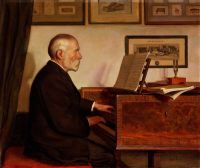
Alfred James Hipkins

Alfred James Hipkins

Summary

Portrait of Alfred James Hipkins Alfred James Hipkins A Dictionary of Music and Musicians (1900)

Still, to tune the groundwork of a piano to a carefully measured set of chromatic tuning forks, such as Scheibler formerly provided, would ensure a nearer approach to a perfect equal temperament than the existing system of fourths and fifths, with the slight flattening upwards of fifths and downwards of fourths, to bring all within the perfect octave. But to achieve this, a normal pitch admitting of no variation is a sine quâ non, because no tuner would or could give the time to work by a set of forks making beats with the pitch wanted.
Source: Wikisource

Portrait of Alfred James Hipkins Alfred James Hipkins A Dictionary of Music and Musicians (1900)

By the phenomena of beats between two notes heard at the same time we can make much finer distinctions, which are of great use in tuning the organ and harmonium; but with the piano we may not entirely depend upon them, and a good musical ear for melodic succession has the advantage. In fact the rapid beats of the upper partial tones frequently prevent the recognition of the slower beats of the fundamental tones of the notes themselves until they become too faint to count by. The tuner also finds difficulty in tuning the treble of a piano by beats only.
Source: Wikisource

Get perspective with Kwize: daily news enlightened by great literature