Keyboard

Definition and stakes

Various,  The Art of Music - Vol. 7 (of 14… (1915)

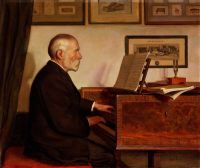
“ The third variation gives the theme to the left hand, and the right flies up the keyboard in arpeggios and down in scales, at a high rate of speed. From here the music expands freely into a sort of fantasia. Fundamentally there are still variations, but they are not cut off definitely from each other. Notice from here on, likewise, some excellent writing for the keyboard, something of an independent and melodious part for the left hand, brilliant chromatics, trills, and runs that drop in whirling circles, tremolos, filigree scales over smooth basses à la John Field. ”
Source: Gutenberg

Archibald Williams,  The Romance of Modern Invention

“ The Monotype, like the Linotype, aims at speed in composition, but in its mechanism it differs essentially from the linotype. In the first place, the apparatus is constructed in two quite separate parts. There is a keyboard, which may be on the third floor of the printing offices, and the casting machine, which ceaselessly casts and sets type in the basement. Yet they are but one whole. The connecting link is the long strip of paper punched by the keyboard mechanism, and then transferred to the casting machine to bring about the formation of type. The keyboard is the servant of man ”
Source: Gutenberg

Kathleen Schlesinger,  1911 Encyclopædia Britannica (1911)

“ The two principal types of keyboard instruments are the organ and the piano; their keyboards, although similarly constructed, differ widely in scope and capabilities. The keyboard of the organ, a purely mechanical contrivance, is the external means of communicating with the valves or pallets that open and close the entrances to the pipes. As its action is incapable of variation at the will of the performer, the keyboard of the organ remains without influence on the quality and intensity of the sound. ”
Source: Wikisource

Get perspective with Kwize: daily news enlightened by great literature