
“ The Tuxedo, which is the essential evening dress of a gentleman, is simply the English dinner coat. It was first introduced in this country at the Tuxedo Club to provide something less formal than the swallow-tail, and the name has clung ever since. To a man who can not afford to get two suits of evening clothes, the Tuxedo is of greater importance. It is worn every evening and nearly everywhere, whereas the tail coat is necessary only at balls, formal dinners, and in a box at the opera. ”
Tuxedo
Definition and stakes
The theme of “tuxedo” has been addressed by authors such as Emily Post, Kurt Vonnegut, Charles Reynolds Brown, Jane Warren Wells and Joseph Triemens. It is often associated with terms like trousers, clothing, dress, shirt and coat.
Quotes about “tuxedo”
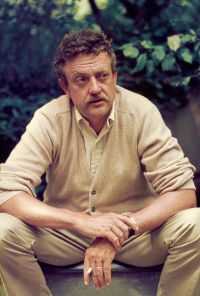 Kurt Vonnegut,
Breakfast of Champions
(1973)
Kurt Vonnegut,
Breakfast of Champions
(1973)
“ “Maybe they invited me because they know I have a tuxedo,” he said. ”
Charles Reynolds Brown, The Cap and Gown (1910)
“ The simple pleasures are the best for everybody and especially so for young people. The tuxedo is not a suitable garment for a five-year-old boy even though his father is able to buy him a hundred of them ”
Jane Warren Wells, Dress and Look Slender
“ The Tuxedo panels of the black dress are designed as part of the collar, in scarf effect, thus giving a youthful line rather than a heavy, collar trim and one that can be worn by all but full bust figures. 149 YOUTHFUL STYLES TO AVOID Don’t be tempted to buy a bright colored cheviot suit when a navy charmeen or a smart black and white stripe would be much more distinctive and slenderizing.Don’t let any one make you look old. Avoid bulk in your clothes, such as heavy skirts, bulging ornaments, ruffles, frills and flounces. Learn to delight in slenderizing. ”
Joseph Triemens, The Handy Cyclopedia of Things Worth Knowing
“ The informal evening suit includes the shorter dinner jacket or Tuxedo, as it was formerly called, and, strictly speaking, this is only considered proper for the club or for parties where ladies are not expected to be present. However, men who commonly dress for dinner in the home circle generally prefer the dinner jacket to the long coat, and well-dressed men are often seen wearing it at small dinner parties, at the theater or at any informal evening event. ”
“ Proper Theater ClothesAt the evening performance in New York a lady wears a dinner dress; a gentleman a dinner coat, often called a Tuxedo. Full dress is not correct, but those going afterwards to a ball can perfectly well go to the theater first if they do not make themselves conspicuous. A lady in a ball dress and many jewels should avoid elaborate hair ornamentation and must keep her wrap, or at least a sufficiently opaque scarf, about her shoulders to avoid attracting people's attention. A gentleman in full dress is not conspicuous. ”
Reginald Harvey Arnold, Simplex Munditiis, Gentlemen
“ For wear with Tuxedo or Cowes body-coat, or the dress body-coat at informal affairs, theater, club, or home dinners, the black satin cravat—self-tying—is the proper thing. It may be once or twice around as you like. Never wear this cravat with a white waistcoat or white sash. [63] WALKING STICK AND UMBRELLA The walking stick is worn with morning wear, afternoon dress, but never with evening dress.The styles are ever changing. Sticks are worn in summer and winter. In selecting sticks do not take the extremes in heavy or light. Never have any metal but silver—it is the most elegant. ”
Isabel De Nyse Conover, A Complete Course in Dressmaking (1922)
“ To make the collar pattern, trace the front and the upper part of the back onto another piece of paper. Trace the front first, tracing along the sewing line, that is, without seams. Then, trace the upper part of the back without seams, keeping the shoulder edges even. (See Fig. 61.) Mark the outline of the collar as indicated by the AB. This gives a collar that lies flat on the dress. If you want a collar to roll high in the back, use just a straight fold of goods. Fig. (61) A diagram for making a Tuxedo collar To make the lining pattern, use your block pattern, as shown in Fig. ”
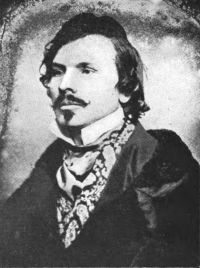 Mayne Reid,
Odd People: Being a Popular Description of Singular Races of Man
Mayne Reid,
Odd People: Being a Popular Description of Singular Races of Man
“ Some of the very poorer people wear nothing but a short woollen tonic or shirt, with a pair of coarse woollen drawers. Others, in place of this shirt, are clad in a longer garment, a sort of robe or wrapper, like a gentleman’s dressing-gown, made of camel’s-hair cloth, or some coarse brown woollen staff. But the true Turcoman costume, and that worn by all who can afford it, consists of a garment of mixed silk and cotton,—the baronnee,—which descends below the knee, and though open in front, is made to button over the breast quite up to the neck. A gay sash around the waist adds to the effect ”
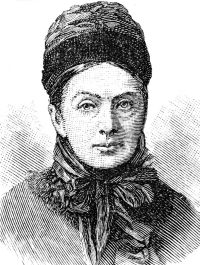 Isabella L. Bird,
Journeys in Persia and Kurdistan…
Isabella L. Bird,
Journeys in Persia and Kurdistan…
“ The under-garment is a coloured shirt, over which is worn a sleeved waistcoat of a different colour, and above this is an open-fronted coat reaching to the knees. Loose trousers, so full as to look like a petticoat, are worn, and frequently an apron and a heavy silver belt are added. The head-dress is very becoming, and consists of a raised cap of cloth or silk, embroidered or jewelled, with a white muslin veil over it and the head, but the face is exposed, except in the case of married women, who draw a part of the veil over the mouth. It is not proper that the hair should be seen. ”
active 1803-1825 William Bennet Stevenson, Historical and descriptive narrative of twenty years' residence in South America…
“ The dress of the men is generally a pair of pantaloons of blue cotton, dyed tocuyo, a white or blue shirt hanging loose on the outside of the pantaloons, and a large straw hat. The women wear a piece of blue cotton or woollen cloth wrapped round the waist, and reaching down to their knees, also a shirt, or more commonly a handkerchief, having two of the corners tied together at the back of the neck, while the handkerchief hangs down before; when at work, or in their houses, both men and women generally throw off the shirt. ”
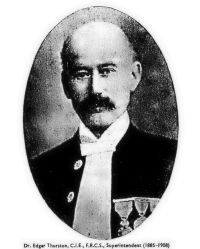 Edgar Thurston,
Castes and Tribes of Southern India
(1909)
Edgar Thurston,
Castes and Tribes of Southern India
(1909)
“ The males dress like the low-country people, with cloths about four cubits long extending from the hip to the knee. Another cloth, about one or two cubits in length, is put over the back, one end of which passes under their right arm and the other over the shoulder, both meeting in front over the chest, where they are tied together in a peculiar knot by folding the extremities, thus forming a bag wherein to contain their wayside necessaries. ”
Dion Clayton Calthrop, English Costume
“ At the back men and women in hoods and wimples, in short tunics and loose gowns. A very brightly-coloured picture, though the dyes of the dresses be faded by rain and sun—they are the finer colours for that: Master Tousell, no doubt, in a short tunic for riding, with his loose coat on him, the heavy hood back, a little cap on his head; the workmen with their tunics off, a twist of coloured stuff about their waists, their heads bare. ”
The Crimson Conquest: A Romance of Pizarro and Peru
“ The costume was that of a Peruvian noble: a shirt of white cotton, another of white wool, and a loose, sleeveless tunic, handsomely woven in rich colors and conventional design, to be belted in at the waist, leaving its skirts falling as a kilt almost to the knees. There was a girdle—a broad band, highly ornamental in its woven pattern, heavily fringed with flat braids of cord, each of half the breadth of a hand, and reaching to the bottom of the tunic. ”
M. H. Spielmann, The History of "Punch"
“ However new, however good the tailor, however comely the leg beneath, the Trouser is the one heart-breaking object to the conscientious but æsthetically-minded draughtsman on wood! It ignores the knee, and falls on the boot in a shape that has no reference to the ankle whatever—a shape of its own—and yet the ankle is the foundation of everything! ”
Various, The Atlantic Monthly, Volume 20…
“ The younger men are of inferior stature, and nearly all bow-legged. They have turned the flowing trousers into modern pantaloons, the legs of which are cut like the old-fashioned gigot sleeve, very big and baggy at the top, and tied with a drawing-string around the waist. My first impression was, that the men had got up in a great hurry, and put on their trousers hinder-end foremost. ”
“ A stripe of intricately patterned gold lace runs down the seams of the trousers, which latter, tight-fitting at the top, are adjusted very closely at the calf of the leg. For riding in rough country a further leg-covering is worn ”
 Nathaniel Hawthorne,
Passages from the French and Italian Notebooks…
Nathaniel Hawthorne,
Passages from the French and Italian Notebooks…
“ The broad-brimmed, high-crowned hat of Tuscan straw is the customary female head-dress, and is as unbecoming as can possibly be imagined, and of little use, one would suppose, as a shelter from the sun, the brim continually blowing upward from the face. ”
Florence Finch Kelly, With Hoops of Steel
“ Another man stood a little way off with leveled gun, apparently relieving guard for the first. He was in the shade of a tall mesquite bush, but Tuttle could see that he was of medium height and build and was dressed in a Mexican suit of closely fitting, braided trousers and jacket. The wide brim of his Mexican sombrero was pulled low over his eyes, so that only the lower part of his face could be seen, and that dimly. But it was evidently dark-skinned, and the mouth was shaded by a black mustache. “Some Greaser scalawag,” was Tuttle’s immediate decision. ”
Various, Tales from "Blackwood," Volume 8
“ The foremost rider was a cavalier scarce twenty years, apparently, of age; clad simply, but elegantly, in the travelling dress of a Tuscan gentleman of that day. His vest, which was of the richest velvet, slashed and embroidered in the fashion of the time, was covered, on back and breast, by the strong “Jazeran,” or scaled corslet, which was the armour then generally worn in Italy, and which, while it was less cumbrous than complete steel, was yet fully proof against the thrust either of lance or poniard. ”
Edgar Thurston,
Castes and Tribes of Southern India
(1909)
“ Females wear two pieces of cloth, nine and two and a half cubits in length respectively, and folded in the middle. The larger is the lower garment, and the smaller upper garment is worn with two ends tied around the neck. Males wear brass finger and toe-rings, sometimes of silver. ”
 Robert Tressell,
The Ragged Trousered Philanthropists
(1914)
Robert Tressell,
The Ragged Trousered Philanthropists
(1914)
“ As Sweater paused, a thrill of horror ran through the meeting. Men wearing broken boots and with patches upon the seats and knees, and ragged fringes round the bottoms of the legs, of their trousers, grew pale and glanced apprehensively at each other. If ever Socialism did come to pass they evidently thought it very probable, that they would have to go without any trousers or boots at all. ”
 Nellie Bly,
Six Months In Mexico — Chapter VII.
(1889)
Nellie Bly,
Six Months In Mexico — Chapter VII.
(1889)
“ Ladies wear beautiful costumes, dark habits, short skirts, silver and gold buttons, and broad sombreros. Men display greater variety of costumes; some wear yellow buckskin suits trimmed with gold or silver, others have a drab skin suit artistically trimmed, still others wear light cloth suits and high boots, buttoned at the side, and reaching the knee. A belt holding a revolver, and a Mexican saddle to which is fastened a sword complete this beautiful riding suit. ”
 Aldous Huxley,
Crome Yellow
(1921)
Aldous Huxley,
Crome Yellow
(1921)
“ He decided to wear white flannel trousers—white flannel trousers and a black jacket, with a silk shirt and his new peach-coloured tie. And what shoes? White was the obvious choice, but there was something rather pleasing about the notion of black patent leather. ”
 Fanny Fern,
Fern Leaves from Fanny's Port-folio…
Fanny Fern,
Fern Leaves from Fanny's Port-folio…
“ When a masculine comes in with a white vest, flashy neck-tie, extraordinary looking plaid trousers, several yards of gold chain festooned over his vest, and a mammoth seal ring on his little finger, you may be sure that his tailor and his laundress are both on the anxious seat; and whenever you see travelers of either sex peregrinating the country in their “best bib and tucker,” you can set them down for unmitigated “snobs,” for high-bred people can’t afford to be so extravagant! ”
 Ivan Sergeevich Turgenev,
Virgin Soil
Ivan Sergeevich Turgenev,
Virgin Soil
“ He had on a long-skirted, shabby, yellowish nankin coat, with small buttons and a high waist; his hair was dressed in the Russian fashion with a parting straight down the middle; he had a blue kerchief round his neck, in his hand he held a cap with a broken peak, on his feet a pair of dirty leather boots. “Heavens!” Mariana exclaimed. “How ugly you look!” and thereupon threw her arms round him and kissed him quickly. “But why did you get yourself up like this? You look like some sort of shopkeeper, or pedlar, or a retired servant. Why this long coat? Why not simply like a peasant?” ”
“ You will think the gentlemen were fine dandies in those Mexican days, when I tell you that they often wore crimson velvet knee trousers trimmed with gold lace, embroidered white shirts, bright green cloth or velvet jackets with rows and rows of silver buttons and red sashes with long streaming ends. ”
Henry Frith, In the Yellow Sea
“ The trousers, tunic, or kirtle, need no decided measurement, for one measure is sufficient for each garment, as from hip to ankle, or from neck to the knees, as the case may be. In winter, wadding is quilted into the clothes, and several suits worn over the innermost, so that a man may be apparently stout until unrolled, or undressed. The suits wear for years, as the fashion of the Chinese passeth not away ”
“ Fig. 17.—Fourteenth century.A very tight-fitting suit called Justacorps [78] came into use from the 12th century, and developed a padded round-shaped body towards the end of the 14th century; the closely-cut body was buttoned up to the throat, or was set with a high collar for the first time. The tights came over it, sometimes rather high up the waist, being laced to it. A long tunic was chiefly favoured during the 10th and 11th centuries with short or long cuffless sleeves, and a full bell-shaped falling sleeve showed a close-fitting under one. ”
 James Justinian Morier,
The adventures of Hajji Baba of Ispahan…
(1824)
James Justinian Morier,
The adventures of Hajji Baba of Ispahan…
(1824)
“ I tied on my trousers with the air of a man of fashion, and when I heard the rustling of my vest, I turned about in exultation to see who might be looking at me. My shawl was wound about me in the newest style, rather falling in front, and spread out large behind, and when the dagger glittered in my girdle, I conceived that nothing could exceed the finish of my whole adjustment. ”
 Ada S. Ballin,
Science of Dress
(1885)
Ada S. Ballin,
Science of Dress
(1885)
“ The middle part of the body is, however, overheated, for it is covered by the tops of the petticoats and drawers fastening close round with bands, by the stays, chemise, and sometimes vest. The neck and arms are, as a rule, quite as badly protected as the legs, for they have only the thickness of the dress over them, as the vest and chemise are cut low in the neck and short in the sleeves, and high petticoat bodices are not always worn. ”
George Alexander Thompson, Narrative of an Official Visit to Guatemala from Mexico (1829)
“ The men have seldom any clothing on down to the waist except the shirt: a loose pair of roughly tanned, brown chamoise breeches, open at the knees, makes up the extent of their toilette: they nevertheless wear their hair parted like the women, or suffer it to hang down in short curls like those which seem to be prescriptively appropriate to the temples of an English tar ”
Portal:The Folk-Lore Society, Folk-Lore (1909)
“ Pendants of tusks or of the canine teeth of some animal, such as the four shown in the top row in Fig. 8, are, I am told, largely bought as a protection by men who tend wild animals in shows etc. The middle object in the top row is a cornelian mounted in metal and worn by Jewesses as a charm against the evil eye, and the second row consists of a boot, two canine teeth, and a tusk. ”
 Eliza Davis Aria,
Costume: Fanciful, Historical, and Theatrical…
(1906)
Eliza Davis Aria,
Costume: Fanciful, Historical, and Theatrical…
(1906)
“ A typical costume is evolved from a long, straight piece of material wound round the body from the waist downwards, and drawn between the legs to form a trouser-like division. A shawl, draped about the upper portion of the figure, is manipulated in such a way as to cross on the left shoulder, one end hanging in front and the other behind. A shako-shaped turban and a chaplet of beads put the finishing touches, while on the forehead, breast, and bare arms the mark of the sect is painted with white powder. ”
Various, Punch, or the London Charivari…
“ Although it is generally imagined that the coat is the principal article of dress, we attach far greater importance to the trousers, the cut of which should, in the first place, be regulated by nature’s cut of the leg. A gentleman who labours under either a convex or a concave leg, cannot be too particular in the arrangement of the strap-draught. ”
