“ Pure ornament, like pure language, should be simple in its construction and expression, clear in its meaning, with just sufficient embellishment about it to interest the imagination, leaving the intention honestly revealed to the passing glance. The truest lines of grace are the plainest; the most majestic designs are those freest from detail; the greatest charm about the disposal of drapery is in the fewest folds, big folds, falling straight; the best dressed men or women are those costumed the quietest. ”
Ornament
Definition and stakes
Ornament, in architecture and decorative arts, refers to embellishments that enhance objects or structures without depending on large figurative forms. Historically, it has drawn inspiration from natural motifs, geometry, and cultural symbolism, as seen in Egyptian papyrus patterns or Central Asian animal designs. Authors like Hume Nisbet emphasized simplicity and clarity in ornament, while James Ward focused on its interaction with architectural lines.
Richard Glazier differentiated between symbolic and aesthetic ornament, noting its role in expressing utility and meaning. Across different eras, ornament reflects both practical requirements and cultural ideologies, from Roman wall decorations to medieval pattern books, illustrating its lasting significance in human creativity.
Quotes about “ornament”
Various, The Brochure Series of Architectural Illustration…
“ As decoration we can but admire the masterly way in which the ornament is distributed, the refined sense of scale and proportion, and the skilful and subtle treatment of light and shade, even if the detail of the ornament itself is crude and archaic. ”
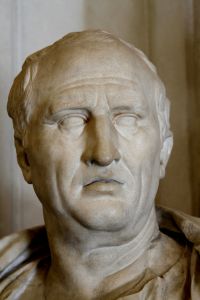 Marcus Tullius Cicero,
Cicero's Brutus or History of Famous Orators…
Marcus Tullius Cicero,
Cicero's Brutus or History of Famous Orators…
“ Here, therefore, all the glitter of ornament, like that of jewels and diamonds, must be laid aside; nor must we apply even the crisping-iron to adjust the hair. There must be no colouring, no artful washes to heighten the complexion: but elegance and neatness must be our only aim. ”
Richard Herring, Paper & paper making, ancient and modern (1855)
“ Nor let any one scoff at the interest, which I venture to express in the ornament even of a cottage wall. Ornament is the crown of art. Taste is thought. Elegance is the refinement of civilization. The study of beauty, grandeur, and truth, in History and in Nature, is the most practical education of man! ”
J. C. Stobart, The Grandeur That Was Rome: a survey of Roman culture and civilisation
“ The whole wall space shows a riot of fantastic ornament often extremely graceful and effective. Flying goddesses and cupids impart a sense of airy lightness, and floral forms festoon themselves in charming curves. ”
James Ward, The Principles of Ornament
“ The rigid lines of architecture should act as a foil to the graceful curves of ornament, and the plain faces should not only set off fretted surfaces, but make the undulations of carved ornament precious. When I speak of ornament, I include the highest form of it, the human figure, and I may point to the Doric frieze of the Greeks as a brilliant example of success. This conjunction of ornament and architecture, however, demands high qualities in the ornament, and insight in the artists as to what is wanted for mutual contrast or emphasis ”
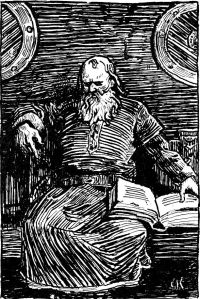 Snorri Sturluson,
Heimskringla — Saga of Sigurd the Crusader and His Brothers Eystein and Olaf
Snorri Sturluson,
Heimskringla — Saga of Sigurd the Crusader and His Brothers Eystein and Olaf
“ It is not less a distinction and an ornament that a man is of a handsome appearance, so as to be easily known from others on that account; and this appears to me to suit a chief best, because the best ornament is allied to beauty. I am moreover more knowing in the law than you, and on every subject my words flow more easily than yours. ”
Kate Heintz Watson, Textiles and Clothing
“ All decoration should be planned to enrich—not to assert. All jewelry or ornament should form a note in the general harmony of color—a decorative touch to add beauty and to be subordinated to the object decorated. It should serve the purpose of seeming to strengthen the whole or to protect the parts receiving most wear. Ornament is everywhere attempted. We see ornament at every turn—good and bad alike—in our homes, on clothes, linen, and kitchen utensils. ”
Richard Glazier, A Manual of Historic Ornament
“ Ornament is the means by which Beauty or Significance is imparted to Utility. It is either Symbolical or Aesthetic. Symbolic ornament consists of elements or forms chosen for the sake of their significance—Aesthetic ornament consists of forms or elements chosen for their Beauty alone, or their power of appealing to the senses.Of the historic styles of ornament, the Egyptian, Assyrian, Byzantine, Scandinavian, Persian, Indian, Gothic, Polynesian, and much of the Chinese and Japanese are symbolical, having elements and ornamental details chosen for their significance ”
Elisabeth Luther Cary, William Morris: Poet, Craftsman…
“ A work on Art, I think, bears less of ornament than any other kind of book (non bis in idem is a good motto) ; again, a book that must have illustrations, more or less utilitarian, should, I think, have no actual ornament at all, because the ornament and the illustration must almost certainly fight.” He designed all his ornaments with his own hand, from the minute leaves and flowers which took the place of periods on his page, to the full-page borders, titles, and elaborate initials. ”
 Charles Frederick Hartt,
Popular Science Monthly
(1874)
Charles Frederick Hartt,
Popular Science Monthly
(1874)
“ It is verily surprising what an important element ornament is in life. Is it, then, wonderful that man, striving everywhere to please the same eye by lines, should occasionally invent, independently, similar ornamental forms, or that decorative art should, in its beginning, evolve in the same direction in different countries? ”
 Noah Webster,
Webster's Unabridged Dictionary…
Noah Webster,
Webster's Unabridged Dictionary…
“ We decorate and ornament by putting on some adjunct which is attractive or beautiful, and which serves to heighten the general effect. Thus, a lady's head-dress may be ornament or decorated with flowers or jewelry; a hall may be decorated or ornament with carving or gilding, with wreaths of flowers, or with hangings. Ornament is used in a wider sense than decorate. To embellish is to beautify or ornament richly, not so much by mere additions or details as by modifying the thing itself as a whole. ”
Maud C. Cooke, Twentieth Century Culture and Deportment
“ Decorations.A tenet of Delsartean art asserts that, “A decoration is to make something else beautiful and must not assert, but sacrifice itself. Ornament that has no use whatever is never, in any high sense, beautiful.” ”
James Thomson, The Seasons — Autumn (1791)
“ Sat fair proportion'd on her polish'd limbs, Veil'd in a simple robe, their best attire, Beyond the pomp of dress; for loveliness Needs not the foreign aid of ornament, 205 But is when unadorn'd adorn'd the most. ”
 John Ruskin,
The Seven Lamps of Architecture
John Ruskin,
The Seven Lamps of Architecture
“ I believe the right question to ask, respecting all ornament, is simply this: Was it done with enjoyment—was the carver happy while he was about it? ”
Philippe Daryl, Ireland's disease (1888)
“ An ornament greatly appreciated on the chimney-piece is a glass vessel full of miraculous water in which swims a reduction of the tools of the Passion, the cross, the ladder, the hammer, the nails, and the crown of thorns. ”
 Anthony M. Ludovici,
Nietzsche and Art
Anthony M. Ludovici,
Nietzsche and Art
“ The ornament is nervous and excited, festoons, trefoils, gables, gargoyles and niches, all thrust themselves at you; all strive for individual effect, individual attention, and individual value, with a restlessness and an importunacy which knows no limits ”
 Alfred Plummer,
The Expositor's Bible: The Pastoral Epistles
Alfred Plummer,
The Expositor's Bible: The Pastoral Epistles
“ It is precisely those things which in themselves are good and beautiful that we consider capable of adornment and worthy of it. To add ornament to an object that is intrinsically vile or hideous, does but augment the existing bad qualities by adding to them a glaring incongruity. ”
M. Digby Wyatt, History, Theory, and Practice of Illuminating (1861)
“ Historically we should remember that miniature ornament of every period reflects on a diminished scale, and frequently in a highly concentrated form, the leading spirit which may have pervaded the greater revolutions of monumental art. ”
Kate Heintz Watson, Textiles and Clothing
“ The general proportion may be good, the mouldings accurate, but the instant ornament is attempted, the architect or the dressmaker reveals how much of an artist he is. To put ornament in the right place—where it serves a purpose—is indeed difficult; to render that ornament at the same time an added beauty and an expression of the desired unity is far more difficult. ”
 Laurence Housman,
Ploughshare and Pruning-hook
(1919)
Laurence Housman,
Ploughshare and Pruning-hook
(1919)
“ And it is association, with this compound appeal, which again and again decides (over and above all questions of use) what material is the best, or the most delightful, to be employed for a given purpose. You choose a material because it makes a decorative covering to mere utility. That beauty of choice in material alone is the beginning of ornament. ”
Richard Glazier, A Manual of Historic Ornament
“ The development and continuity of ideas and customs, the traditions of style and craftsmanship carried on through many centuries of the world’s history have obliterated the early or primitive style of ornament, chosen first for its significance or emblematic character. ”
John Ruskin,
The Stones of Venice, Volume 1…
“ We have the servile ornament, in which the executive is absolutely subjected to the inventive,—the ornament of the great Eastern nations, more especially Hamite, and all pre-Christian, yet thoroughly noble in its submissiveness. ”
Richard Glazier, A Manual of Historic Ornament
“ Conventional ornament is the adaptation of natural forms to ornamental and technical requirements, and is seen in its greatest beauty in the frank treatment by the Indians and Persians of their flora and fauna for the decorative enrichment of their textile fabrics, pottery, and jewellery.Inventive ornament is that which consists of elements not derived from any natural source ”
Modern Design in Jewellery and Fans
“ A history of personal ornament is open to many side issues, and unfolds itself in two different—indeed, opposite—directions. Primitive savages, as is well known, wear ornaments before they take to clothes. ”
James Ward, The Principles of Ornament
“ Contrast comes next, as the mere alternation of upright and horizontal lines form a contrasted ornament | —— | —— | —— | Symmetry perhaps comes next, and is the repetition of any form on its axis; even the rudest blot so doubled makes ornament. Radiation alone is the basis of much ornament, and directly we get as far as the scroll, we must have tangential junction, for broken-backed curves are hardly ornament. Next comes Repose: any decoration that seems to crawl is not pleasing but distressing. As we advance we want Variety and Subordination. ”
Jennie J. Young, The Ceramic Art
“ In the shape which an object intended for ornament should assume, or in the style of its decoration, there is, as we have seen, no absolute rule. Individual taste is paramount, since ornaments are intended mainly to administer to the pleasure of the possessor, but one rule may be considered universal in regard to the decoration. If the object be a vase intended to brighten a house, then its ornamentation should never be of such an order that its greatest and best effect is perceived when it stands alone. ”
 Oscar Wilde,
The Picture of Dorian Gray
Oscar Wilde,
The Picture of Dorian Gray
“ Then I feel, Harry, that I have given away my whole soul to someone who treats it as if it were a flower to put in his coat, a bit of decoration to charm his vanity, an ornament for a summer's day." ”
John Ruskin,
The Seven Lamps of Architecture
(1849)
“ What ornament is, will without difficulty be determined by the application of the same test. It must consist of such studious arrangements of form as are imitative or suggestive of those which are commonest among natural existences, that being of course the noblest ornament which represents the highest orders of existence. Imitated flowers are nobler than imitated stones, imitated animals, than flowers; imitated human form, of all animal forms the noblest. ”
Viscountess Marianne Margaret Compton Cust Alford, Needlework As Art
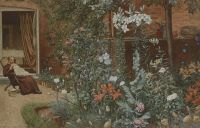
“ The humble early efforts at decoration, called by the French “primitif,” are the first we know and class, and are found in all savage attempts at ornament. This style consists mainly of straight lines, zigzags, wavy lines, dots, and little discs. ”
 F. Hamilton Jackson,
Intarsia and Marquetry
F. Hamilton Jackson,
Intarsia and Marquetry
“ Certain forms of flowers and leaves are also suitable for ornament expressed in a certain way, and when this harmony occurs the representation of nature is satisfactory as ornament; but the reverse is very often shown to be the case in work of a more modern type, in which the design is based on the dictum that the copying of natural forms will produce ornament. ”
“ And thus arise the various forms of inferior decorative art, respecting which the general law is, that the lower the place and office of the thing, the less of natural or perfect form you should have in it; a zigzag or a chequer is thus a better, because a more consistent ornament for a cup or platter than a landscape or portrait is: hence the general definition of the true forms of conventional ornament is, that they consist in the bestowal of as much beauty on the object as shall be consistent with its Material, its Place, and its Office. ”
 Walter Crane,
The Bases of Design
Walter Crane,
The Bases of Design
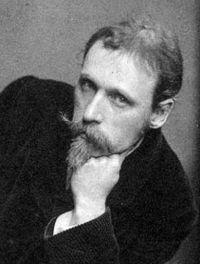
“ PERSISTENT PATTERN PLANS, RECTANGULAR BASIS.Nothing has degraded the form of common things so much as a mistaken love of ornament. The production of things of beauty for ordinary use has declined with the gradual separation of artist and craftsman. Decoration, or ornament, we have been too much accustomed to consider as accidental and unrelated addition to an object, not as an essential expression and organic part of it; not as a beauty which may satisfy us in simple line, form, or proportion, combined with fitness to purpose, even without any surface ornament at all. ”
Lewis F. Day, Windows: A Book About Stained & Painted Glass
“ Ornamental design has subsided because no one asks for, cares for, or encourages, ornament. It needs only to be in the hands of an artist—not necessarily a Holbein, but just a Rhodian potter, a Persian carpet weaver, a mediæval carver, or a nameless glazier—to be worthy of its modest place in art. ”
 Sir Walter Alexander Raleigh,
Style
Sir Walter Alexander Raleigh,
Style
“ Figure and ornament, therefore, are not interchangeable terms; the loftiest figurative style most conforms to the precepts of gravity and chastity. None the less there is a decorative use of figure, whereby a theme is enriched with imaginations and memories that are foreign to the main purpose. Under this head may be classed most of those allusions to the world’s literature, especially to classical and Scriptural lore, which have played so considerable, yet on the whole so idle, a part in modern poetry. It is here that an inordinate love of decoration finds its opportunity and its snare. ”
 John Mawe,
A Treatise on Diamonds, and Precious Stones
(1823)
John Mawe,
A Treatise on Diamonds, and Precious Stones
(1823)
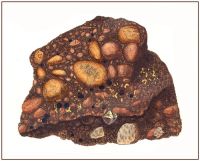
“ He then commences the operations belonging to his department or art; which is to arrange, display, and set the gems so as to produce the best effect, and present the most striking and captivating appearance, according to the nature of the ornament required: whether it be an elegant groupe, richly combined, a necklace, an ear-drop, a ring, or a pin. ”
 Moncure Daniel Conway,
Travels in South Kensington
Moncure Daniel Conway,
Travels in South Kensington
“ The ornament should be flat, without shadow and relief. 2. If flowers, foliage, or other natural objects are the motive, they should not be direct imitations of nature, but conventionalized in obedience to the above rule. 3. The ornament should cover the surface either by a diaper based on some regular geometrical figure, or growing out of itself by graceful flowing curves; any arrangement that carries lines or pronounces figures in the direction of breadth is to be avoided, and the effect produced by the folding of the stuff should be carefully studied. ”
T. F. Bell, Jacquard Weaving and Designing
“ One thing is certain, that the ‘million’ are better satisfied with floral forms than any other class of ornament, and the more loosely treated these are, or the further they are from ornament, the more pleasing they are to those uninitiated in the beauty of line, wanting which no ornamental forms can be pleasing to those educated in art. ”
Giorgio Vasari, Lives of the Most Excellent Painters… (1850)
“ But, as nothing in this world remains fixed, or will long endure, however good and praiseworthy it may be, so, refining on this first mode of ornament, the custom prevailed, after no long time, of forming richer decorations, by carvings in natural wood, covered with gold, which did indeed produce most rich and magnificent ornaments ”
 Lillian Eichler Watson,
Book of Etiquette, Volume II
Lillian Eichler Watson,
Book of Etiquette, Volume II
“ So intense did this love of ornament grow among women, that they began to cover their bodies with fur, feathers, shell, beads and countless ornaments. As late as the year 400 the primitive desire for self-adornment is evident. ”
 John Dando Sedding,
Garden-Craft Old and New
John Dando Sedding,
Garden-Craft Old and New
“ The question now before us—"What ornament is fit and right for a garden?"—of itself implies a tendency to err in the direction of ornament. We see that on the face of it the transposition of the simple of Nature into the subtle of Art has its dangers. ”
Charles Chipiez, A History of Art in Ancient Egypt…
“ Towards the close of the prehistoric age the taste for ornament becomes very marked, but that ornament is always of the kind which we call geometric. Hardly a single decorative motive is taken from the vegetable world. Like the rude efforts of the cave-men, this decoration proves that those by whom it was imagined and who frequently employed it with such happy results, were not contented with bare utility, but, so far as they could, sought after beauty. ”
Related terms
Authors who wrote about “ornament”
James WardH. Clifford SmithRichard GlazierJohn RuskinArthur Hamilton SmithWalter CraneM. Digby WyattCharles Frederick HarttElisabeth Luther CaryT. Tindall WildridgeArts and Crafts Exhibition SocietyEdmund G. Gress Edward JohnstonHume NisbetLewis F. DayVariousKate Heintz WatsonOscar WildeMaud C. CookeMarcus Tullius Cicero
John RuskinArthur Hamilton SmithWalter CraneM. Digby WyattCharles Frederick HarttElisabeth Luther CaryT. Tindall WildridgeArts and Crafts Exhibition SocietyEdmund G. GressEdward JohnstonHume NisbetLewis F. DayVariousKate Heintz WatsonOscar WildeMaud C. CookeMarcus Tullius Cicero