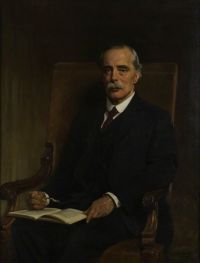
Alfred William Pollard

Alfred William Pollard

Summary

Portrait of Alfred William Pollard Alfred William Pollard 1911 Encyclopædia Britannica, Volume 4… (1911)

It was from the name by which they called the papyrus, βύβλος or βίβλος, that the Greeks formed βιβλίον, their word for a book, the plural of which (mistaken for a feminine singular) has given us our own word Bible. In the 2nd century B.C. Eumenes II., king of Pergamus, finding papyrus hard to procure, introduced improvements into the preparations of the skins of sheep and calves for writing purposes, and was rewarded by the name of his kingdom being preserved in the word pergamentum, whence our “parchment,” by which the dressed material is known.
Source: Wikisource

Portrait of Alfred William Pollard Alfred William Pollard 1911 Encyclopædia Britannica, Volume 4… (1911)

In the 10th century the supremacy which parchment had gradually established was attacked by the introduction from the East of a new writing material made from a pulp of linen rags, and the name of the vanquished papyrus was transferred to this new rival. Paper-mills were set up in Europe in the 12th century, and the use of paper gained ground, though not very rapidly, until on the invention of printing, the demand for a cheap material for books, and the ease with which paper could be worked on a press, gave it a practical monopoly.
Source: Wikisource

Portrait of Alfred William Pollard Alfred William Pollard 1911 Encyclopædia Britannica, Volume 4… (1911)

The printer’s type (see Typography) would as a rule be based on a handwriting considered by the scribes appropriate to works of the same class; the chapter headings, headlines, initial-letters, paragraph marks, and in some cases illustrations, would be added by hand in a style which might closely resemble the like decorations in the manuscript from which the text was being printed; there would be no title-page, and very probably no statement of any kind that the book was printed, or as to where, when or by whom it was produced.
Source: Wikisource

Get perspective with Kwize: daily news enlightened by great literature