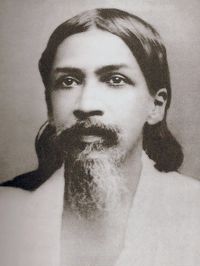
Aurobindo Ghose

Aurobindo Ghose

Summary

Portrait of Aurobindo Ghose Aurobindo Ghose Essays On The Gita (1922)

Arjuna and Krishna, this human and this divine, stand together not as seers in the peaceful hermitage of meditation, but as fighter and holder of the reins in the clamorous field, in the midst of the hurtling shafts, in the chariot of battle. The Teacher of the Gita is therefore not only the God in man who unveils himself in the word of knowledge, but the God in man who moves our whole world of action, by and for whom all our humanity exists and struggles and labours, towards whom all human life travels and progresses.
Source: Wikisource

Portrait of Aurobindo Ghose Aurobindo Ghose Essays On The Gita (1922)

Look not at thy own pleasure and gain and profit, but above and around, above at the shining summits to which thou climbest, around at this world of battle and trial in which good and evil, progess and retrogression are locked in stern conflict. Men call to thee, their strong man, their hero for help; help then, fight. Destroy when by destruction the world must advance, but hate not that which thou destroyest, neither grieve for all those who perish. Know everywhere the one self, know all to be immortal souls and the body to be but dust.
Source: Wikisource

Portrait of Aurobindo Ghose Aurobindo Ghose Essays On The Gita (1922)

Thus the figure of Krishna becomes, as it were, the symbol of the divine dealings with humanity. Through our egoism and ignorance we are moved, thinking that we are the doers of the work, vaunting of ourselves as the real causes of the result, and that which moves us we see only occasionally as some vague or even some human and earthly fountain of knowledge, aspiration, force, some Principle or Light or Power which we acknowledge and adore without knowing what it is until the occasion arises that forces us to stand arrested before the Veil.
Source: Wikisource

Get perspective with Kwize: daily news enlightened by great literature