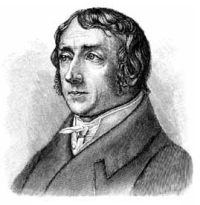
Barthold Georg Niebuhr

Barthold Georg Niebuhr

Summary

Portrait of Barthold Georg Niebuhr Barthold Georg Niebuhr The Great Events by Famous Historians… (1905)

We must conceive as a succession of centuries the period from the origin of Rome down to the times wherein were constructed the enormous works, such as the great drains, the wall of Servius, and others, which were actually executed under the kings and rival the great architectural works of the Egyptians. Romulus and Numa must be entirely set aside; but a long period follows, in which the nations gradually unite and develop themselves until the kingly government disappears and makes way for republican institutions.
Source: Wikisource

Portrait of Barthold Georg Niebuhr Barthold Georg Niebuhr The Great Events by Famous Historians… (1905)

A Venetian nobleman treated those citizens with far more condescension than he displayed toward others, provided they did not presume to exercise any authority in political matters. Whoever belonged to the Luceres called himself a Roman, and if the very dictator of Tusculum had come to Rome, a man of the third tribe there would have looked upon him as an inferior person, though he himself had no influence whatever.
Source: Wikisource

Portrait of Barthold Georg Niebuhr Barthold Georg Niebuhr The Great Events by Famous Historians… (1905)

The Romans, therefore, reëstablished their independence by a war, the result of which may have been such as we read it in the tradition—Romulus being, of course, set aside—namely, that both places as two closely united towns formed a kind of confederacy, each with a senate of one hundred members, a king, an offensive and defensive alliance, and on the understanding that in common deliberations the burghers of each should meet together in the space between the two towns which was afterward called the comitium. In this manner they formed a united state in regard to foreign nations.
Source: Wikisource

Get perspective with Kwize: daily news enlightened by great literature