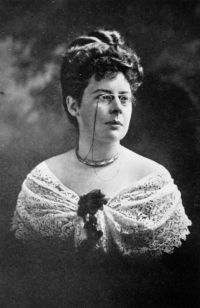
Beatrice Grimshaw

Beatrice Grimshaw

Summary

Portrait of Beatrice Grimshaw Beatrice Grimshaw The Sorcerer's Stone (1913)

The Marquis looked at the ugly ornament much as a collector of insects looks at a hideous and valuable beetle.
“Flint, this is what you call the real Mackay,” he said. “This is the worth of my money.” He rose, and was about to greet the sorcerer with all the grace of Versailles—in fact, he had already begun a courtly bow—when a small and very ugly man, with ears like a bat, came running out of the dark from nowhere, and grabbed the great man by the foot, as he went up.
“Mo! Mo!” he cried; and then came a flood of native, intermingled with the wildest gestures.
Source: Wikisource

Portrait of Beatrice Grimshaw Beatrice Grimshaw The Sorcerer's Stone (1913)

Anyhow, I looked at Mo a good deal. If there was mischief in the village—no matter of what kind—the sorcerer was sure to be at the bottom of it.
The drums galloped outside, the dance went on. The moon climbed over the motionless tops of the cocoanut palms, and looked down into the open mouth of the marea. Half in the moonlight, half in the firelight, Mo's face grew suddenly dark: he made a snatch at something that the Marquis was examining and hid it away—where, I could not see.
Source: Wikisource

Portrait of Beatrice Grimshaw Beatrice Grimshaw The Sorcerer's Stone (1913)

All the same, she was just a little nigger, and the Marquis never ought to have flattered her by taking notice of her. It puts them out of their place.
Still, he went on dancing, and I really forgot about the girl for a little, watching him. It was so good, and the scene was so extraordinary—the open space of sandy soil, all lit up by the moon, and that great figure, dancing with incomparable lightness, against the background of long banana leaf and slender betel palm, like a very new sort of fairy in a very strange kind of fairy glade.
Source: Wikisource

Get perspective with Kwize: daily news enlightened by great literature