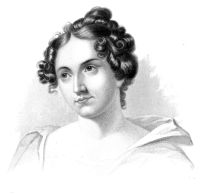
Catharine Maria Sedgwick

Catharine Maria Sedgwick

Summary

Portrait of Catharine Maria Sedgwick Catharine Maria Sedgwick Letters from Abroad to Kindred at Home… (1841)

Would not the world go on swimmingly if all strangers errant were dealt by as mine host of the Weisse Rosse dealt by us?
How would you like, dear C., to see us, your nearest and dearest relations, boating on the Rhine with men whose German even K. found it hard to comprehend? There would be no reason for anxiety; they took us in good faith in half an hour to Rheinstein, or, rather, the current took us.
Source: Wikisource

Portrait of Catharine Maria Sedgwick Catharine Maria Sedgwick Letters from Abroad to Kindred at Home… (1841)

The Castle of Rheinstein has been restored by Prince Frederic of Prussia and refurnished, and is now supposed to represent the castles as they were when there was wassail in the hall and love in the bower. The castle itself is the most beautiful on the Rhine. It is planted on a projecting rock, half way to the summit of a steep, and set off by a dark, rich woodland. It is built of stone taken from the bed of rock that forms its foundation, and you can scarce tell where nature finishes and art begins. In truth, the art is so perfect that you forget it.
Source: Wikisource

Portrait of Catharine Maria Sedgwick Catharine Maria Sedgwick Letters from Abroad to Kindred at Home… (1841)

The Mouse and the Cat, the beautiful ruins of two castles, are at either extremity of the view. The "Cat" is well stationed to watch its prey, but, contrary to all precedent, the "Mouse" is said always to have been the strongest when they were held by their lords, rivals and enemies. The immense Castle of Rheinfels, half way up the steep behind St. Goar, looks, as L. says, like a great bulldog that might have kept all its subordinates civil. Rheinfels, as early as the fourteenth century, was the strongest hold on the Rhine.
Source: Wikisource

Get perspective with Kwize: daily news enlightened by great literature