Summary

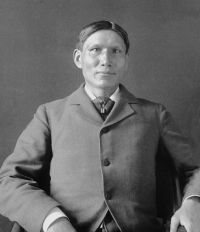
Portrait of Charles A. Eastman Charles A. Eastman Wigwam Evenings: Sioux Folk Tales Retold

The cold December moon is just [3] showing above the tree-tops, pointing a white finger here and there at the clustered teepees of the Sioux, while opposite their winter camp on the lake shore a lonely, wooded island is spread like a black buffalo robe between the white, snow-covered ice and the dull gray sky.
All by itself at the further end of the village stands the teepee of Smoky Day, the old story-teller, the school-master of the woods. The paths that lead to this low brown wigwam are well beaten; deep, narrow trails, like sheep paths, [4] in the hard-frozen snow.
Source: Gutenberg

Portrait of Charles A. Eastman Charles A. Eastman Wigwam Evenings: Sioux Folk Tales Retold

The big voice of the Bumble-Bee was heard in every nook and corner of the wood, and from end to end of the deep valley, for Unktomee, the generous, was giving a feast, and the Bee was his herald, the crier of the day.
"Ho, every creeper, every buzzer, all ye little people who fly without feathers, come this day to the festival!" boomed the Bee. "All must prepare to exhibit their best skill; the Toad, who can neither fly nor run, his brother the Bullfrog, with his band of musicians, and even the Flying-squirrel with the rest.
Source: Gutenberg

Portrait of Charles A. Eastman Charles A. Eastman Wigwam Evenings: Sioux Folk Tales Retold

At last the great peace-maker, the Sun, appeared, holding in his hand the Rainbow, like a flag of many colors, a sign that the battle is over. He sent each [121] of the warriors to his own place. Gentle airs came down from above to meet and play with the little waves that danced upon the blue water. He who is our Father, the father of our bodies, whose wife is our Mother the Earth, wishes safety and peace for all his children, therefore he still watches the unruly ones from the middle of the sky, and their battles are quickly ended.
Source: Gutenberg

Get perspective with Kwize: daily news enlightened by great literature