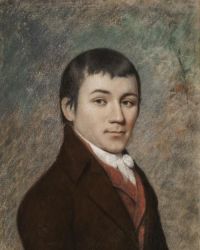
Charles Brockden Brown

Charles Brockden Brown

Summary

Portrait of Charles Brockden Brown Charles Brockden Brown Edgar Huntly, or The Sleep Walker (1831)

Every sentiment, at length, yielded to my sympathy. Every new accent of the mourner struck upon my heart with additional force, and tears found their way spontaneously to my eyes. I left the spot where I stood, and advanced within the verge of the shade. My caution had forsaken me, and, instead of one whom it was duty to persecute, I beheld, in this man, nothing but an object of compassion.
My pace was checked by his suddenly ceasing to lament. He snatched the spade, and, rising on his feet, began to cover up the pit with the utmost diligence.
Source: Wikisource

Portrait of Charles Brockden Brown Charles Brockden Brown Edgar Huntly, or The Sleep Walker (1831)

You, Clithero, know the wishes that I once cherished: I had hoped that my son would have found, in this darling child, an object worthy of his choice, and that my girl would have preferred him to all others; but I have long since discovered that this could not be—they are nowise suited to each other. There is one thing, in the next place, desirable, and now my wishes are accomplished: I see that you love each other; and never, in my opinion, was a passion more rational and just: I should think myself the worst of beings if I did not contribute all in my power to your happiness.
Source: Wikisource

Portrait of Charles Brockden Brown Charles Brockden Brown Edgar Huntly, or The Sleep Walker (1831)

How should Clithero be unacquainted with its situation, since none but he could have dug for it this grave?
This mystery vanished when I reflected on the history of my own manuscript. Clithero had buried his treasure with his own hands, as mine had been secreted by myself; but both acts had been performed during sleep: the deed was neither prompted by the will, nor noticed by the senses, of him by whom it was done. Disastrous and humiliating is the state of man! By his own hands is constructed the mass of misery and error in which his steps are for ever involved.
Source: Wikisource

Get perspective with Kwize: daily news enlightened by great literature