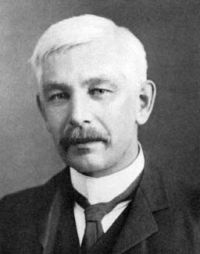
Charles Chree

Charles Chree

Summary

Portrait of Charles Chree Charles Chree 1911 Encyclopedia Britannica (1911)

What is aimed at in ordinary observations of atmospheric potential is the measurement of the difference of potential between the earth and a point a given distance above it, or of the difference of potential between two points in the same vertical line a given distance apart. Let a conductor, say a metallic sphere, be supported by a metal rod of negligible electric capacity whose other end is earthed.
Source: Wikisource

Portrait of Charles Chree Charles Chree 1911 Encyclopedia Britannica (1911)

Above the level plain of absolutely smooth surface, devoid of houses or vegetation, the equipotential surfaces under normal conditions would be strictly horizontal, and if we could determine the potential at one metre above the ground we should have a definite measure of the potential gradient at the earth’s surface. The presence, however, of apparatus or observers upsets the conditions, while above uneven ground or near a tree or a building the equipotential surfaces cease to be horizontal. In an ordinary climate a building seems to be practically at the earth’s potential
Source: Wikisource

Portrait of Charles Chree Charles Chree 1911 Encyclopedia Britannica (1911)

Whether there is any real difference between high and mean latitudes in the annual frequency of the causes rendered visible by aurora, it is difficult to say. The Scandinavian data, from the wealth of observations, are probably the most representative, and even in the most northern district of Scandinavia the smallness of the excess of the frequencies in December and January over those in March and October suggests that some influence tending to create maxima at the equinoxes has largely counterbalanced the influence of sunlight and twilight in reducing the frequency at these seasons.
Source: Wikisource

Get perspective with Kwize: daily news enlightened by great literature