Summary

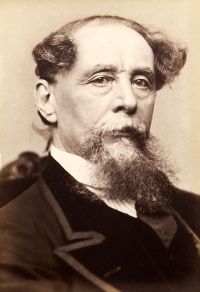
Portrait of Charles Dickens Charles Dickens Bleak House — Chapter XX: A New Lodger (1852)

With these magnificent portraits, unworthily confined in a band-box during his seclusion among the market-gardens, he decorates his apartment; and as the Galaxy Gallery of British Beauty wears every variety of fancy dress, plays every variety of musical instrument, fondles every variety of dog, ogles every variety of prospect, and is backed up by every variety of flower-pot and balustrade, the result is very imposing.
But fashion is Mr. Weevle’s, as it was Tony Jobling’s, weakness.
Source: Wikisource

Portrait of Charles Dickens Charles Dickens Bleak House — Chapter XX: A New Lodger (1852)

As it is Mr. Guppy’s perplexing way with boastful misery to tempt his particular friends into this subject, and the moment they touch it, to turn on them with that trenchant severity about the chords in the human mind, both Mr. Jobling and Mr. Smallweed decline the pitfall by remaining silent.
“Such things may be,” repeats Mr. Guppy, “or they may not be. They are no part of the case. It is enough to mention that both Mr. and Mrs. Snagsby are very willing to oblige me and that Snagsby has, in busy times, a good deal of copying work to give out.
Source: Wikisource

Portrait of Charles Dickens Charles Dickens Bleak House — Chapter XX: A New Lodger (1852)

Smallweed thinks.
“Certainly. It’s the fashionable way; and fashion and whiskers have been my weaknesses, and I don’t care who knows it,” says Mr. Jobling. “They are great weaknesses—Damme, sir, they are great. Well,” proceeds Mr. Jobling after a defiant visit to his rum-and- water, “what can a fellow do, I ask you, but enlist?”
Mr. Guppy comes more fully into the conversation to state what, in his opinion, a fellow can do. His manner is the gravely impressive manner of a man who has not committed himself in life otherwise than as he has become the victim of a tender sorrow of the heart.
Source: Wikisource

Get perspective with Kwize: daily news enlightened by great literature