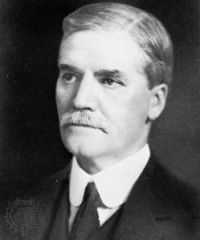
Dugald Clerk

Dugald Clerk

Summary

Portrait of Dugald Clerk Dugald Clerk 1911 Encyclopædia Britannica (1911)

It has long been known that under certain conditions of internal surface a gas engine may be made to run with very great regularity, without incandescent tube or any other form of igniter, if some portion of the interior surfaces of the cylinder or combustion space be so arranged that the temperature can rise moderately; then, although the temperature may be too low to ignite the mixture at atmospheric temperature, yet when compression is completed the mixture will often ignite in a perfectly regular manner.
Source: Wikisource

Portrait of Dugald Clerk Dugald Clerk 1911 Encyclopædia Britannica (1911)

Notwithstanding much which has been said as to varying mixture, there is only one mixture of air and petrol which gives the best results—that in which there is some excess of oxygen, more than sufficient to burn all the hydrogen and carbon present. It is necessary to secure this mixture under all conditions, not only to obtain economy in running but also to maintain purity of exhaust gases.
Source: Wikisource

Portrait of Dugald Clerk Dugald Clerk 1911 Encyclopædia Britannica (1911)

The oil ignites at once as it enters the combustion space, and so a power impulse is obtained, but without explosion. The pressure does not rise above the pressure of air and oil injection. The Diesel engine thus embodies two very original features; it operates at compression pressures very much higher than those used in any other internal combustion engines, and it dispenses with the usual igniting devices by rendering the air charge incandescent by compression. The engine operates generally on the Otto cycle, but it is also built giving an impulse at every revolution.
Source: Wikisource

Get perspective with Kwize: daily news enlightened by great literature