Summary

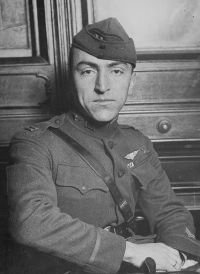
Portrait of Eddie Rickenbacker Eddie Rickenbacker Fighting the Flying Circus — Chapter 15 (1919)

I put Captain Marr's Nieuport up to a little over 19,000 feet that morning, and there she hung. Every artifice that ever moved an engine was experimented in but without increasing her capacities an inch. Just as I had satisfied myself that I had exhausted her possibilities, I discovered my old friend, No. 16, winging his way calmly towards me. He was certainly prompt and business-like in the way he kept his appointments.
Just as yesterday, the Rumpler was some two thousand feet above my highest possible elevation.
Source: Wikisource

Portrait of Eddie Rickenbacker Eddie Rickenbacker Fighting the Flying Circus — Chapter 15 (1919)

As for the Americans, we had to take what machines the Allied nations could spare us. Naturally they kept the best for themselves; and our squadrons of American pilots did the best they could with the second best.
It was at this time that we heard rumors of a new English fighting machine called the Snipe. Like the Camel, it was a Sopwith production. A new engine that was shrouded in much secrecy and mystery was reputed to have carried this little scout machine to the incredible altitude of 33,000 feet.
Source: Wikisource

Portrait of Eddie Rickenbacker Eddie Rickenbacker Fighting the Flying Circus — Chapter 15 (1919)

The ideal fighting machine is of course one that will outperform every enemy machine in every variety of movement. And there are several kinds of performances that are almost equally valuable in combat fighting. A swift speed is essential. A rapid climb, the ability to dive directly down without overstraining the structure or ripping off the fabric by too sudden an alteration of direction; a high ceiling, which necessitates high engine power and perfect carburetion; quick maneuverability—all these characteristics if combined would make an ideal fighting machine.
Source: Wikisource

Get perspective with Kwize: daily news enlightened by great literature