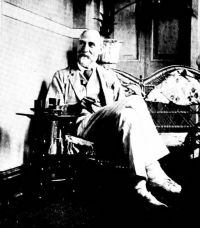
Edward Hamilton Aitken

Edward Hamilton Aitken

Summary

Portrait of Edward Hamilton Aitken Edward Hamilton Aitken Behind the Bungalow

In a word, Mukkun is a slave. Yet he does not jump into the garden well, nor his quietus make with a bare bodkin. No, he plods through life, eats his rice and curry with gusto, smokes his cigarette with satisfaction, oils his lovelocks, borrows money from the cook to buy a set of silver buttons for his waistcoat, and when he tires of them, pawns them to pay for a velvet cap on which he has set his heart.
Source: Gutenberg

Portrait of Edward Hamilton Aitken Edward Hamilton Aitken Behind the Bungalow

As they squat together there, indulging “the first and purest of our instincts” in the mud or dust of the narrow back road, reflect that their tender roots are nourished by a thin rivulet of rupees which flows from you. If you dried up, they would droop and perhaps die. The butler has a bright little boy, who goes to school every day in a red velvet cap and print jacket, with a small slate in his hand, and hopes one day to climb higher in the word than his father. His tendrils are wrapped about your salary.
Source: Gutenberg

Portrait of Edward Hamilton Aitken Edward Hamilton Aitken Behind the Bungalow

And so, in the golden age, when men did everything that is wise and right, there was established a caste whose office it was to remove that sign from secular chins. How impious and revolutionary then must it be for a man who is not a barber to tamper with his own beard, thus taking the bread out of the mouths of barbers born, and blaspheming the wisdom of the ancient founders of civilization!
Source: Gutenberg

Get perspective with Kwize: daily news enlightened by great literature