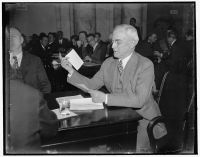
Edward Samuel Corwin

Edward Samuel Corwin

Summary

Portrait of Edward Samuel Corwin Edward Samuel Corwin John Marshall and the Constitution… (1918)

Marshall’s own outlook upon his task sprang in great part from a profound conviction of calling. He was thoroughly persuaded that he knew the intentions of the framers of the Constitution—the intentions which had been wrought into the instrument itself—and he was equally determined that these intentions should prevail. For this reason he refused to regard his office merely as a judicial tribunal; it was a platform from which to promulgate sound constitutional principles, the very cathedra indeed of constitutional orthodoxy.
Source: Gutenberg

Portrait of Edward Samuel Corwin Edward Samuel Corwin John Marshall and the Constitution… (1918)

It was in his eyes “a subtle corps of sappers and 183 miners constantly working underground to undermine our confederated fabric”; and this latest assault upon the rights of the States seemed to him, though perpetrated in the usual way, the most outrageous of all: “An opinion is huddled up in conclave, perhaps by a majority of one, delivered as if unanimous, and with the silent acquiescence of lazy or timid associates, by a crafty chief judge, who sophisticates the law to his own mind by the turn of his own reasoning.”
Source: Gutenberg

Portrait of Edward Samuel Corwin Edward Samuel Corwin John Marshall and the Constitution… (1918)

No part of the Constitution has realized the hopes of its framers more brilliantly than has Article III, where the judicial power of the United States is defined and organized, and no part has shown itself to be more adaptable to the developing needs of a growing nation. Nor is the reason obscure: no part came from the hands of the framers in more fragmentary shape or left more to the discretion of Congress and the Court.
Source: Gutenberg

Get perspective with Kwize: daily news enlightened by great literature