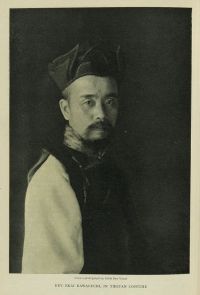
Ekai Kawaguchi

Ekai Kawaguchi

Summary

Portrait of Ekai Kawaguchi Ekai Kawaguchi Three Years in Tibet

A sand-storm is something which one can never experience, or form any idea of, in Japan. As strong gust after gust of wind arose, the loose sand actually surged into big billows, tossing, dashing, tumbling, and sweeping, like the angry waves of the mighty ocean. The wind burrowed deep into the ground here and built high hills of sand there, filling the air with blinding particles, which rested in heaps on the luggage, penetrated down the neck, and made impossible any progress forward, while to stand still was to risk being buried alive.
Source: Gutenberg

Portrait of Ekai Kawaguchi Ekai Kawaguchi Three Years in Tibet

I was profoundly astonished to find any people making a permanent abode of such a lonely secluded place, where the vegetation is so poor that the inhabitants have no staple food but tahu, which is a cereal somewhat akin to buckwheat, but much inferior in its dietetic qualities. Nevertheless I must not omit to pay a tribute to the grandeur of the natural scenery, the ever present snow-clad peaks, the gigantic heaps upon heaps of rugged rocks, the serene quietude, all inspiring the mind with awe and soul-lifting thoughts.
Source: Gutenberg

Portrait of Ekai Kawaguchi Ekai Kawaguchi Three Years in Tibet

There is no fixed standard as to the property which a bride takes with her to her husband’s on the occasion of her marriage. Some are rich enough to take a piece of land as a dowry, but some can afford only to take a few clothes.
When she leaves her house, the bride weeps bitterly, and all efforts to get her on horseback are in vain, she prostrates herself on the ground and lies there obstinately helpless. Her features become those of one whose heart is too heavy to part with her parents and her home. In such a case, the bride is lifted up and placed by friends on horseback.
Source: Gutenberg

Get perspective with Kwize: daily news enlightened by great literature