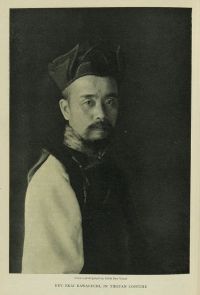
Kawaguchi Ekai

Kawaguchi Ekai

Summary

Portrait of Kawaguchi Ekai Kawaguchi Ekai Three Years in Tibet (1909)

I was profoundly astonished to find any people making a permanent abode of such a lonely secluded place, where the vegetation is so poor that the inhabitants have no staple food but tahu, which is a cereal somewhat akin to buckwheat, but much inferior in its dietetic qualities. Nevertheless I must not omit to pay a tribute to the grandeur of the natural scenery, the ever present snow-clad peaks, the gigantic heaps upon heaps of rugged rocks, the serene quietude, all inspiring the mind with awe and soul-lifting thoughts.
Source: Wikisource

Portrait of Kawaguchi Ekai Kawaguchi Ekai Three Years in Tibet (1909)

But Tsarang has its horrors as well as its charms, as when a snow storm rages. The wind is often so strong that it blows away the tilled surface of a farm, and in time changes it into a barren field of sand, while the snow comes down in such abundance that it drifts itself into huge mountains here and there on the plain. The cold is, of course, intense on such occasions and nobody dares to go out.
Source: Wikisource

Portrait of Kawaguchi Ekai Kawaguchi Ekai Three Years in Tibet (1909)

The Tsar, they think, may be the sovereign who is the incarnate Founder, but his very munificence towards Tibet may have some deep meaning at bottom. That munificence may not be for nothing; if it is, then Russia must be regarded as a country composed of people who are quite godly — a very rare thing in this world of give and take, where selfishness is a guiding motive. Is it not more reasonable and safer to interpret those repeated acts of outward friendship as coming from her ambitious design to place a snare before Tibet and finally to absorb the country?
Source: Wikisource

Get perspective with Kwize: daily news enlightened by great literature