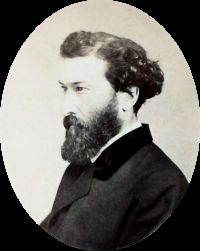
Emile Gaboriau

Emile Gaboriau

Summary

Portrait of Emile Gaboriau Emile Gaboriau Monsieur Lecoq, v. 1

Skilfully as the magistrate had delivered this thrust, it had been as skilfully parried; so skilfully, indeed, that Goguet, the smiling clerk, could not conceal an approving grimace. Besides, on principle, he always took the prisoner’s part, in a mild, Platonic way, of course.
“Let us consider the circumstances that followed your arrest,” resumed M. Segmuller. “Why did you refuse to answer all the questions put to you?”
A gleam of real or assumed resentment shone in the prisoner’s eyes.
“This examination,” he growled, “will alone suffice to make a culprit out of an innocent man!”
Source: Gutenberg

Portrait of Emile Gaboriau Emile Gaboriau Monsieur Lecoq, v. 1

Is it possible to be so strong in theory, and yet so ridiculously weak in practise? Ah! I am only a child, a mere novice, disheartened by the slightest obstacle. I meet with a difficulty, and at once I lose all my courage. Now, let me reflect calmly. What did I tell the judge about this murderer, whose plan of defense so puzzles us? Did I not tell him that we had to deal with a man of superior talent—with a man of consummate penetration and experience—a bold, courageous fellow of imperturbable coolness, who will do anything to insure the success of his plans?
Source: Gutenberg

Portrait of Emile Gaboriau Emile Gaboriau Monsieur Lecoq, v. 1

All the officials assembled at the Poivriere knew at least by sight the magistrate who now made his appearance, and Gevrol, an old habitue of the Palais de Justice, mechanically murmured his name: “M. Maurice d’Escorval.”
He was the son of that famous Baron d’Escorval, who, in 1815, sealed his devotion to the empire with his blood, and upon whom Napoleon, in the Memorial of St. Helena, pronounced this magnificent eulogium: “Men as honest as he may, I believe, exist; but more honest, no, it is not possible.”
Source: Gutenberg

Get perspective with Kwize: daily news enlightened by great literature