Deductive reasoning
Definition and stakes
Quotes about “deductive reasoning”
Various, Popular Science Monthly (1913)
“ And now since such fecundity, such proof of novelties, is the essence of the live process of deduction as it exists in the deductive sciences, why should not psychologists study that live process instead of studying the dead body which some text-books have called the syllogism? And if they must study the syllogism as the supposed typical example of deductive reasoning, why should they confine their attention to considering the most traditional and trivial aspect of it? ”
 John Stuart Mill,
Inaugural address delivered to the University of St…
(1867)
John Stuart Mill,
Inaugural address delivered to the University of St…
(1867)
“ It is chiefly from mathematics we realize the fact that there actually is a road to truth by means of reasoning; that anything real, and which will be found true when tried, can be arrived at by a mere operation of the mind. The flagrant abuse of mere reasoning in the days of the schoolmen, when men argued confidently to supposed facts of outward nature without properly establishing their premises, or checking the conclusions by observation, created a prejudice in the modern, and especially in the English mind, against deductive reasoning altogether, as a mode of investigation. ”
 William Stanley Jevons,
The principles of science
William Stanley Jevons,
The principles of science
“ All inductive reasoning is but the inverse application of deductive reasoning. Being in possession of certain particular facts or events expressed in propositions, we imagine some more general proposition expressing the existence of a law or cause; and, deducing the particular results of that supposed general proposition, we observe whether they agree with the facts in question. Hypothesis is thus always employed, consciously or unconsciously. ”
Fredric B. Lozo, Sequential Problem Solving
“ Deductive reasoning [9] is stating a series of valid relationships with a conclusion about them: When it rains the streets get wet. It is raining. Therefore the streets are wet. Several types of reasoning fallacies exist: (1) formal deductive fallacies, which occur because of an error in the form of the argument, and (2) informal fallacies that contain false content. ”
 Edwin Abbott Abbott,
The Kernel and the Husk
(1886)
Edwin Abbott Abbott,
The Kernel and the Husk
(1886)
“ When therefore you bear in mind that in every Syllogism the Premises are often the result of an Induction in which Imagination has played a part, and that the conclusion always depends upon an axiom of the Imagination, you must admit that even Deductive Reasoning by no means excludes the Imagination. (iii) Practically, errors seldom arise, and truth is seldom discovered, from mere Deductive Reasoning. Any one can see his way through a logical Syllogism, and almost any one can lay his finger on the weak point in an illogical one. ”
George K. Pattee, Practical Argumentation
“ If they are only probably correct, the conclusion is a mere presumption; if either one is false, the conclusion is probably false. But if the syllogism is correctly framed, and if both premises are true, the conclusion is irrefutable. As premises are facts that have first been established by induction, the relation between inductive and deductive reasoning is very close. In fact, deduction depends on induction for its very existence. To overthrow a deductive argument all that is necessary is to show the error in the inductive process that built up either one or both of the premises. ”
J. H. Gardiner, The Making of Arguments
“ Logicians generally distinguish between two branches of their science, inductive and deductive reasoning. In inductive reasoning we pass from individual facts to general principles; in deductive reasoning we pass from general principles to conclusions about individual facts. ”
 Stratton D. Brooks,
Composition-Rhetoric
Stratton D. Brooks,
Composition-Rhetoric
“ Each conclusion carries with it, however, the weakness of the premises on which it is based, and as these premises are general principles that have been themselves established by inductive reasoning, the conclusions of deductive reasoning can be no more sure than those of inductive reasoning. Each may prove only that the proposition is probably true rather than that it is surely true, though in many cases this probability becomes almost a certainty. ”
T. Troward, The Edinburgh Lectures on Mental Science
“ The subjective mind is only able to reason deductively and not inductively, while the objective mind can do both. Deductive reasoning is the pure syllogism which shows why a third proposition must necessarily result if two others are assumed, but which does not help us to determine whether the two initial statements are true or not. ”
 William Walker Atkinson,
The Art of Logical Thinking; Or…
William Walker Atkinson,
The Art of Logical Thinking; Or…
“ These facts may be either the observed phenomena or facts apparent to the perception, or else facts obtained [Pg 142] by deductive reasoning. The latter may be said to be facts which are held to be true if the hypothesis be true. Thus if we erect the hypothesis that "All men are mortal," we may reason deductively that it will follow that each and every thing that is a man must die sooner or later. Then we test our hypotheses upon each and every man whom we may subject to observation and experiment. If we find a single man who does not die, then the test disproves our hypotheses ”
Carveth Read, Logic: Deductive and Inductive
“ But the name of the suppositio itself has no contradictory, except with reference to a wider and inclusive suppositio.The difficulty of actual reasoning, not with symbols, but about matters of fact, does not arise from the principles of Logic, but sometimes from the obscurity or complexity of the facts, sometimes from the ambiguity or clumsiness of language, sometimes from the deficiency of our own minds in penetration, tenacity and lucidity. One must do one's best to study the facts, and not be too easily discouraged. ”
Carveth Read, Logic: Deductive and Inductive
“ It is usual to point out that Psychology tries to explain the subjective processes of conception, judgment and reasoning, and to give their natural history; but that Logic is wholly concerned with the results of such processes, with concepts, judgments and reasonings, and merely with the validity of the results, that is, with their truth or consistency; whilst Psychology has nothing to do with their validity, but only with their causes. ”
St. George William Joseph Stock, Deductive Logic
“ Whenever in the course of our reasoning we are involved in error, either the conclusion follows from the premisses or it does not. If it does not, the fault must lie in the process of reasoning, and we have then what is called a Logical Fallacy. If, on the other hand, the conclusion does follow from the premisses, the fault must lie in the premisses themselves, and we then have what is called a Material Fallacy. ”
 Henri Poincaré,
The Foundations of Science — SCIENCE AND HYPOTHESIS
(1913)
Henri Poincaré,
The Foundations of Science — SCIENCE AND HYPOTHESIS
(1913)
“ Is is really deductive, as is commonly supposed? A deeper analysis shows us that it is not, that it partakes in a certain measure of the nature of inductive reasoning, and just because of this is it so fruitful. None the less does it retain its character of rigor absolute ”
St. George William Joseph Stock, Deductive Logic
“ By a fallacy is meant a piece of reasoning which appears to establish a conclusion without really doing so. The term applies both to the legitimate deduction of a conclusion from false premisses and to the illegitimate deduction of a conclusion from any premisses. There are errors incidental to conception and judgement, which might well be brought under the name; but the fallacies with which we shall concern ourselves are confined to errors connected with inference. ”
St. George William Joseph Stock, Deductive Logic
“ We mean persons of whom the terms 'friend' and 'patriot' are truly or falsely predicated. Neither can we with any propriety talk of true or false reasoning. Reasoning is either valid or invalid: it is only the premisses of our reasonings, which are propositions, that can be true or false. We may have a perfectly valid process of reasoning which starts from a false assumption and lands us in a false conclusion. ”
William Walker Atkinson,
The Art of Logical Thinking; Or…
“ On the other hand, all incorrect reasoning consists in putting one thing for another where there is not the requisite likeness. It is the purpose of the rules of deductive and inductive logic to enable us to judge as far as possible when we are thus rightly or wrongly reasoning from some things to others. ”
 Edward L. Thorndike,
The Psychology of Arithmetic
Edward L. Thorndike,
The Psychology of Arithmetic
“ When the conclusion is reached as the effect of many particular experiences, the reasoning is called inductive. When some principle already established leads to another principle or to a conclusion about some particular fact, the reasoning is called deductive. ”
Various, Popular Science Monthly (1913)
“ I assert that in the recent psychology of reasoning, the nature of the deductive process and its principal purpose have been equally misunderstood. Deduction in its more developed forms simply does not consist in an analysis of the premises. Nor is it intended to make you believe the conclusion. The true interest of deduction lies in the fact (1) that it is a process possessing an inexhaustible fecundity, and (2) that this fruitfulness results in giving you a knowledge that certain premises imply certain conclusions. ”
William Stanley Jevons,
The principles of science
“ The logical process by which we seem to pass directly from examined to unexamined cases consists in an inverse application of deductive inference, so that all reasoning may be said to be either directly or inversely deductive.3. The result is always of a hypothetical character, and is never more than probable.4. No net addition is ever made to our knowledge by reasoning; what we know of future events or unexamined objects is only the unfolded contents of our previous knowledge, and it becomes less probable as it is more boldly extended to remote cases. ”
“ The isolation of deduction is seen, at the other end, wherever there is failure to clinch and test the results of the general reasoning processes by application to new concrete cases. The final point of the deductive devices lies in their use in assimilating and comprehending individual cases. No one understands a general principle fully—no matter how adequately he can demonstrate it, to say nothing of repeating it—till he can employ it in the mastery of new situations, which, if they are new, differ in manifestation from the cases used in reaching the generalization. ”
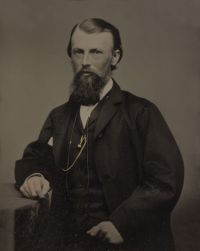 William John Wills,
Successful Exploration Through the Interior of Australia
William John Wills,
Successful Exploration Through the Interior of Australia
“ You should carefully study the Art of Reasoning, as it is what most people are very deficient in, and I know few things more disagreeable than to argue, or even converse with a man who has no idea of inductive and deductive philosophy. ”
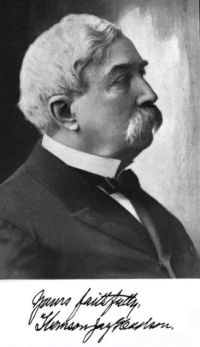 Thomson Jay Hudson,
The Law of Psychic Phenomena
Thomson Jay Hudson,
The Law of Psychic Phenomena
“ In other words, it has never been noted that their reasoning is always deductive, or syllogistic. The subjective mind never classifies a series of known facts, and reasons from them up to general principles ”
St. George William Joseph Stock, Deductive Logic
“ All not-perceptions are things of which we have an imperfect idea. All substances are not-perceptions. .'. All substances are things of which we have an imperfect idea.Indirect Reduction.§ 691. We will apply this method to Baroko. All A is B. All fishes are oviparous. Some C is not B. Some marine animals are not oviparous. .'. Some C is not A. .'. Some marine animals are not fishes.§ 692. The reasoning in such a syllogism is evidently conclusive: but it does not conform, as it stands, to the first figure, nor (permutation apart) can its premisses be twisted into conformity with it. ”
Carveth Read, Logic: Deductive and Inductive
“ That the modality of a conclusion follows the less certain of the premises combined, is inadequate for scientific guidance; so that, as Deductive Logic can get no farther than this, it has abandoned the discussion of Modals. To endeavour to determine the degree of certainty attaching to a problematic judgment is not, however, beyond the reach of Induction, by analysing circumstantial evidence, or by collecting statistics with regard to it. ”
John Stuart Mill,
A System of Logic, Ratiocinative and Inductive
(1843)
“ We can never, therefore, affirm with certainty that a cause which has a particular tendency in one people or in one age will have exactly the same tendency in another, without referring back to our premises, and performing over again for the second age or nation, that analysis of the whole of its influencing circumstances which we had already performed for the first. The deductive science of society will not lay down a theorem, asserting in a universal manner the effect of any cause ”
St. George William Joseph Stock, Deductive Logic
“ Strictly we ought to speak of conceiving, judging and inferring on the one hand, and, on the other, of the concept, the judgement and the inference.The direct object of logic is the study of the products rather than of the processes of thought. But, at the same time, in studying the products we are studying the processes in the only way in which it is possible to do so. For the human mind cannot be both actor and spectator at once; we must wait until a thought is formed in our minds before we can examine it. ”
St. George William Joseph Stock, Deductive Logic
“ Inductive inferences are wholly extraneous to the science of formal logic, which deals only with formal, or necessary, inferences, that is to say with deductive inferences, whether immediate or mediate. These are called formal, because the truth of the consequent is apparent from the mere form of the antecedent, whatever be the nature of the matter, that is, whatever be the terms employed in the proposition or pair of propositions which constitutes the antecedent. In deductive inference we never do more than vary the form of the truth from which we started. ”
St. George William Joseph Stock, Deductive Logic
“ Negative terms proper are formed by the prefix 'not-' or 'non-,' and are mere figments of logic. We do not in practice require to speak of the whole universe of objects minus those which possess a given attribute or collection of attributes. We have often occasion to speak of things which might be wise and are not, but seldom, if ever, of all things other than wise. ”
St. George William Joseph Stock, Deductive Logic
“ We cannot be justified in inferring that platinum will be melted by heat, except where we have equal reason for asserting the same thing of copper or any other metal. In fact we are justified in drawing an individual inference only when we can lay down the universal proposition, 'Every metal can be melted by heat.' But the moment this universal proposition is stated, the truth of the proposition in the individual instance flows from it by way of deductive inference. Take away the universal, and we have no logical warrant for arguing from one individual case to another. ”
John Stuart Mill,
A System of Logic, Ratiocinative and Inductive
(1843)
“ To the Deductive Method, thus characterized in its three constituent parts, Induction, Ratiocination, and Verification, the human mind is indebted for its most conspicuous triumphs in the investigation of nature. To it we owe all the theories by which vast and complicated phenomena are embraced under a few simple laws, which, considered as the laws of those great phenomena, could never have been detected by their direct study. ”
Carveth Read, Logic: Deductive and Inductive
“ The Materialist, admitting all this, may say that a judgment is only the proximate meaning of a proposition, and that the ultimate meaning, the meaning of the judgment itself, is always some matter-of-fact; that the other schools have not hitherto been eager to recognise the unity of Deduction and Induction or to investigate the conditions of trustworthy experiments and observations within the limits of human understanding ”
St. George William Joseph Stock, Deductive Logic
“ The example we took before of an A proposition in the conjunctive form— 'If kings are ambitious, their subjects always suffer'may be converted into 'If subjects suffer, it may be that their kings are ambitious,'i.e. among the possible causes of suffering on the part of subjects is to be found the ambition of their rulers, even if every actual case should be referred to some other cause. It is in this sense only that the inference is a necessary one. But then this is the only sense which formal logic is competent to recognise. To judge of conformity to fact is no part of its province. ”
St. George William Joseph Stock, Deductive Logic
“ If we study the laws of thought merely that we may know what they are, we are making it a speculative science; if we study the same laws with a view to deducing rules for the guidance of thought, we are making it a practical science. ”
Related terms
Authors who wrote about “deductive reasoning”
John Stuart MillJ. H. GardinerSt. George William Joseph StockCarveth ReadWilliam Walker AtkinsonWilliam Stanley Jevons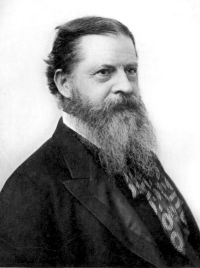 Charles Sanders Peirce
 David HumeGeorge K. PatteeThomson Jay HudsonEthan AllenEdward L. ThorndikeVariousHenri PoincaréWilliam John WillsFredric B. Lozo
 Rafael SabatiniStratton D. BrooksT. TrowardF. V. N. Painter