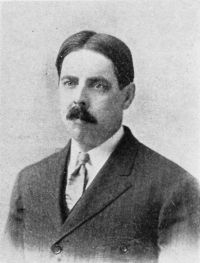
Edward L. Thorndike

Edward L. Thorndike

Summary

Portrait of Edward L. Thorndike Edward L. Thorndike The Psychology of Arithmetic

Should a pupil, that is, learn why he inverts and multiplies, only to forget it as soon as he can be trusted to divide by a fraction? Should he learn why he puts the units figure of each partial product in multiplication under the figure that he multiplies by, only to forget the reason as soon as he has command of the process? Should he learn why he gets the number of square inches in a rectangle by multiplying the length by the width, both being expressed in linear inches, and forget why as soon as he is competent to make computations of the areas of rectangles?
Source: Gutenberg

Portrait of Edward L. Thorndike Edward L. Thorndike The Psychology of Arithmetic

We distinguish 'thinking things together,' as when a diagram or problem or proof is understood, from thinking of one thing after another as when a number of words are spelled or a poem in an unknown tongue is learned. In proportion as thinking is purposive, with selection from the ideas that come up, and in proportion as it deals with novel problems for which no ready-made habitual response is available, and in proportion as many bonds act together in an organized way to produce response, we call it reasoning.
Source: Gutenberg

Portrait of Edward L. Thorndike Edward L. Thorndike The Psychology of Arithmetic

It certainly is not the best psychology and not the best educational theory to think that the pupil first masters a principle and then merely applies it—first does some thinking and then computes by mere routine. On the contrary, the applications should help to establish, extend, and refine the principle—the work a pupil does with numbers should be a main means of increasing his understanding of the principles of arithmetic as a science.
Source: Gutenberg

Get perspective with Kwize: daily news enlightened by great literature