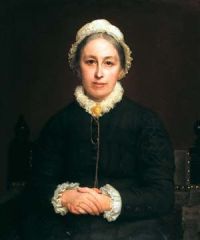
Emily Davies

Emily Davies

Summary

Portrait of Emily Davies Emily Davies The Higher Education of Women (1866)

We make the world even more puzzling than it is by nature, when we shut our eyes to the facts of daily life; and we know, as a fact, that women have a part in the world, and that men are by no means ciphers in the home circle—we know that a man who should be all head would be as monstrous an anomaly as a woman all heart—that men require the protection of law, and women are not so uniformly prosperous as to be independent of comfort and consolation—men have no monopoly of working, nor women of weeping.
Source: Wikisource

Portrait of Emily Davies Emily Davies The Higher Education of Women (1866)

Men are supposed to marry the sort of women they like. But looking upon the infinite variety of wives to be met with in society, could any one generalise from them a model wife, who might serve as a pattern to educators? Would any man wish for a wife so modelled? Might it not be as well to abandon this distracting theory—to discard the shifting standard of opinion, and to fall back upon the old doctrine which teaches educators to seek in every human soul for that divine image which it is their work to call out and to develope?
Source: Wikisource

Portrait of Emily Davies Emily Davies The Higher Education of Women (1866)

Even those who hold most strongly that classics and mathematics are proper for boys, and modern languages and the fine arts for girls, leave as common ground the wide field of English literature, in itself almost an education. To a large extent men and women read the same books, magazines, and newspapers; and though in the highest class of literature, written by scholars for scholars, and, therefore, full of classical and scientific allusions, there is much that women only half understand, the deficiency under which they labour is shared by many male readers.
Source: Gutenberg

Get perspective with Kwize: daily news enlightened by great literature