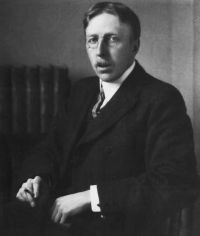
Ford Madox Hueffer

Ford Madox Hueffer

Summary

Portrait of Ford Madox Hueffer Ford Madox Hueffer The Soul of London — Chapter II. (1905)

You have to attend to yourself even more particularly than when you are in a motor-car; you have only half a horizon—the half that is in front of you. You are nearer the dust when there is dust, or nearer the mud. Transition from country to town becomes rather wearisome; you think a good deal in miles. London manifests itself slowly with high-banked and gravelled footpaths, with those same blackened tree trunks, in a certain coarseness of the grass, in houses of call that you feel uninclined to call at.
Source: Wikisource

Portrait of Ford Madox Hueffer Ford Madox Hueffer The Soul of London — Chapter II. (1905)

These great roads into London are pleasant enough, inspiring too and impressive when they are full of people. In the times when one is in the mood, when one is "looking"—and at such times the top of the horse-drawn tram is the best of all vehicles—one sees glimpses of so many things that it is like sitting before an unending stage procession, only more actual, more pathetic and much more inspiring.
Source: Wikisource

Portrait of Ford Madox Hueffer Ford Madox Hueffer The Soul of London — Chapter II. (1905)

The plane tree grows best of all in London, because it sheds its bark continually; getting rid of its soot it clears the pores of its skin and flourishes, if I may be allowed an image that appears frivolous but that is sober enough, a perpetual emblem to the city of the morning tub. In the suburbs the plane yields first place to the flowering almond, in the parks to the thorn, but it is the tree of intimate London.
Elms, however, are the trees most noticeable on the roads into London, and their trunks blacken perhaps soonest of all.
Source: Wikisource

Get perspective with Kwize: daily news enlightened by great literature