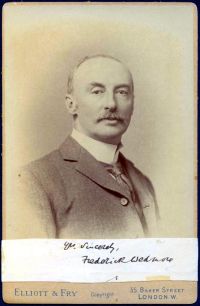
Frederick Wedmore

Frederick Wedmore

Summary

Portrait of Frederick Wedmore Frederick Wedmore 1911 Encyclopædia Britannica (1911)

An initiator in his own generation, and ever tastefully experimental, Whistler no doubt has found enjoyment in the variety of the mediums he has worked in, and in the variety of subjects he has brilliantly tackled. The absence of concentration in the Whistlerian temperament, the lack of great continuity of effort, may probably prove a drawback to his taking exactly the place as a painter of oil pictures, which, in other circumstances, his genius and his taste would most certainly have secured for him. In the future Whistler must be accounted, in oil painting, a master exquisite but rare.
Source: Wikisource

Portrait of Frederick Wedmore Frederick Wedmore 1911 Encyclopædia Britannica (1911)

It is evident that architecture must enter largely into any representation of a city, however much such representation may be a vision, and however little a chronicle. Besides, the architectural portion even of Méryon’s labour is but indirectly imaginative; to the imagination he has given freer play in his dealings with the figure, whether the people of the street or of the river or the people who, when he is most frankly or even wildly symbolical, crowd the sky.
Source: Wikisource

Portrait of Frederick Wedmore Frederick Wedmore 1911 Encyclopædia Britannica (1911)

To the middle time, too, belong, not perhaps all of his slight but delicately modelled pastels of the figure, but at least his more universally accepted pastels of Venetian scenes, in which he caught the sleepy beauty of the Venetian by-way. In pastel, as in painting, in water colour and in etching, Whistler has never been unmindful of the particular qualities of the medium in which he has worked, nor of the applicability of a given medium to a given subject.
Source: Wikisource

Get perspective with Kwize: daily news enlightened by great literature