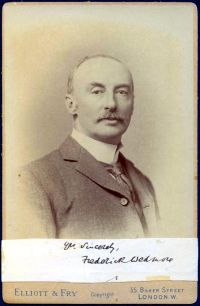
Sir Frederick Wedmore

Sir Frederick Wedmore

Summary

Portrait of Sir Frederick Wedmore Sir Frederick Wedmore Four Masters of Etching

SEYMOUR HADEN. Perhaps the two qualities which, as one gets a little blasé about the productions of Art, continue the most to stir and stimulate, and to quicken the sense of enjoyment, are the quality of vigour and the quality of exquisiteness. If an artist is so fortunate as to possess both these virtues in any fulness, he is sure not only to please a chosen public during several generations, but to please the individual student—if he be a capable student—at all times and in all moods, and, of the two, perhaps, that is really the severer test.
Source: Gutenberg

Portrait of Sir Frederick Wedmore Sir Frederick Wedmore Four Masters of Etching

The years of deterioration and of decay, in which first the artist does but dully reproduce the spontaneous work of his youth, and then is sterile altogether—the years in which he is no longer the fashion at all, but only the landmark or the finger-post of a fashion that is past—the years when a name once familiar is uttered at rare intervals and in tones of apology as the name of one whose performance has never quite equalled the promise he had aforetime given—these years never came to Jules Jacquemart.
Source: Gutenberg

Portrait of Sir Frederick Wedmore Sir Frederick Wedmore Four Masters of Etching

Afterwards, in a series of pastels, it became clear who it was that had seen Venice. It was Mr. Whistler the exquisite colourist, not the exquisite etcher.
Mr. Whistler’s fame as an aquafortist, then, rests chiefly still on his Thames-side work; and, even there, less on the faint agreeable sketches done of later years, though these have their charm, like the better of his painted Nocturnes, than on the work of his first maturity.
Source: Gutenberg

Get perspective with Kwize: daily news enlightened by great literature