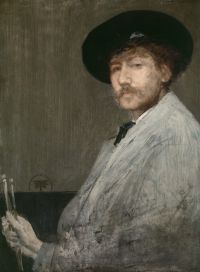
James McNeill Whistler

James McNeill Whistler

Summary

Portrait of James McNeill Whistler James McNeill Whistler The Gentle Art of Making Enemies

To say to the painter, that Nature is to be taken as she is, is to say to the player, that he may sit on the piano.
That Nature is always right, is an assertion, artistically, as untrue, as it is one whose truth is universally taken for granted. Nature is very rarely right, to such an extent even, that it might almost be said that Nature is usually wrong: that is to say, the condition of things that shall bring about the perfection of harmony worthy a picture is rare, and not common at all.
Source: Gutenberg

Portrait of James McNeill Whistler James McNeill Whistler The Gentle Art of Making Enemies

A man of genius is scarcely at liberty to choose whether he shall or shall not be considered as a serious figure—one to be acknowledged and respected as an equal or a superior, not applauded and dismissed as a tumbler or a clown. And if the better part of Mr. Whistler's work as an artist is to be accepted as the work of a serious and intelligent creature, it would seem incongruous and preposterous to dismiss the more characteristic points of his theory as a lecturer with the chuckle or the shrug of mere amusement or amazement.
Source: Gutenberg

Portrait of James McNeill Whistler James McNeill Whistler The Gentle Art of Making Enemies

To say of a picture, as is often said in its praise, that it shows great and earnest labour, is to say that it is incomplete and unfit for view.
Industry in Art is a necessity—not a virtue—and any evidence of the same, in the production, is a blemish, not a quality; a proof, not of achievement, but of absolutely insufficient work, for work alone will efface the footsteps of work.
Source: Gutenberg

Get perspective with Kwize: daily news enlightened by great literature