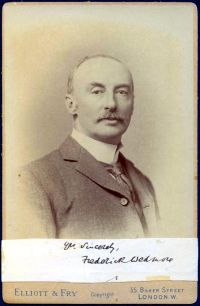
Sir Frederick Wedmore

Sir Frederick Wedmore

Summary

Portrait of Sir Frederick Wedmore Sir Frederick Wedmore Etching in England (1895)

There is accent about the etching; emphasis, vitality; an atmosphere plays, as it were, amongst the boughs; the tree is not the tree only, but a part of Nature and the day.
Gœthe said to that disciple to whom he most fully unveiled himself,—to the privileged Eckermann,—“All my poems are ‘occasional’ poems.” In that resided their freshness, and Gœthe knew it well. “All my etchings are ‘occasional’ etchings,” could be said by nearly every fine etcher, too wise to set forth upon the picturesque tour with the deliberate resolution to perpetrate particular prints.
Source: Gutenberg

Portrait of Sir Frederick Wedmore Sir Frederick Wedmore Etching in England (1895)

And here and there, in brief suggestive studies of contemporary existence, an imaginative light is flashed upon the page, a touch of romance suggested, as where, in the curious little etching of a Bohemian wayfarer—a someone who has lost caste probably, whose pence and whose friends are few—lighting his pipe at a flaring gas-jet over some street bookstall on a Saturday night, you feel that for a moment there has sprung into your vision a fellow-creature with a history, whose mysteriousness you will not solve.
Source: Gutenberg

Portrait of Sir Frederick Wedmore Sir Frederick Wedmore Etching in England (1895)

We have etchers amongst us, and clever ones, too, to whom the presence of character in their living models, and in those models’ backgrounds, has been, above all things, precious; to whom the presence of the eccentric has been valuable, and the presence of beauty, superfluous, not to say burdensome. But, with M. Helleu, beauty—beauty of no conventional order, the rapid charm of movement, of expression, of contour—is the inspiring and satisfactory thing. He lives in its intimacy.
Source: Gutenberg

Get perspective with Kwize: daily news enlightened by great literature