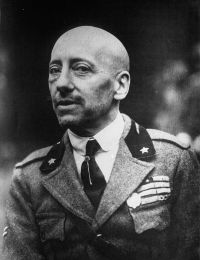
Gabriele D'Annunzio

Gabriele D'Annunzio

Summary

Portrait of Gabriele D'Annunzio Gabriele D'Annunzio The Child of Pleasure

Andrea's heart swelled with bitterness; he could not take his eyes off Elena's hands. Out of those hands, so delicately, ideally white and transparent, with their faint tracery of azure veins—from those rosy hollowed palms, wherein a chiromancer would have discovered many an intricate crossing of lines, ten, twenty different men had drunk at a price. He could see the heads of these unknown men bending over her and drinking the wine. But Secinaro was one of his friends—a great handsome jovial fellow, imperially bearded like a very Lucius Verus, and a most formidable rival to have.
Source: Gutenberg

Portrait of Gabriele D'Annunzio Gabriele D'Annunzio The Child of Pleasure

In that attitude her whole figure, continued by the train, seemed taller and more erect; the shadow of the palm veiled and, so to speak, spiritualised the pallor of her skin. Andrea gazed at her in a kind of rapture, increased by the pathos of the music.
As if drawn by the young man's impetuous desire, Elena turned her head a little, and smiled at him—a smile so subtle, so spiritual, that it seemed rather an emanation of the soul than a movement of the lips, while her eyes remained sad and as if lost in a far away dream.
Source: Gutenberg

Portrait of Gabriele D'Annunzio Gabriele D'Annunzio The Child of Pleasure

He was alone. Of all his youth, of all his boasted fulness of inner life, of all his ideality, not a vestige remained; within—a black and yawning abyss, around him—impassive nature, endless source of pain to solitary souls. Every hope was dead, every voice mute, every anchor gone—what use was life?
Suddenly the image of Elena rose up before him, then that of other women whom he had known and loved. Each of them smiled a hostile smile, and each one, as she vanished, seemed to carry away something of him—what, he could not definitely say.
Source: Gutenberg

Get perspective with Kwize: daily news enlightened by great literature