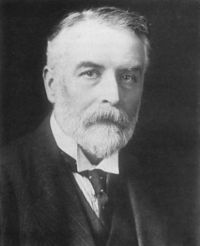
George Albert Boulenger

George Albert Boulenger

Summary

Portrait of George Albert Boulenger George Albert Boulenger 1911 Encyclopædia Britannica (1910)

With the exception of a number of forms in which the whole development takes place within the egg or in the body of the mother, batrachians undergo metamorphoses, the young passing through a free-swimming, gill-breathing period of considerable duration, during which their appearance, structure, and often their régime, are essentially different from those of the mature form. Even the fossil Stegocephalia underwent metamorphosis, as we know from various larval remains first described as Branchiosaurus.
Source: Wikisource

Portrait of George Albert Boulenger George Albert Boulenger 1911 Encyclopædia Britannica (1910)

The outcome of our present knowledge points to the Stegocephalia, probably themselves derived from the Crossopterygian fishes (8) , having yielded on the one hand the true batrachians (retrogressive series) , with which they are to a certain extent connected through the Caudata and the Apoda, on the other hand the reptiles (progressive series) , through the Rhynchocephalians and the Anomodonts, the latter being believed, on very suggestive evidence, to lead to the mammals (9) .
Source: Wikisource

Portrait of George Albert Boulenger George Albert Boulenger 1911 Encyclopædia Britannica (1910)

Skeleton.—In the earliest forms of this order, the Stegocephalia, we meet with considerable variety in the constitution of the vertebrae, and these modifications have been used for their classification. All agree, however, in having each vertebra formed of at least two pieces, the suture between which persists throughout life. In this they differ from the three orders which have living representatives. Even the inferior arches or chevrons of the tail of salamanders are continuously ossified with the centra.
Source: Wikisource

Get perspective with Kwize: daily news enlightened by great literature