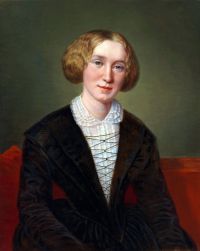
George Eliot

George Eliot

Summary

Portrait of George Eliot George Eliot Adam Bede — Chapter XVII (1859)

And I would not, even if I had the choice, be the clever novelist who could create a world so much better than this, in which we get up in the morning to do our daily work, that you would be likely to turn a harder, colder eye on the dusty streets and the common green fields—on the real breathing men and women, who can be chilled by your indifference or injured by your prejudice; who can be cheered and helped onward by your fellow-feeling, your forbearance, your outspoken, brave justice.
Source: Wikisource

Portrait of George Eliot George Eliot Adam Bede — Chapter XVII (1859)

In this world there are so many of these common, coarse people, who have no picturesque sentimental wretchedness! It is so needful we should remember their existence, else we may happen to leave them quite out of our religion and philosophy, and frame lofty theories which only fit a world of extremes. Therefore let Art always remind us of them; therefore let us always have men ready to give the loving pains of a life to the faithful representing of commonplace things—men who see beauty in these commonplace things, and delight in showing how kindly the light of heaven falls on them.
Source: Wikisource

Portrait of George Eliot George Eliot Adam Bede — Chapter XVII (1859)

There are few prophets in the world; few sublimely beautiful women; few heroes. I can't afford to give all my love and reverence to such rarities: I want a great deal of those feelings for my everyday fellow-men, especially for the few in the foreground of the great multitude, whose faces I know, whose hands I touch, for whom I have to make way with kindly courtesy. Neither are picturesque lazzaroni or romantic criminals half so frequent as your common labourer, who gets his own bread, and eats it vulgarly but creditably with his own pocket-knife.
Source: Wikisource

Get perspective with Kwize: daily news enlightened by great literature