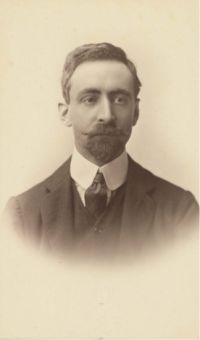
George Hurlstone Hardy

George Hurlstone Hardy

Summary

Portrait of George Hurlstone Hardy George Hurlstone Hardy The Book of the Fly

One can understand the violent efforts of the horse to free himself from the exceedingly painful bites of a newly attached forest-fly, but one can only wonder at the frantic galloping of oxen and horses to and fro when a non-biting œstrid fly buzzes about like a harmless fat bumble bee and slowly approaches.
Source: Gutenberg

Portrait of George Hurlstone Hardy George Hurlstone Hardy The Book of the Fly

This fact accounts for our seldom seeing some kinds of these flies abroad except females; and these are never seen to indulge in dances, flirtations, and games of chasing and buffeting each other, after the manner of so many kinds of flies. They habitually fly low; nevertheless they travel very great distances, for, though short, their flights are incessant when searching for their special kind of food.
The most disinclined to roam of all common flies is the stable-fly. None other is a more eager seeker of sunshine, but when basking on a sunny wall it seems unwary and sluggish
Source: Gutenberg

Portrait of George Hurlstone Hardy George Hurlstone Hardy The Book of the Fly

THE STRUCTURE OF THE HOUSE-FLY The house-fly has quite the typical insect form, inasmuch as there are three well defined sections of body—the head, the chest or thorax, and the abdomen; also it has three pairs of legs, each with nine joints, of which five joints constitute what may be called the foot. The twelve segments of the maggot are observable as twelve rings in the puparium, but in the fly the three which form the thorax look like one, whilst the eight which should theoretically exist in the abdomen look like four or five, until the rings of the ovipositor are counted.
Source: Gutenberg

Get perspective with Kwize: daily news enlightened by great literature